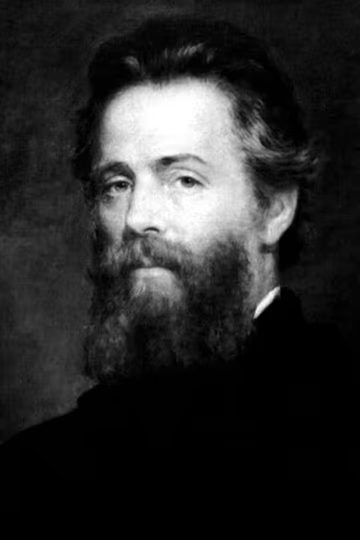
Herman Melville (1819–1891) belongs to the group of artists whose works grew in importance and stature after their death. His works exemplify the genre of Dark Romanticism, probing the darker aspects of human nature through allegory, symbolism, and philosophical digression. Born in New York City on August 1, 1819, he published Moby-Dick; or The Whale in 1851, the year before Harriet Beecher Stowe was to publish Uncle Tom's Cabin and the year after Nathaniel Hawthorne published The Scarlet Letter.
👶 Early Life and Education
Melville was the third of eight children born to Allan Melvill, an importer of French goods, and Maria Gansevoort, of a prominent Dutch-American family. The family lived comfortably until Allan's business failed in 1830. He died bankrupt and delirious in 1832, when Herman was just twelve. The family later added the "e" to their surname. Left to piece together his own education, young Melville attended the Albany Academy and Albany Classical School, but his formal schooling ended early. He worked as a clerk, a farmhand, and a schoolteacher before the sea called him away.
 In 1839, at the age of twenty, he took to the seas, starting off as a cabin boy on the merchant ship St. Lawrence. January of 1841 found him aboard the whaling ship Acushnet. After eighteen months, he deserted in the Marquesas Islands, was briefly held captive by the Typee people, escaped on an Australian whaler, took part in a mutiny in Tahiti, and finally sailed home aboard the frigate United States. He left the sea in the fall of 1844, determined to write about his adventures.
📖 Literary Career and Rise to Fame
His first manuscript, for the novel Typee, was turned down in America, partly because publishers had difficulty believing the tales were true. The book was published in England in February 1846 and launched his career. On an upswing, he married Elizabeth Shaw, the daughter of the Chief Justice of Massachusetts, in 1847. The couple would have four children: Malcolm, Stanwix, Elizabeth, and Frances. Melville quickly turned out Omoo in 1847, the ambitious Mardi in 1849, then Redburn in 1849, and White-Jacket in 1850.
Then Melville turned to a higher ambition: the writing of Moby-Dick. In June 1850, he described the book to his English publisher as "a romance of adventure, founded upon certain wild legends in the Southern Sperm Whale Fisheries." That August, he met Nathaniel Hawthorne, who became his closest literary friend and intellectual companion. Their intense correspondence — Melville's letters brimming with admiration and philosophical passion — has fascinated scholars ever since. Moby-Dick was dedicated to Hawthorne: "In token of my admiration for his genius, this book is inscribed to Nathaniel Hawthorne."
The novel appeared in England on October 18, 1851 as The Whale and on November 14 in America as Moby-Dick. Unfortunately, it was not well received. Critics were baffled by its philosophical ambitions, and it sold only about 3,000 copies during Melville's lifetime.
🌊 Decline and Personal Tragedy
After Moby-Dick, Melville published the dark, controversial Pierre (1852), which was savaged by critics. He turned to magazine fiction, producing some of his finest short works — including Bartleby, the Scrivener, Benito Cereno, and The Encantadas — before publishing The Confidence-Man in 1857, his last published novel. By then, his literary reputation had collapsed.
Personal tragedy compounded his professional disappointments. In 1867, his eldest son Malcolm, eighteen years old, was found dead of a self-inflicted gunshot wound in his bedroom. In 1886, his second son Stanwix died alone in a San Francisco hospital at thirty-five. These losses, combined with financial strain and an increasingly difficult marriage, marked the darkest period of Melville's life.
⚓ The Customs House Years and Poetry
From 1866 to 1885, Melville worked as a customs inspector on the New York docks — a -a-day government job that kept his family fed while his literary ambitions went largely dormant. During these years, he turned to poetry. Battle-Pieces and Aspects of the War (1866) was among the earliest and most significant collections of Civil War poetry. His epic poem Clarel: A Poem and Pilgrimage in the Holy Land (1876), at nearly 18,000 lines, explored religious doubt after a trip to the Holy Land. Two final poetry collections — John Marr and Other Sailors (1888) and Timoleon (1891) — were published in tiny private editions of just 25 copies each.
✒️ Writing Style
Melville's prose is characterized by its dense, allusive texture, blending adventure narrative with philosophical meditation, biblical allusion, and Shakespearean rhetoric. He favored allegory and symbolism — the white whale, the wall in Bartleby's office, the ship as microcosm of society — to explore the deepest questions of good and evil, free will, and the unknowability of the universe. His style ranged from the accessible adventure of Typee to the radical experimentation of Moby-Dick and The Confidence-Man.
✨ Death and Legacy
Herman Melville died of cardiac dilation on September 28, 1891, at his home in New York City. He was seventy-two. The New York Times obituary misspelled his name as "Henry Melville," and a local paper called him a "long forgotten" author. On his desk lay the unfinished manuscript of Billy Budd, the story of a good-hearted sailor destroyed by false accusation and rigid law.
The "Melville Revival" began in the 1920s when scholars rediscovered his work. Billy Budd was finally published in 1924 and Moby-Dick was recognized as one of the greatest American novels ever written. Today, Melville stands alongside Hawthorne, Poe, and Whitman as a towering figure of nineteenth-century American literature.
You may enjoy reading D.H. Lawrence's chapters on Melville in Studies in Classic American Literature.