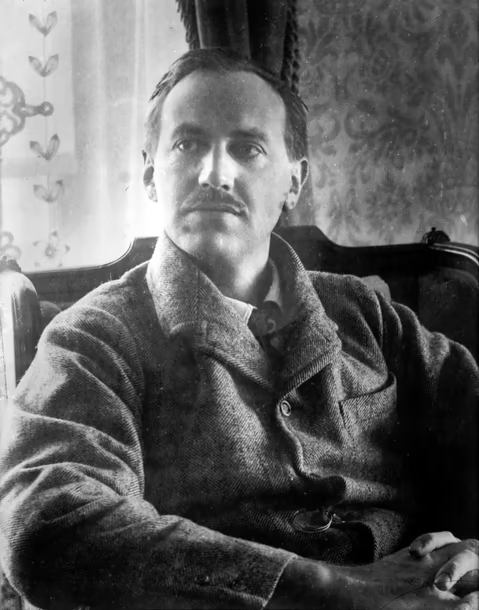
Quick Facts
Edward John Moreton Drax Plunkett, 18th Baron Dunsany
Pen Name: Lord Dunsany
Born: July 24, 1878
Died: October 25, 1957
Nationality: Irish
Genres: Fantasy, Horror, Drama, Mythology
Notable Works: The King of Elfland's Daughter, The Gods of Pegana, The Book of Wonder, A Dreamer's Tales, The Sword of Welleran and Other Stories
👶 Early Life and Education
Edward John Moreton Drax Plunkett was born on July 24, 1878, in London, the eldest son of one of Ireland's oldest peerages. His family seat was Dunsany Castle in County Meath — possibly the longest-continuously-inhabited house in Ireland, near the ancient Hill of Tara. He was raised partly at Dunstall Priory in Shoreham, Kent, and educated at Cheam School, Eton College, and the Royal Military College, Sandhurst, which he entered in 1896. He inherited the barony in 1899 at age twenty-one upon his father's death, becoming the 18th Baron Dunsany.
⚔️ Military Service
Dunsany served as a second lieutenant in the Coldstream Guards — his grandfather's regiment — during the Second Boer War (1899–1902), including a posting to Gibraltar. During World War I, he held the rank of captain in the 5th Royal Inniskilling Fusiliers and served in France. In 1916, while on leave during the Easter Rising, he drove into Dublin to offer assistance and was shot — a bullet lodged in his skull, though he survived and recovered. During World War II, he served in the Home Guard and was in Greece when the German invasion forced his evacuation in 1941.
📖 Career and Literary Contributions
Dunsany's literary career began with The Gods of Pegāna (1905), a collection of linked mythological vignettes that created an entirely original cosmogony — an invented pantheon presided over by the sleeping creator-god Māna-Yood-Sushāī. This was followed by Time and the Gods (1906) and then a remarkable burst of short fiction that would redefine the possibilities of fantasy literature.
His finest early collections — The Sword of Welleran and Other Stories (1908), A Dreamer's Tales (1910), The Book of Wonder (1912), and Fifty-One Tales (1915) — established him as the premier fantasist of the English language. Many of these stories were illustrated by Sidney H. Sime, whose dreamlike drawings became inseparable from Dunsany's prose. For The Book of Wonder, the process was uniquely reversed: Sime drew the illustrations first, and Dunsany wrote stories to match them.
He was equally successful as a dramatist. His one-act play A Night at an Inn (1916) was a sensation in New York, and at the height of his fame he had five plays running simultaneously on Broadway. The Gods of the Mountain (1911), first produced at the Abbey Theatre in Dublin, was considered his dramatic masterpiece.
His major novels include Don Rodriguez (1922), a picaresque fantasy set in a mythical Spain; The King of Elfland's Daughter (1924), widely regarded as one of the greatest fantasy novels ever written; The Charwoman's Shadow (1926); and The Blessing of Pan (1927). In his later career, he created the character of Joseph Jorkens, a club raconteur whose tall tales filled five volumes of stories between 1931 and 1954.
🌿 Writing Style and Themes
Dunsany's prose is a singular achievement — archaic yet fluid, rhythmic and incantatory, drawing on the cadences of the King James Bible, the imagery of the Arabian Nights, and the syntax of W.B. Yeats. Ursula K. Le Guin famously warned young fantasy writers against trying to imitate his style, calling him "the First Terrible Fate that Awaiteth Unwary Beginners in Fantasy." He wrote exclusively in longhand with quill pens that he cut himself.
His central themes include the beauty and fragility of imagined worlds, the tension between enchantment and modernity, and the allure of unreachable places. Stories like Carcassonne embody his philosophy that the longing for a destination may be more powerful than arrival. His invented mythologies in The Gods of Pegāna prefigured J.R.R. Tolkien's The Silmarillion by decades.
✨ Influence and Legacy
Dunsany's influence on modern fantasy is immeasurable. H.P. Lovecraft wrote in 1932: "Dunsany has certainly influenced me more than any other living writer," and credited him with inspiring the artificial pantheon of Cthulhu, Yog-Sothoth, and Azathoth. Lovecraft's entire "Dream Cycle" — including stories like The Doom That Came to Sarnath and Celephäis — is directly Dunsanian in style and substance.
Tolkien read Dunsany and presented Clyde S. Kilby with a copy of The Book of Wonder as preparation for work on The Silmarillion. Other writers who acknowledged Dunsany's influence include Jorge Luis Borges, Arthur C. Clarke, Jack Vance, Michael Moorcock, and Neil Gaiman. The Encyclopedia of Fantasy has called him the "Father of Genre Fantasy."
🏡 Personal Life
In 1904, Dunsany married Lady Beatrice Child-Villiers, daughter of the 7th Earl of Jersey. They had one son, Randal, born in 1906, who succeeded him as the 19th Baron. Beyond literature, Dunsany was the pistol-shooting champion of Ireland, an avid horseman and hunter, and a serious chess player who once drew against the world champion José Raúl Capablanca in a simultaneous exhibition. He won the chess tournament at the 1924 Tailteann Games and invented "Dunsany's Chess," an asymmetrical variant of the game. He served as president of the Irish Chess Union and the Sevenoaks Chess Club for fifty-four years.
In 1947, he transferred the Meath estate to his son and settled at Dunstall Priory in Kent. He died on October 25, 1957, in Dublin, of appendicitis, at the age of seventy-nine. He was buried in the churchyard of St Peter and St Paul, Shoreham, Kent.
✒️ Notable Works
Dunsany's most celebrated works include The King of Elfland's Daughter (1924), the mythological cycle of The Gods of Pegāna (1905), and the short story collections The Book of Wonder (1912) and A Dreamer's Tales (1910). Individual stories that have entered the fantasy canon include The Sword of Welleran, Idle Days on the Yann, The Fortress Unvanquishable, Save for Sacnoth, The Hoard of the Gibbelins, Carcassonne, and Bethmoora.
⭐ Interesting Facts
- At the height of his popularity, Dunsany was known as "America's favorite peer" and had five plays running simultaneously on Broadway.
- His military belt, lost during the Easter Rising shooting, was later used at the burial of Irish revolutionary leader Michael Collins.
- He wrote The Book of Wonder (1912) in reverse: the artist Sidney H. Sime created illustrations first, and Dunsany wrote stories to match them.
- The Last Revolution (1951), his penultimate novel, is about machines revolting against humanity — proto-AI fiction decades before the concept entered mainstream literature.