Hunting The Deceitful Turkey
by Mark Twain
Hunting the Deceitful Turkey is a brief, charming memoir of boyhood frustration, in which young Sam Clemens spends an entire day pursuing a turkey that always seems just within reach. "A turkey is the most...deceitful bird."
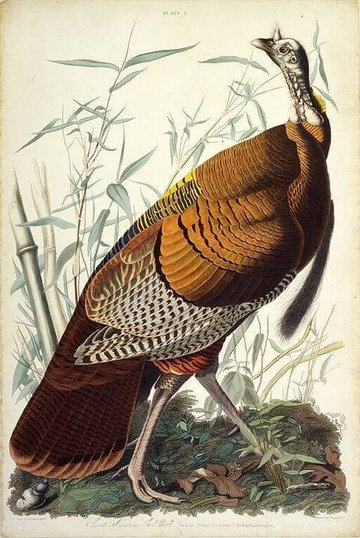
When I was a boy my uncle and his big boys hunted with the rifle, the youngest boy Fred and I with a shotgun--a small single-barrelled shotgun which was properly suited to our size and strength; it was not much heavier than a broom. We carried it turn about, half an hour at a time. I was not able to hit anything with it, but I liked to try. Fred and I hunted feathered small game, the others hunted deer, squirrels, wild turkeys, and such things. My uncle and the big boys were good shots. They killed hawks and wild geese and such like on the wing; and they didn't wound or kill squirrels, they stunned them. When the dogs treed a squirrel, the squirrel would scamper aloft and run out on a limb and flatten himself along it, hoping to make himself invisible in that way-- and not quite succeeding. You could see his wee little ears sticking up. You couldn't see his nose, but you knew where it was. Then the hunter, despising a "rest" for his rifle, stood up and took offhand aim at the limb and sent a bullet into it immediately under the squirrel's nose, and down tumbled the animal, unwounded, but unconscious; the dogs gave him a shake and he was dead. Sometimes when the distance was great and the wind not accurately allowed for, the bullet would hit the squirrel's head; the dogs could do as they pleased with that one--the hunter's pride was hurt, and he wouldn't allow it to go into the gamebag.
In the first faint gray of the dawn the stately wild turkeys would be stalking around in great flocks, and ready to be sociable and answer invitations to come and converse with other excursionists of their kind. The hunter concealed himself and imitated the turkey-call by sucking the air through the leg-bone of a turkey which had previously answered a call like that and lived only just long enough to regret it. There is nothing that furnishes a perfect turkey-call except that bone. Another of Nature's treacheries, you see. She is full of them; half the time she doesn't know which she likes best--to betray her chid or protect it. In the case of the turkey she is badly mixed: she gives it a bone to be used in getting it into trouble, and she also furnishes it with a trick for getting itself out of the trouble again. When a mamma-turkey answers an invitation and finds she has made a mistake in accepting it, she does as the mamma-partridge does--remembers a previous engagement--and goes limping and scrambling away, pretending to be very lame; and at the same time she is saying to her not-visible children, "Lie low, keep still, don't expose yourselves; I shall be back as soon as I have beguiled this shabby swindler out of the country."
When a person is ignorant and confiding, this immoral device can have tiresome results. I followed an ostensibly lame turkey over a considerable part of the United States one morning, because I believed in her and could not think she would deceive a mere boy, and one who was trusting her and considering her honest. I had the single-barrelled shotgun, but my idea was to catch her alive. I often got within rushing distance of her, and then made my rush; but always, just as I made my final plunge and put my hand down where her back had been, it wasn't there; it was only two or three inches from there and I brushed the tail- feathers as I landed on my stomach--a very close call, but still not quite close enough; that is, not close enough for success, but just close enough to convince me that I could do it next time. She always waited for me, a little piece away, and let on to be resting and greatly fatigued; which was a lie, but I believed it, for I still thought her honest long after I ought to have begun to doubt her, suspecting that this was no way for a high-minded bird to be acting. I followed, and followed, and followed, making my periodical rushes, and getting up and brushing the dust off, and resuming the voyage with patient confidence; indeed, with a confidence which grew, for I could see by the change of climate and vegetation that we were getting up into the high latitudes, and as she always looked a little tireder and a little more discouraged after each rush, I judged that I was safe to win, in the end, the competition being purely a matter of staying power and the advantage lying with me from the start because she was lame.
Along in the afternoon I began to feel fatigued myself. Neither of us had had any rest since we first started on the excursion, which was upwards of ten hours before, though latterly we had paused awhile after rushes, I letting on to be thinking about something else; but neither of us sincere, and both of us waiting for the other to call game but in no real hurry about it, for indeed those little evanescent snatches of rest were very grateful to the feelings of us both; it would naturally be so, skirmishing along like that ever since dawn and not a bite in the meantime; at least for me, though sometimes as she lay on her side fanning herself with a wing and praying for strength to get out of this difficulty a grasshopper happened along whose time had come, and that was well for her, and fortunate, but I had nothing--nothing the whole day.
More than once, after I was very tired, I gave up taking her alive, and was going to shoot her, but I never did it, although it was my right, for I did not believe I could hit her; and besides, she always stopped and posed, when I raised the gun, and this made me suspicious that she knew about me and my marksmanship, and so I did not care to expose myself to remarks.
I did not get her, at all. When she got tired of the game at last, she rose from almost under my hand and flew aloft with the rush and whir of a shell and lit on the highest limb of a great tree and sat down and crossed her legs and smiled down at me, and seemed gratified to see me so astonished.
I was ashamed, and also lost; and it was while wandering the woods hunting for myself that I found a deserted log cabin and had one of the best meals there that in my life-days I have eaten. The weed-grown garden was full of ripe tomatoes, and I ate them ravenously, though I had never liked them before. Not more than two or three times since have I tasted anything that was so delicious as those tomatoes. I surfeited myself with them, and did not taste another one until I was in middle life. I can eat them now, but I do not like the look of them. I suppose we have all experienced a surfeit at one time or another. Once, in stress of circumstances, I ate part of a barrel of sardines, there being nothing else at hand, but since then I have always been able to get along without sardines.
Frequently Asked Questions about Hunting The Deceitful Turkey
What is "Hunting the Deceitful Turkey" by Mark Twain about?
Hunting the Deceitful Turkey is an autobiographical tall tale in which young spends an entire day — upwards of ten hours — chasing a mother turkey who pretends to be lame. The turkey stays tantalizingly just out of reach, collapsing in apparent exhaustion after each of the boy's diving lunges, only to hop a few inches away at the last moment. The boy follows her across what he hyperbolically claims is "a considerable part of the United States," noticing "the change of climate and vegetation" as they go. Finally, the turkey reveals her deception by flying effortlessly to the top of a tall tree, where she "sat down and crossed her legs and smiled down" at him. Lost in the woods, the boy stumbles upon an abandoned cabin with a garden full of ripe tomatoes and eats himself into a surfeit he never fully recovers from.
What is the theme of "Hunting the Deceitful Turkey"?
The story explores several interconnected themes. The most prominent is naivete and misplaced trust — the boy believes the turkey is genuinely lame because he "could not think she would deceive a mere boy," and his faith persists long after any reasonable person would have caught on. A second theme is excess and its consequences: the boy's obsessive pursuit causes him to lose his way entirely, and his later gorging on tomatoes creates an aversion that lasts decades. also gently satirizes human pride — the boy suspects the turkey "knew about me and my marksmanship" and refuses to shoot for fear of exposing himself "to remarks." Underneath the humor lies a warm theme of boyhood innocence, where a day of complete failure becomes, in retrospect, one of the most vividly remembered and lovingly told adventures of a life.
Is "Hunting the Deceitful Turkey" a true story?
The story is autobiographical but heavily embellished — a characteristic Twain tall tale built on a real childhood experience. It originated as part of a 90-page unfinished manuscript titled "My Autobiography [Random Extracts from It]" and first appeared in Harper's Magazine in December 1906 as part of "Chapters from My Autobiography." The setting is the Florida, Missouri farm of 's uncle John A. Quarles, where young Sam Clemens spent several summers hunting with his uncle and cousins. The core experience — a boy fruitlessly chasing a mother turkey who feigns injury to protect her chicks — is plausible and based on real turkey behavior. But Twain's comic exaggerations — following the bird across state lines, noticing changes in "climate and vegetation," the turkey crossing her legs and smiling — transform memoir into the American tall tale tradition.
Why does the turkey pretend to be lame in the story?
The turkey's feigned lameness is actually a real defensive behavior exhibited by mother turkeys and other ground-nesting birds like partridges. When a predator approaches their hidden chicks, the mother will limp and scramble away from the nest, pretending to be injured, to lure the threat away from her young. explains this in the story: the mother turkey is "saying to her not-visible children, 'Lie low, keep still, don't expose yourselves; I shall be back as soon as I have beguiled this shabby swindler out of the country.'" The comedy arises from the boy being too naive to recognize this well-known trick. He attributes human emotions to the turkey — honesty, fatigue, discouragement — and the turkey exploits his credulity for an entire day before finally revealing the deception by flying effortlessly to a treetop.
What literary devices does Mark Twain use in "Hunting the Deceitful Turkey"?
employs the full toolkit of the American tall tale. Hyperbole is the dominant device: the boy follows the turkey across "a considerable part of the United States" and notices changes in "climate and vegetation" — absurd exaggerations delivered deadpan. Personification gives the turkey human qualities — she "crossed her legs and smiled," she fans herself with a wing, she "prays for strength." Dramatic irony operates throughout: the reader recognizes the broken-wing display immediately, while the narrator remains oblivious for ten hours. Understatement appears in lines like "I began to doubt her" and "this was no way for a high-minded bird to be acting." The story also demonstrates frame narrative structure — it begins with a general description of hunting on the uncle's farm before narrowing to the single turkey chase — and uses digression (the tomato surfeit, the sardine barrel) exactly as Twain prescribes in his essay How to Tell a Story.
When was "Hunting the Deceitful Turkey" published?
Hunting the Deceitful Turkey was first published in the December 1906 issue of Harper's Magazine as part of 's serialized "Chapters from My Autobiography." The material comes from a longer unfinished manuscript about Twain's boyhood summers on his Uncle Quarles's farm in Florida, Missouri. The story has become one of the most beloved and frequently reprinted of Twain's shorter pieces — the Library of America has noted that it ranks among the ten most popular selections ever featured in their "Story of the Week" series. It is frequently anthologized as a standalone story despite originally being embedded in autobiographical material.
What happens at the end of "Hunting the Deceitful Turkey"?
The ending delivers a double punchline. First, after ten hours of pursuit, the turkey finally reveals her deception: "she rose from almost under my hand and flew aloft with the rush and whir of a shell and lit on the highest limb of a great tree and sat down and crossed her legs and smiled down at me, and seemed gratified to see me so astonished." The boy is left "ashamed, and also lost." Then comes the second, quieter comedy: wandering the woods trying to find his way home, he stumbles upon an abandoned cabin with a garden full of ripe tomatoes. He eats them "ravenously" despite never having liked them before, gorging himself into a surfeit so complete that he does not eat another tomato until middle age. The story ends with a characteristic Twain digression about once eating "part of a barrel of sardines" under similar desperation, and how he has "always been able to get along without sardines" since.
What does "Hunting the Deceitful Turkey" reveal about Nature?
uses the turkey chase to make a broader philosophical observation about Nature's contradictions. He notes that Nature "is full of" treacheries and "half the time she doesn't know which she likes best — to betray her child or protect it." The turkey bone used to make a turkey call is itself taken from a previously deceived turkey — "Nature's treachery" in giving an animal the very instrument of its own destruction. Yet Nature also gives the turkey the broken-wing trick for escaping that same trap. This duality — Nature simultaneously equipping creatures for survival and for doom — is presented with Twain's characteristic light touch, but it connects to deeper themes in his later work about a universe that is indifferent rather than benevolent. Even in this gentle boyhood tale, Twain finds the cosmic joke: Nature is playing both sides.
Save stories, build your reading list, and access all study tools — completely free.
Save Hunting The Deceitful Turkey to your library — it's free!Need help with Hunting The Deceitful Turkey?
Study tools to help with homework, prepare for quizzes, and deepen your understanding.
Flashcards →