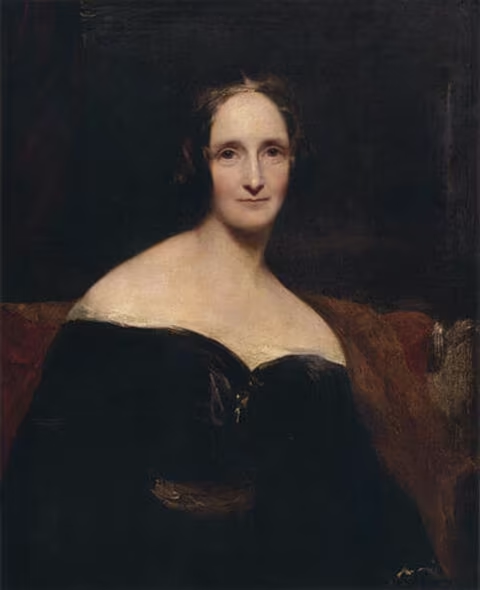
Quick Facts
Mary Shelley
Born: August 30, 1797
Died: February 1, 1851
Nationality: British
Genres: Gothic, Horror, Romanticism, Science Fiction
Notable Works: Frankenstein, The Last Man, Mathilda, The Mortal Immortal, Valperga
👶 Early Life and Family
Mary Wollstonecraft Godwin was born on August 30, 1797, in Somers Town, London. Her parents were two of the most radical intellectuals of their era: her mother, Mary Wollstonecraft, was the pioneering feminist author of A Vindication of the Rights of Woman, and her father, William Godwin, was a political philosopher whose An Enquiry Concerning Political Justice influenced a generation of Romantic thinkers. Tragedy struck almost immediately: Wollstonecraft died of puerperal fever just eleven days after Mary's birth, leaving Godwin to raise Mary and her older half-sister, Fanny Imlay.
Godwin remarried in 1801 to Mary Jane Clairmont, bringing stepsiblings into the household, including Claire Clairmont, who would later play a significant role in Mary's life. Growing up surrounded by her father's library and his circle of intellectual visitors — including Samuel Taylor Coleridge and William Wordsworth — Mary received an extraordinary, if unconventional, education. She later recalled reading on her mother's grave at St Pancras churchyard, a habit that would become one of the most haunting details of her early life.
❤️ Mary and Percy Bysshe Shelley
In 1812, the teenaged Mary met Percy Bysshe Shelley, a young Romantic poet and devoted follower of her father's philosophy. Despite the fact that Percy was already married, the two fell deeply in love, and in 1814 they eloped to continental Europe with Claire Clairmont. The scandal was immense — Percy's first wife, Harriet Westbrook, was pregnant at the time — and the couple returned to England as social outcasts burdened by debt.
Their early years together were shadowed by loss. Their premature daughter died in 1815, and Harriet Westbrook took her own life in late 1816. Percy and Mary married in December 1816, but respectability did little to ease their circumstances. After moving to Italy in 1818, the Shelleys suffered further heartbreak when two of their children died. Mary's only surviving child, Percy Florence, was born in 1819.
Percy Bysshe Shelley drowned in a sailing accident in the Gulf of Spezia on July 8, 1822. Mary was just twenty-four years old. She returned to England and devoted the rest of her life to raising her son and advancing her writing career, while also editing and promoting Percy's poetry — work that was instrumental in securing his literary reputation.
📖 The Creation of Frankenstein
As a teenager, Mary spent time living with a family in Dundee, Scotland, where she later wrote that she first felt the imaginative awakening that led to the idea for Frankenstein. She began developing and writing the novel in 1816 while staying near Lake Geneva as a guest of Lord Byron, during a stormy summer that famously inspired discussions of ghost stories. Byron proposed that each member of their party — which included Percy Shelley, John William Polidori, and Claire Clairmont — write a ghost story. From that challenge came two landmark works of horror fiction: Mary's Frankenstein; or, The Modern Prometheus and Polidori's The Vampyre.
Published anonymously in 1818, Frankenstein was initially attributed to Percy Shelley by many reviewers. The novel tells the story of Victor Frankenstein, a young scientist who creates a sentient creature and then abandons it, setting in motion a chain of tragedy. With its themes of scientific ambition, parental responsibility, and the consequences of playing God, Frankenstein is widely regarded as the first true science fiction novel and remains one of the most influential works of Gothic literature.
✒️ Notable Works
Though best known for Frankenstein, Shelley was a prolific writer whose output included novels, short stories, essays, travel narratives, and biographical entries. Her second major novel, The Last Man (1826), is an apocalyptic tale of a global plague that destroys civilization — a work now recognized as a pioneering example of dystopian and post-apocalyptic fiction. Other novels include the historical romances Valperga (1823) and The Fortunes of Perkin Warbeck (1830), the semi-autobiographical Lodore (1835), and Falkner (1837). Her novella Mathilda, written in 1819 but suppressed by her father and not published until 1959, explores the taboo subject of a father's incestuous obsession.
Shelley also produced a rich body of short fiction, much of it published in literary annuals such as The Keepsake and The London Magazine. Stories like The Mortal Immortal (1833), Transformation (1831), and The Invisible Girl (1832) explore Gothic, supernatural, and tragic themes with a psychological depth that prefigured later masters of the form like Edgar Allan Poe.
🌿 Writing Style and Themes
Shelley's writing bridges the Romantic and Gothic traditions, blending emotional intensity with philosophical inquiry. Her prose is characterized by atmospheric settings, psychologically complex characters, and a persistent concern with the ethical implications of human ambition. Themes of isolation, the pursuit of forbidden knowledge, and the tension between creator and creation run throughout her work. She was deeply influenced by the Romantic idealism of her husband and Lord Byron, but her fiction is often darker and more skeptical, interrogating the costs of unchecked genius. Her contributions helped establish the foundations of science fiction and cemented the Gothic novel as a vehicle for serious moral and philosophical exploration.
✨ Death and Legacy
In her later years, Shelley suffered from chronic headaches and periods of partial paralysis, symptoms now believed to have been caused by a brain tumor. She died on February 1, 1851, at the age of 53, in London. Her cause of death was recorded as a brain tumor.
Shelley's literary legacy extends far beyond Frankenstein, though that novel alone would secure her place in literary history. She is credited as a foundational figure in science fiction and Gothic literature. Her works are featured in our collections: Gothic, Ghost, Horror & Weird Library, Halloween Stories, and Short Stories for High School. Her work is also referenced in our Gothic Literature Study Guide.
"If I cannot inspire love, I will cause fear!"
Frequently Asked Questions about Mary Shelley
Where can I find study guides for Mary Shelley's stories?
We offer free interactive study guides for the following Mary Shelley stories:
- The Invisible Girl — comprehension questions, vocabulary review, and discussion prompts
- The Mortal Immortal — comprehension questions, vocabulary review, and discussion prompts
- Transformation — comprehension questions, vocabulary review, and discussion prompts