The Cactus
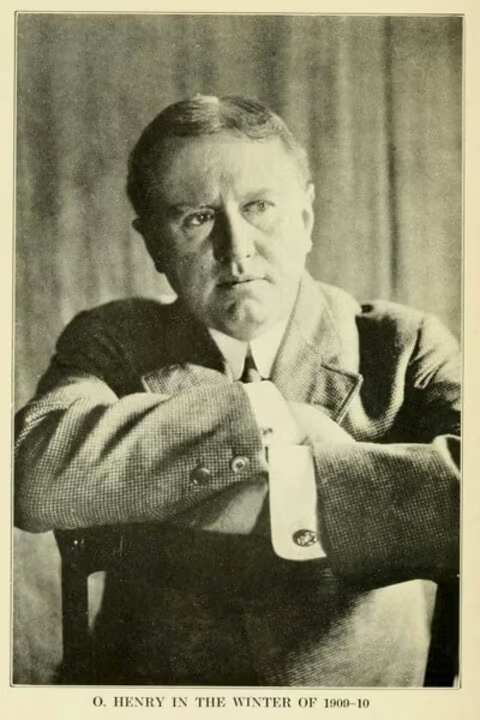
by O. Henry
"The garments of his soul must have appeared sorry and threadbare. Vanity and conceit? These were the joints in his armor. And how free from either she had always been--But why--"
The most notable thing about Time is that it is so purely relative. A large amount of reminiscence is, by common consent, conceded to the drowning man; and it is not past belief that one may review an entire courtship while removing one's gloves.
 That is what Trysdale was doing, standing by a table in his bachelor apartments. On the table stood a singular-looking green plant in a red earthen jar. The plant was one of the species of cacti, and was provided with long, tentacular leaves that perpetually swayed with the slightest breeze with a peculiar beckoning motion.
Trysdale's friend, the brother of the bride, stood at a sideboard complaining at being allowed to drink alone. Both men were in evening dress. White favors like stars upon their coats shone through the gloom of the apartment.
As he slowly unbuttoned his gloves, there passed through Trysdale's mind a swift, scarifying retrospect of the last few hours. It seemed that in his nostrils was still the scent of the flowers that had been banked in odorous masses about the church, and in his ears the lowpitched hum of a thousand well-bred voices, the rustle of crisp garments, and, most insistently recurring, the drawling words of the minister irrevocably binding her to another.
From this last hopeless point of view he still strove, as if it had become a habit of his mind, to reach some conjecture as to why and how he had lost her. Shaken rudely by the uncompromising fact, he had suddenly found himself confronted by a thing he had never before faced --his own innermost, unmitigated, arid unbedecked self. He saw all the garbs of pretence and egoism that he had worn now turn to rags of folly. He shuddered at the thought that to others, before now, the garments of his soul must have appeared sorry and threadbare. Vanity and conceit? These were the joints in his armor. And how free from either she had always been--But why--
As she had slowly moved up the aisle toward the altar he had felt an unworthy, sullen exultation that had served to support him. He had told himself that her paleness was from thoughts of another than the man to whom she was about to give herself. But even that poor consolation had been wrenched from him. For, when he saw that swift, limpid, upward look that she gave the man when he took her hand, he knew himself to be forgotten. Once that same look had been raised to him, and he had gauged its meaning. Indeed, his conceit had crumbled; its last prop was gone. Why had it ended thus? There had been no quarrel between them, nothing--
For the thousandth time he remarshalled in his mind the events of those last few days before the tide had so suddenly turned.
She had always insisted upon placing him upon a pedestal, and he had accepted her homage with royal grandeur. It had been a very sweet incense that she had burned before him; so modest (he told himself); so childlike and worshipful, and (he would once have sworn) so sincere. She had invested him with an almost supernatural number of high attributes and excellencies and talents, and he had absorbed the oblation as a desert drinks the rain that can coax from it no promise of blossom or fruit.
As Trysdale grimly wrenched apart the seam of his last glove, the crowning instance of his fatuous and tardily mourned egoism came vividly back to him. The scene was the night when he had asked her to come up on his pedestal with him and share his greatness. He could not, now, for the pain of it, allow his mind to dwell upon the memory of her convincing beauty that night--the careless wave of her hair, the tenderness and virginal charm of her looks and words. But they had been enough, and they had brought him to speak. During their conversation she had said:
"And Captain Carruthers tells me that you speak the Spanish language like a native. Why have you hidden this accomplishment from me? Is there anything you do not know?"
Now, Carruthers was an idiot. No doubt he (Trysdale) had been guilty (he sometimes did such things) of airing at the club some old, canting Castilian proverb dug from the hotchpotch at the back of dictionaries. Carruthers, who was one of his incontinent admirers, was the very man to have magnified this exhibition of doubtful erudition.
But, alas! the incense of her admiration had been so sweet and flattering. He allowed the imputation to pass without denial. Without protest, he allowed her to twine about his brow this spurious bay of Spanish scholarship. He let it grace his conquering head, and, among its soft convolutions, he did not feel the prick of the thorn that was to pierce him later.
How glad, how shy, how tremulous she was! How she fluttered like a snared bird when he laid his mightiness at her feet! He could have sworn, and he could swear now, that unmistakable consent was in her eyes, but, coyly, she would give him no direct answer. "I will send you my answer to-morrow," she said; and he, the indulgent, confident victor, smilingly granted the delay. The next day he waited, impatient, in his rooms for the word. At noon her groom came to the door and left the strange cactus in the red earthen jar. There was no note, no message, merely a tag upon the plant bearing a barbarous foreign or botanical name. He waited until night, but her answer did not come. His large pride and hurt vanity kept him from seeking her. Two evenings later they met at a dinner. Their greetings were conventional, but she looked at him, breathless, wondering, eager. He was courteous, adamant, waiting her explanation. With womanly swiftness she took her cue from his manner, and turned to snow and ice. Thus, and wider from this on, they had drifted apart. Where was his fault? Who had been to blame? Humbled now, he sought the answer amid the ruins of his self-conceit. If--
The voice of the other man in the room, querulously intruding upon his thoughts, aroused him.
"I say, Trysdale, what the deuce is the matter with you? You look unhappy as if you yourself had been married instead of having acted merely as an accomplice. Look at me, another accessory, come two thousand miles on a garlicky, cockroachy banana steamer all the way from South America to connive at the sacrifice--please to observe how lightly my guilt rests upon my shoulders. Only little sister I had, too, and now she's gone. Come now! take something to ease your conscience."
"I don't drink just now, thanks," said Trysdale.
"Your brandy," resumed the other, coming over and joining him, "is abominable. Run down to see me some time at Punta Redonda, and try some of our stuff that old Garcia smuggles in. It's worth the, trip. Hallo! here's an old acquaintance. Wherever did you rake up this cactus, Trysdale?"
"A present," said Trysdale, "from a friend. Know the species?"
"Very well. It's a tropical concern. See hundreds of 'em around Punta every day. Here's the name on this tag tied to it. Know any Spanish, Trysdale?"
"No," said Trysdale, with the bitter wraith of a smile--"Is it Spanish?"
"Yes. The natives imagine the leaves are reaching out and beckoning to you. They call it by this name--Ventomarme. Name means in English, 'Come and take me.'"
Frequently Asked Questions about The Cactus
What is "The Cactus" by O. Henry about?
"The Cactus" is a short story about a vain man named Trysdale who attends the wedding of the woman he once loved and reflects on how he lost her. After proposing marriage, he received a cactus plant from her instead of a direct answer. Believing it was a rejection, Trysdale let his wounded pride prevent him from seeking clarification, and the two drifted apart. The twist ending reveals that the cactus bore a Spanish tag reading "Ventomarme" -- meaning "Come and take me" -- which was actually her acceptance of his proposal. Trysdale's false claim of knowing Spanish, and his failure to simply ask about the plant, cost him the woman he loved.
What is the main theme of "The Cactus" by O. Henry?
The central theme of "The Cactus" is how vanity and false pride destroy love. Trysdale builds an image of himself as learned, cultured, and superior, and he allows his beloved to place him on a pedestal rather than being honest about his limitations. When she sends a cactus with a Spanish name he cannot read, his ego prevents him from admitting ignorance or asking for an explanation. uses this to argue that love requires humility and honesty, and that pretending to be something you are not inevitably leads to devastating consequences.
What is the surprise ending in "The Cactus" by O. Henry?
The surprise twist is that the cactus Trysdale received was not a rejection at all -- it was an acceptance of his marriage proposal. The plant bore a Spanish tag with the name "Ventomarme," meaning "Come and take me" in English. The bride's brother, who has lived in South America, casually translates the tag at the end of the story, revealing that the woman had said yes. Trysdale's failure to understand the message -- because he falsely let her believe he spoke Spanish -- is what destroyed their relationship. It is a classic ironic reversal, where the protagonist's own deception becomes the instrument of his downfall.
What does the cactus symbolize in O. Henry's story?
The cactus operates as a powerful dual symbol in the story. On the surface, its thorny exterior suggests rejection and distance -- which is exactly how Trysdale interprets it. However, the plant's Spanish name, "Ventomarme" ("Come and take me"), reveals it as a symbol of love and invitation. deliberately subverts the conventional symbolism of the cactus: what appears to be a prickly rebuff is actually a tender acceptance. The cactus also symbolizes the relationship itself -- beautiful and offering something genuine beneath a surface that Trysdale is too proud and shallow to look past.
What role does irony play in "The Cactus"?
Irony is the central literary device in "The Cactus" and operates on multiple levels. The most prominent is situational irony: Trysdale loses the woman he loves precisely because of the false image he cultivated to impress her -- his pretended knowledge of Spanish. There is also dramatic irony, as readers discover the truth about the cactus's meaning at the same moment Trysdale does, making his years of bitter reflection feel tragically unnecessary. Even the story's timeline is ironic: Trysdale spends the entire narrative searching for why she rejected him, only to learn she never did. uses this layered irony to deliver a devastating critique of male ego and self-deception.
Who is the main character in "The Cactus" and what is his flaw?
The main character is Trysdale, an upper-class bachelor whose fatal flaw is vanity and conceit. He enjoys being placed on a pedestal by the woman he courts, absorbing her admiration "as a desert drinks the rain." When she praises his supposed fluency in Spanish -- based on a casual remark overheard by a friend -- Trysdale allows the false impression to stand rather than correcting it. His ego also prevents him from seeking clarification after receiving the cactus, choosing pride over communication. makes clear that Trysdale's self-awareness comes too late: only at her wedding to another man does he finally see "the garbs of pretence and egoism" he has worn.
What does "Ventomarme" mean in "The Cactus"?
"Ventomarme" is the Spanish name on the tag attached to the cactus plant, and it means "Come and take me" in English. The woman sent the cactus as her answer to Trysdale's marriage proposal, trusting that he would understand the Spanish because he had let her believe he was fluent in the language. The name refers to the way the cactus's long leaves sway and appear to beckon, as if inviting someone to approach. Trysdale's brother-in-law reveals the translation at the end of the story, unknowingly delivering the devastating punchline that exposes Trysdale's lie and his tragic misunderstanding.
When was "The Cactus" by O. Henry published?
"The Cactus" was first published in October 1902 in Everybody's Magazine, a popular American periodical of the era. It was later collected in 's 1904 anthology Cabbages and Kings and subsequent compilations. The story was written during O. Henry's most prolific period in New York City, when he was producing roughly one short story per week. It exemplifies his signature style of tightly constructed narratives with ironic twist endings that made him one of the most widely read American short story writers of the early twentieth century.
How does O. Henry use the glove-removing scene in "The Cactus"?
The story's framing device is Trysdale slowly removing his gloves after the wedding, and uses this simple, physical action to structure the entire narrative. As Trysdale unbuttons each glove, his mind replays the courtship and its collapse in a swift "scarifying retrospect." The opening line -- "The most notable thing about Time is that it is so purely relative" -- establishes that an entire love story can be reviewed in the minutes it takes to remove a pair of gloves. The final unbuttoning coincides with the devastating revelation about the cactus's meaning, making the mundane gesture a vehicle for the story's emotional climax.
What is the moral or lesson of "The Cactus" by O. Henry?
The moral of "The Cactus" is that dishonesty and false pride inevitably destroy what matters most. Trysdale's small, seemingly harmless lie about knowing Spanish spirals into a catastrophic miscommunication that costs him the woman he loves. also warns against letting ego substitute for genuine connection: Trysdale enjoys being worshipped but never truly engages with his beloved as an equal. The story suggests that real love requires vulnerability and honesty rather than performance. Had Trysdale simply admitted he did not know Spanish -- or asked what the cactus meant -- the entire tragedy would have been averted.
Save stories, build your reading list, and access all study tools — completely free.
Save The Cactus to your library — it's free!Need help with The Cactus?
Study tools to help with homework, prepare for quizzes, and deepen your understanding.
Flashcards →