Four-Feet
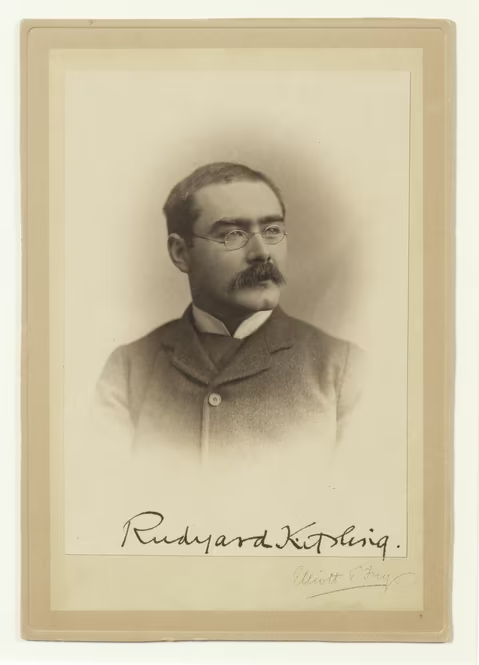
by Rudyard Kipling
Four-Feet is a quietly devastating poem about the loss of a beloved dog, capturing the silence left behind when those four faithful feet stop trotting along. "I can't forget, if I wanted to, / Four-Feet trotting behind."
I have done mostly what most men do,
And pushed it out of my mind;
But I can't forget, if I wanted to,
Four-Feet trotting behind.

Day after day, the whole day through —
Wherever my road inclined —
Four-feet said, "I am coming with you!"
And trotted along behind.

Now I must go by some other round, —
Which I shall never find —
Somewhere that does not carry the sound
Of Four-Feet trotting behind.
Frequently Asked Questions about Four-Feet
What is "Four-Feet" by Rudyard Kipling about?
Four-Feet is a short, deeply personal poem about the bond between a person and their dog, and the grief that follows the dog's death. The speaker describes how, throughout his daily life, he was always accompanied by the sound of four feet trotting behind him. After the dog is gone, the speaker realizes he must now find new paths — routes that don't carry the haunting echo of that faithful companionship. The poem captures both the joy of a pet's constant presence and the devastating emptiness left by its absence.
What is the theme of "Four-Feet" by Rudyard Kipling?
The central themes are companionship, loyalty, and grief. The poem celebrates the unwavering devotion of a dog who followed its owner everywhere, then pivots to the painful reality of loss. suggests that the most faithful relationships leave the deepest voids — the speaker cannot simply "push it out of my mind" the way he has handled other experiences. A secondary theme is the permanence of memory: the sound of four feet trotting behind becomes an inescapable presence even after the dog is gone.
Is "Four-Feet" about a dog?
Yes. While never uses the word "dog" in the poem, the phrase "Four-Feet" unmistakably refers to a canine companion. The image of four feet "trotting behind" and the line "I am coming with you!" capture the characteristic behavior of a loyal dog following its owner. The poem has become one of the most beloved dog memorial poems in the English language, frequently read at pet loss services and printed on memorial keepsakes.
When was "Four-Feet" by Rudyard Kipling written?
Four-Feet was written by (1865–1936) and is believed to have been inspired by his personal experience with losing a beloved pet. Kipling was a lifelong dog owner who wrote several poems about canine companionship, including The Power of the Dog, His Apologies, and The Supplication of the Black Aberdeen. The poem first appeared in his collection Actions and Reactions (1909).
What literary devices does Kipling use in "Four-Feet"?
Kipling employs several literary devices with remarkable economy. Personification gives the dog a voice: "Four-Feet said, 'I am coming with you!'" Metonymy replaces the dog with "Four-Feet," reducing the companion to its most essential, recognizable trait — the sound and rhythm of its movement. The poem uses a consistent ABAB rhyme scheme with "mind/behind/find/behind" creating an almost hypnotic repetition. The word "behind" appears at the end of every stanza, functioning as a refrain that mirrors the persistent, faithful following of the dog itself. The shift from past tense ("trotted") to present necessity ("Now I must go") marks the poem's emotional volta.
What does the last stanza of "Four-Feet" mean?
The final stanza is the poem's emotional climax. The speaker says he must now travel "by some other round" — a new path — that doesn't carry the sound of his companion's footsteps. The devastating line "Which I shall never find" reveals his true grief: there is no route in the world that can erase this memory. Every road, every walk, will carry the ghost of that faithful trotting. Rather than finding closure, the speaker acknowledges that the loss is permanent and inescapable. This makes the poem resonate so powerfully with anyone who has lost a beloved pet.
How does "Four-Feet" compare to Kipling's "The Power of the Dog"?
Both poems deal with the grief of losing a canine companion, but from different angles. The Power of the Dog is a longer, more philosophical poem that warns the reader about the inevitable heartbreak of loving a dog whose lifespan is far shorter than a human's — famously concluding that you should "give your heart to a dog to tear." Four-Feet, by contrast, is intimate and retrospective: the speaker has already loved, already lost, and now lives with the aftermath. Where "The Power of the Dog" is a cautionary meditation, "Four-Feet" is a quiet elegy — brief, personal, and devastating in its simplicity.
Why is "Four-Feet" used as a pet memorial poem?
Four-Feet has become one of the most popular poems read at pet memorial services and funerals because it captures the exact experience of pet loss with extraordinary precision. The poem doesn't sentimentalize or offer false comfort — it simply describes the constant presence of a loyal companion and the impossibility of forgetting that presence once it's gone. Its brevity (just twelve lines) makes it ideal for readings, and its universal imagery allows any pet owner to project their own experience onto the poem. It is frequently printed on memorial stones, wall art, and sympathy cards for those grieving a pet.
Save stories, build your reading list, and access all study tools — completely free.
Save Four-Feet to your library — it's free!Need help with Four-Feet?
Study tools to help with homework, prepare for quizzes, and deepen your understanding.
Flashcards →