The White Man's Burden
by Rudyard Kipling
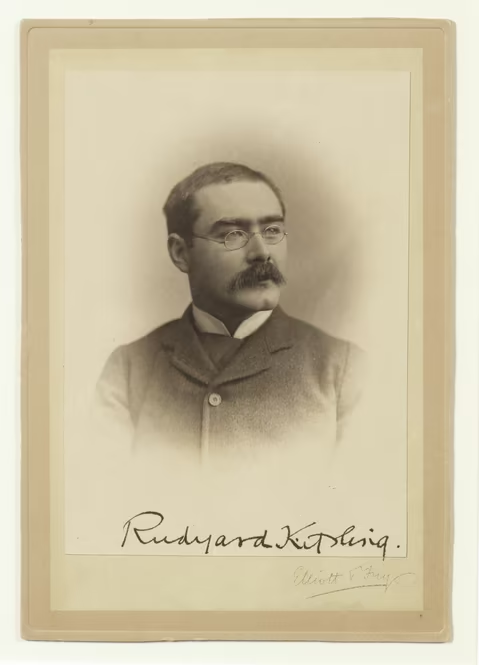
Take up the White man's burden
Send forth the best ye breed
Go bind your sons to exile
To serve your captives' need;
To wait in heavy harness
On fluttered folk and wild
Your new-caught, sullen peoples,
Half devil and half child.

Take up the White Man's burden
In patience to abide,
To veil the threat of terror
And check the show of pride;
By open speech and simple,
An hundred times mad plain.
To seek another's profit,
And work another's gain.

Take up the White Man's burden
The savage wars of peace
Fill full the mouth of Famine
And bid the sickness cease;
And when your goal is nearest
The end for others sought,
Watch Sloth and heathen Folly
Bring all your hope to nought.

Take up the White Man's burden
No tawdry rule of kings,
But toil of serf and sweeper
The tale of common things.
The ports ye shall not enter,
The roads ye shall not tread,
Go make them with your living,
And mark them with your dead!

Take up the White man's burden
And reap his old reward:
The blame of those ye better,
The hate of those ye guard
The cry of hosts ye humour
(Ah, slowly!) toward the light:
"Why brought ye us from bondage,
"Our loved Egyptian night?"

Take up the White Man's burden
Ye dare not stoop to less
Nor call too loud on freedom
To cloak your weariness;
By all ye cry or whisper,
By all ye leave or do,
The silent, sullen peoples
Shall weigh your Gods and you.

Take up the White Man's burden
Have done with childish days
The lightly proffered laurel,
The easy, ungrudged praise.
Comes now, to search your manhood
Through all the thankless years,
Cold-edged with dear-bought wisdom,
The judgment of your peers!
Frequently Asked Questions about The White Man's Burden
What is "The White Man's Burden" by Rudyard Kipling about?
The White Man's Burden is a seven-stanza poem urging the United States to assume colonial control of the Philippines following the Spanish-American War. frames imperialism as a moral obligation—a thankless, grueling duty in which the colonizer must "serve your captives’ need" while enduring the resentment of the colonized and the criticism of fellow citizens at home. Each stanza repeats the refrain "Take up the White Man's burden" and catalogues the supposed hardships of empire: disease, famine, ingratitude, and slow progress. The poem treats the colonized peoples as passive recipients of Western civilization—"new-caught, sullen peoples, half-devil and half-child"—a characterization that was deeply racist even by the standards of 1899 and remains one of the most cited examples of imperial ideology in English literature.
What are the major themes of "The White Man's Burden"?
The poem operates on several interlocking themes. Imperial duty and self-sacrifice is the surface theme: presents colonialism not as exploitation but as exhausting public service, demanding that the colonizer "Fill full the mouth of Famine / And bid the sickness cease." Racial hierarchy runs throughout, with the "white man" cast as a civilizing parent and colonized peoples cast as childlike dependents. Ingratitude and futility forms a secondary thread—each stanza warns that the colonizer will receive only "the blame of those ye better, / The hate of those ye guard." Finally, the cost of empire to the colonizer is a persistent concern: lost youth, wasted labor, and moral compromise. The poem is now studied primarily as a document of how imperial powers justified colonial expansion through the language of benevolence.
What historical event inspired "The White Man's Burden"?
wrote The White Man's Burden in direct response to the United States' annexation of the Philippines after the Spanish-American War of 1898. The Treaty of Paris (December 1898) ceded the Philippines, Guam, and Puerto Rico to the U.S., and a fierce domestic debate erupted over whether America should govern overseas territories. sent a copy of the poem to Theodore Roosevelt, then governor of New York, in November 1898, urging American intervention. The poem was published in The Times (London) and McClure's Magazine (New York) in February 1899—just days before the U.S. Senate voted to ratify the treaty. An earlier version had been drafted for Queen Victoria's Diamond Jubilee in 1897, but revised it to address America specifically.
Is "The White Man's Burden" satire or sincere advocacy for imperialism?
The overwhelming scholarly consensus is that wrote the poem sincerely. His personal correspondence confirms that he genuinely believed in the civilizing mission of empire and hoped the poem would persuade Americans to accept the responsibilities of colonial governance. He sent it to Theodore Roosevelt as a genuine exhortation, not a joke. However, the poem's relentless emphasis on suffering, futility, and ingratitude has led some readers to detect an undercurrent of irony—as though is inadvertently making the best case against empire by cataloguing its costs so thoroughly. This ambiguity helps explain why the phrase "white man's burden" quickly became a term of mockery and critique rather than inspiration, used to expose the hypocrisy of imperial rhetoric.
What does "half-devil and half-child" mean in the poem?
The phrase appears in the opening stanza: "Your new-caught, sullen peoples, / Half-devil and half-child." It encapsulates the racist paternalism at the heart of the imperial worldview. "Half-child" frames colonized peoples as immature, incapable of self-governance, and in need of Western tutelage—a common justification for colonial rule. "Half-devil" suggests they are also dangerous, unpredictable, and morally fallen—requiring not just education but moral correction. Together, the two halves construct colonized peoples as simultaneously pitiable and threatening, which in turn justifies both the colonizer's authority and his use of force. The phrase became one of the most frequently cited examples of dehumanizing colonial language in literary criticism and postcolonial studies.
What were the contemporary responses and criticisms of the poem?
The poem provoked immediate and fierce backlash. Henry Labouchère published The Brown Man's Burden (1899), a biting parody arguing that the real "burden" was borne by colonized peoples subjected to exploitation and violence. H.T. Johnson, an African-American clergyman, wrote The Black Man's Burden (1899), drawing parallels between overseas imperialism and racial oppression at home. Mark Twain, initially supportive of the Spanish-American War, became a vocal anti-imperialist and published To the Person Sitting in Darkness (1901), which savagely attacked the hypocrisy of the civilizing mission. In Congress, the poem was both quoted approvingly by expansionists and denounced by anti-imperialists as a blueprint for racial domination. The intensity of these responses made The White Man's Burden a flashpoint in the American debate over empire.
Why is "The White Man's Burden" still studied today?
The White Man's Burden endures in classrooms because it is one of the most concentrated expressions of imperial ideology ever written in English. For students of history, it provides a primary-source window into how colonial powers justified expansion—not through naked self-interest but through the language of duty, sacrifice, and benevolence. For students of literature, it demonstrates how poetic form (the insistent refrain, the hymn-like stanzas) can serve as propaganda. In postcolonial studies, it is essential reading because the very phrase "white man's burden" became shorthand for the self-serving mythology of empire. The poem also connects to broader questions about interventionism, cultural superiority, and humanitarian rhetoric that remain politically relevant today. Its continued study is less an endorsement of 's views than a recognition that understanding imperial ideology requires reading its most articulate proponents.
How does "The White Man's Burden" relate to Kipling's other poems?
The White Man's Burden shares 's characteristic preoccupation with duty, endurance, and the sacrifices demanded of those who serve empire. In Gunga Din, dramatizes the bravery of an Indian water-bearer who dies saving British soldiers—acknowledging colonial subjects' courage while still framing the relationship through imperial hierarchy. Tommy addresses the mistreatment of common British soldiers by the society they defend, a theme of institutional ingratitude that echoes throughout The White Man's Burden. Even If, his most beloved poem, describes the stoic virtues—patience, self-control, perseverance—that believed empire demanded of its servants. Across these works, consistently elevates the ideal of selfless service while remaining entangled in the racial assumptions of his era.
Save stories, build your reading list, and access all study tools — completely free.
Save The White Man's Burden to your library — it's free!Need help with The White Man's Burden?
Study tools to help with homework, prepare for quizzes, and deepen your understanding.
Flashcards →