A Broadsheet Ballad
by A. E. Coppard
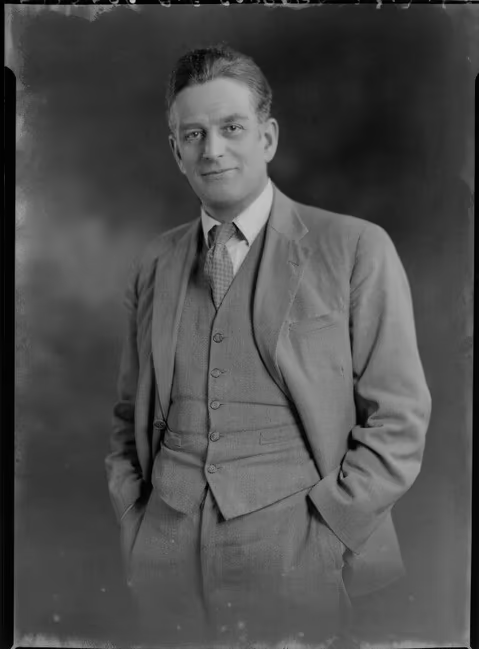
At noon the tiler and the mason stepped down from the roof of the village church which they were repairing and crossed over the road to the tavern to eat their dinner. It had been a nice little morning, but there were clouds massing in the south; Sam the tiler remarked that it looked like thunder. The two men sat in the dim little taproom eating, Bob the mason at the same time reading from a newspaper an account of a trial for murder.
“I dunno what thunder looks like,” Bob said, “but I reckon this chap is going to be hung, though I can’t rightly say for why. To my thinking he didn’t do it at all: but murder’s a bloody thing and someone ought to suffer for it.”
“I don’t think,” spluttered Sam as he impaled a flat piece of beetroot on the point of a pocket-knife and prepared to contemplate it with patience until his stuffed mouth was ready to receive it, “he ought to be hung.”
“There can be no other end for him though, with a mob of lawyers like that, and a judge like that, and a jury too ... why the rope’s half round his neck this minute; he’ll be in glory within a month, they only have three Sundays, you know, between the sentence and the execution. Well, hark at that rain then!”
A shower that began as a playful sprinkle grew to a powerful steady summer downpour. It splashed in the open window and the dim room grew more dim and cool.
“Hanging’s a dreadful thing, continued Sam, and ’tis often unjust I’ve no doubt, I’ve no doubt at all.”
“Unjust! I tell you ... at the majority of trials those who give their evidence mostly knows nothing at all about the matter; them as knows a lot—they stays at home and don’t budge, not likely!”
“No? But why?”
“Why? They has their reasons. I know that, I knows it for truth ... hark at that rain, it’s made the room feel cold.”
They watched the downfall in complete silence for some moments.
“Hanging’s a dreadful thing,” Sam at length repeated, with almost a sigh.
“I can tell you a tale about that, Sam, in a minute,” said the other. He began to fill his pipe from Sam’s brass box which was labelled cough lozenges and smelled of paregoric.
“Just about ten years ago I was working over in Cotswold country. I remember I’d been in to Gloucester one Saturday afternoon and it rained. I was jogging along home in a carrier’s van; I never seen it rain like that afore, no, nor ever afterwards, not like that. B-r-r-r-r! it came down ... bashing! And we come to a cross roads where there’s a public house called The Wheel of Fortune, very lonely and onsheltered it is just there. I see’d a young woman standing in the porch awaiting us, but the carrier was wet and tired and angry or something and wouldn’t stop. ‘No room’—he bawled out to her—‘full up, can’t take you!’ and he drove on. ‘For the love o’ God. Mate,’—I says—‘pull up and take that young creature! She’s ... she’s ... can’t you see!’ ‘But I’m all behind as ’tis’—he shouts to me—‘you know your gospel, don’t you: time and tide wait for no man?’ ‘Ah, but dammit all, they always call for a feller’—I says. With that he turned round and we drove back for the girl. She clumb in and sat on my knees; I squat on a tub of vinegar, there was nowhere else and I was right and all, she was going on for a birth. Well, the old van rattled away for six or seven miles; whenever it stopped you could hear the rain clattering on the tarpaulin, or sounding outside on the grass as if it was breathing hard, and the old horse steamed and shivered with it. I had knowed the girl once in a friendly way, a pretty young creature, but now she was white and sorrowful and wouldn’t say much. By and bye we came to another cross roads near a village, and she got out there. ‘Good day, my gal’—I says, affable like, and ‘Thank you, sir,’—says she, and off she popped in the rain with her umbrella up. A rare pretty girl, quite young, I’d met her before, a girl you could get uncommon fond of, you know, but I didn’t meet her afterwards, she was mixed up in a bad business. It all happened in the next six months while I was working round these parts. Everybody knew of it. This girl’s name was Edith and she had a younger sister Agnes. Their father was old Harry Mallerton, kept The British Oak at North Quainy; he stuttered. Well, this Edith had a love affair with a young chap William, and having a very loving nature she behaved foolish. Then she couldn’t bring the chap up to the scratch nohow by herself, and of course she was afraid to tell her mother or father: you know how girls are after being so pesky natural, they fear, O they do fear! But soon it couldn’t be hidden any longer as she was living at home with them all, so she wrote a letter to her mother. ‘Dear Mother,’ she wrote, and told her all about her trouble.
“By all accounts the mother was angry as an old lion, but Harry took it calm like and sent for young William, who’d not come at first. He lived close by in the village so they went down at last and fetched him.
“‘All right, yes,’ he said, ‘I’ll do what’s lawful to be done. There you are, I can’t say no fairer, that I can’t.’
“‘No,’ they said, ‘you can’t.’
“So he kissed the girl and off he went, promising to call in and settle affairs in a day or two. The next day Agnes, which was the younger girl, she also wrote a note to her mother telling her some more strange news:
“‘God above!’ the mother cried out, ‘can it be true, both of you girls, my own daughters, and by the same man! whatever were you thinking on, both of ye! Whatever can be done now!’”
“What!” ejaculated Sam, “both on ’em, both on ’em!”
“As true as God’s my mercy—both on ’em—same chap. Ah! Mrs. Mallerton was afraid to tell her husband at first, for old Harry was the devil born again when he were roused up, so she sent for young William herself, who’d not come again, of course, not likely. But they made him come, O yes, when they told the girls’ father.
“‘Well, may I go to my d ... d ... d ... damnation at once!’ roared old Harry—he stuttered, you know—‘at once, if that ain’t a good one!’ So he took off his coat, he took up a stick, he walked down the street to William and cut him off his legs. Then he beat him until he howled for his mercy, and you couldn’t stop old Harry once he were roused up—he was the devil born again. They do say as he beat him for a solid hour; I can’t say as to that, but then old Harry picked him up and carried him off to The British Oak on his own back, and threw him down in his own kitchen between his own two girls like a dead dog. They do say that the little one Agnes flew at her father like a raging cat until he knocked her senseless with a clout over head; rough man he was.”
“Well, a’ called for it, sure,” commented Sam.
“Her did,” agreed Bob, “but she was the quietest known girl for miles round those parts, very shy and quiet.”
“A shady lane breeds mud,” said Sam.
“What do you say?—O ah!—mud, yes. But pretty girls both, girls you could get very fond of, skin like apple bloom, and as like as two pinks they were. They had to decide which of them William was to marry.”
“Of course, ah!”
“‘I’ll marry Agnes’—says he.
“‘You’ll not’—says the old man—‘You’ll marry Edie.’
“‘No, I won’t,’—William says—‘it’s Agnes I love and I’ll be married to her or I won’t be married to e’er of ’em.’ All the time Edith sat quiet, dumb as a shovel, never a word, crying a bit; but they do say the young one went on like a ... a young ... Jew.”
“The jezebel!” commented Sam.
“You may say it; but wait, my man, just wait. Another cup of beer. We can’t go back to church until this humbugging rain have stopped.”
“No, that we can’t.”
“Its my belief the ’bugging rain won’t stop this side of four o’clock.”
“And if the roof don’t hold it off it ’ull spoil they Lord’s commandments that’s just done up on the chancel front.”
“O, they be dry by now.” Bob spoke reassuringly and then continued his tale. “‘I’ll marry Agnes or I won’t marry nobody’—William says—and they couldn’t budge him. No, old Harry cracked on but he wouldn’t have it, and at last Harry says: ‘It’s like this.’ He pulls a half crown out of his pocket and ‘Heads it’s Agnes,’ he says, ‘or tails it’s Edith,’ he says.”
“Never! Ha! Ha!” cried Sam.
“‘Heads it’s Agnes, tails it’s Edie,’ so help me God. And it come down Agnes, yes, heads it was—Agnes—and so there they were.”
“And they lived happy ever after?”
“Happy! You don’t know your human nature, Sam; wherever was you brought up? ‘Heads it’s Agnes,’ said old Harry, and at that Agnes flung her arms round William’s neck and was for going off with him then and there, ha! But this is how it happened about that. William hadn’t any kindred, he was a lodger in the village, and his landlady wouldn’t have him in her house one mortal hour when she heard of it; give him the rightabout there and then. He couldn’t get lodgings anywhere else, nobody would have anything to do with him, so of course, for safety’s sake, old Harry had to take him, and there they all lived together at The British Oak—all in one happy family. But they girls couldn’t bide the sight of each other, so their father cleaned up an old outhouse in his yard that was used for carts and hens and put William and his Agnes out in it. And there they had to bide. They had a couple of chairs, a sofa, and a bed and that kind of thing, and the young one made it quite snug.”
“’Twas a hard thing for that other, that Edie, Bob.”
“It was hard, Sam, in a way, and all this was happening just afore I met her in the carrier’s van. She was very sad and solemn then; a pretty girl, one you could like. Ah, you may choke me, but there they lived together. Edie never opened her lips to either of them again, and her father sided with her, too. What was worse, it came out after the marriage that Agnes was quite free of trouble—it was only a trumped-up game between her and this William because he fancied her better than the other one. And they never had no child, them two, though when poor Edie’s mischance came along I be damned if Agnes weren’t fonder of it than its own mother, a jolly sight more fonder, and William—he fair worshipped it.”
“You don’t say!”
“I do. ’Twas a rum go, that, and Agnes worshipped it, a fact, can prove it by scores o’ people to this day, scores, in them parts. William and Agnes worshipped it, and Edie—she just looked on, ’long of it all, in the same house with them, though she never opened her lips again to her young sister to the day of her death.”
“Ah, she died? Well, it’s the only way out of such a tangle, poor woman.”
“You’re sympathizing with the wrong party.” Bob filled his pipe again from the brass box; he ignited it with deliberation; going to the open window he spat into a puddle in the road. “The wrong party, Sam; ’twas Agnes that died. She was found on the sofa one morning stone dead, dead as a adder.”
“God bless me!” murmured Sam.
“Poisoned!” added Bob, puffing serenely.
“Poisoned!”
Bob repeated the word poisoned. “This was the way of it,” he continued: “One morning the mother went out in the yard to collect her eggs, and she began calling out ‘Edie, Edie, here a minute, come and look where that hen have laid her egg; I would never have believed it,’—she says. And when Edie went out her mother led her round the back of the outhouse, and there on the top of a wall this hen had laid an egg. ‘I would never have believed it, Edie’—she says—‘scooped out a nest there beautiful, ain’t she? I wondered where her was laying. T’other morning the dog brought an egg round in his mouth and laid it on the doormat. There now Aggie, Aggie, here a minute, come and look where the hen have laid that egg.’ And as Aggie didn’t answer the mother went in and found her on the sofa in the outhouse, stone dead.”
“How’d they account for it?” asked Sam, after a brief interval.
“That’s what brings me to the point about that young feller that’s going to be hung,” said Bob, tapping the newspaper that lay upon the bench. “I don’t know what would lie between two young women in a wrangle of that sort; some would get over it quick, but some would never sleep soundly any more not for a minute of their mortal lives. Edie must have been one of that sort. There’s people living there now as could tell a lot if they’d a mind to it. Some knowed all about it, could tell you the very shop where Edie managed to get hold of the poison, and could describe to me or to you just how she administrated it in a glass of barley water. Old Harry knew all about it, he knew all about everything, but he favoured Edith and he never budged a word. Clever old chap was Harry, and nothing came out against Edie at the inquest—nor the trial neither.”
“Was there a trial then?”
“There was a kind of a trial. Naturally. A beautiful trial. The police came and fetched poor William. They took him away and in due course he was hanged.”
“William! But what had he got to do with it?”
“Nothing. It was rough on him, but he hadn’t played straight and so nobody struck up for him. They made out a case against him—there was some onlucky bit of evidence which I’ll take my oath old Harry knew something about—and William was done for. Ah, when things take a turn against you it’s as certain as twelve o’clock, when they take a turn; you get no more chance than a rabbit from a weasel. It’s like dropping your matches into a stream, you needn’t waste the bending of your back to pick them out—they’re no good on, they’ll never strike again. And Edith, she sat in court through it all, very white and trembling and sorrowful, but when the judge put his black cap on they do say she blushed and looked across at William and gave a bit of a smile. Well, she had to suffer for his doings, so why shouldn’t he suffer for hers. That’s how I look at it....”
“But God-a-mighty...!”
“Yes, God-a-mighty knows. Pretty girls they were, both, and as like as two pinks.”
There was quiet for some moments while the tiler and the mason emptied their cups of beer. “I think,” said Sam then, “the rain’s give over now.”
“Ah, that it has,” cried Bob. “Let’s go and do a bid more on this ’bugging church or she won’t be done afore Christmas.”