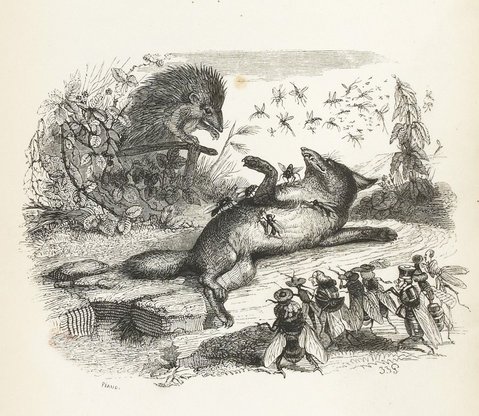
The Fox and the Mosquitoes (Perry Index 427) is one of the most politically significant of the fables attributed to Aesop. Aristotle cited this fable in his Rhetoric to argue against replacing corrupt but sated officials with hungry new ones — a political lesson that has echoed through the centuries. La Fontaine retold it as Le Renard, les Mouches et le Hérisson, and Grandville provided the famous illustration shown here.
A Fox was trying to cross a river when he slipped and fell into a swampy hollow along the bank. The mud held him fast, and struggle as he might, he could not pull himself free.
Before long, a great swarm of mosquitoes discovered him lying there helpless. They settled upon him by the hundreds and began to drink his blood. The Fox lay still, enduring their bites without a word.
A Hedgehog happened to pass by and saw the Fox's miserable state. "You poor creature!" said the Hedgehog. "Let me drive those mosquitoes away for you."
"No, no!" cried the Fox. "I beg you, do not disturb them. These mosquitoes have already had their fill and are taking very little blood now. If you drive them off, a fresh swarm will come — hungrier than these — and they will drain what little blood I have left."
Better to bear a known evil than risk an unknown one.
Frequently Asked Questions about The Fox and the Mosquitoes
What is the moral of The Fox and the Mosquitoes?
The moral is "Better to bear a known evil than risk an unknown one." The fox understands that the mosquitoes currently feeding on him are nearly full and taking little blood. Driving them away would only attract a fresh, hungry swarm that would drain him completely. The fable teaches that removing a familiar problem can sometimes create a far worse one — a lesson Aesop applied directly to corrupt politicians.
Why did Aristotle use this fable in his Rhetoric?
Aristotle recorded this fable in Rhetoric (Book II, Chapter 20) as an example of how Aesop used storytelling for political persuasion. According to Aristotle, Aesop told this story to the people of Samos when they were about to execute a popular leader accused of embezzlement. Aesop argued that this leader had already enriched himself and would steal no more, while his successor would arrive hungry and take even more. It remains one of the earliest recorded uses of a fable as a direct political argument.
What is the Perry Index number for The Fox and the Mosquitoes?
This fable is cataloged as Perry Index 427, also known as "The Fox, the Flies, and the Hedgehog" or "The Fox and the Hedgehog." The Perry Index is the standard scholarly classification system for Aesop's fables, created by classicist Ben Edwin Perry. Different retellings feature mosquitoes, flies, or ticks as the blood-sucking insects, but the core story and moral remain the same across all versions.
How does this fable compare to The Fisherman and the Little Fish?
Both fables teach pragmatic decision-making when facing imperfect choices. In The Fisherman and the Little Fish, a fisherman must decide whether to keep a small catch now or release it hoping for a bigger one later. The fox in this fable faces a similar calculation — keep the sated mosquitoes or risk hungrier replacements. Both warn against gambling a sure thing on an uncertain future, though the fisherman's choice is about greed while the fox's is about survival.
What political lessons does The Fox and the Mosquitoes teach?
The fable is one of Aesop's most explicitly political stories. Its core lesson — that replacing corrupt officials may invite worse ones — has been applied to governance for over 2,000 years. The sated mosquitoes represent leaders who have already enriched themselves and have less incentive to plunder. Fresh mosquitoes represent ambitious newcomers with everything to gain. This mirrors the argument in The Lion and the Ass, where power dynamics and self-interest drive behavior. The fable does not defend corruption — it warns that naive reform can backfire.
Why does the fox refuse the hedgehog's help?
The fox refuses because he has made a rational calculation about risk. The current mosquitoes are nearly full and consuming very little blood. If the hedgehog drives them away, a new swarm of hungry mosquitoes will replace them and drain the fox's remaining blood entirely. The fox's refusal is not stubbornness but wisdom — he recognizes that well-intentioned help can cause more harm than the original problem. This theme of unintended consequences also appears in Two Travelers and a Bear, where crisis reveals the true cost of misplaced trust.
What other versions of this fable exist?
The fable has been retold across centuries and cultures. La Fontaine adapted it as Le Renard, les Mouches et le Hérisson in his celebrated French collection. Samuel Croxall and Thomas Bewick each published English versions with expanded political commentary. The blood-sucking creatures vary — mosquitoes, flies, or ticks depending on the translation — but the moral never changes. The story's adaptability is part of its power, much like The Quack Toad, another fable about seeing through false promises to recognize what truly serves your interest.
Is this the same fable referenced in Isaiah Berlin's "The Hedgehog and the Fox"?
Isaiah Berlin's famous 1953 essay The Hedgehog and the Fox borrows its title from a different Aesop fragment — "The fox knows many things, but the hedgehog knows one big thing" (attributed to the poet Archilochus). While Berlin's essay features the same two animals, his metaphor about intellectual styles is entirely separate from this fable's political lesson about tolerating known evils. The coincidence of characters has caused occasional confusion, but the two works address completely different ideas.
Save stories, build your reading list, and access all study tools — completely free.
The Fox and the Mosquitoes is one of Aesop's most politically potent fables, recorded by Aristotle in his Rhetoric (Book II, Chapter 20). In Aristotle's account, Aesop told this story to the people of Samos …
...
Advertisement
Understanding The Fox and the Mosquitoes
A short summary of the story
The Fox and the Mosquitoes is one of Aesop's most politically potent fables, recorded by Aristotle in his Rhetoric (Book II, Chapter 20). In Aristotle's account, Aesop told this story to the people of Samos when they were about to execute a popular leader accused of embezzling public funds. Aesop's argument: this leader has already enriched himself and will steal no more — but his replacement will arrive hungry and take even more.
The fable's central wisdom — better to endure a known evil than invite an unknown one — has made it a touchstone of political philosophy for over two thousand years. It warns against the assumption that change automatically means improvement. The mosquitoes (or flies, in some versions) represent exploiters who have already taken their fill. The hedgehog's well-meaning offer to help represents the dangerous naivety of those who propose sweeping change without considering what comes next.
The fox's reasoning reveals a sophisticated cost-benefit analysis. He does not defend the mosquitoes or pretend they are harmless — he fully acknowledges that they have fed on him. But he recognizes that the current situation, however painful, is stable and survivable, while the alternative carries a risk of total ruin. This pragmatic calculation echoes throughout history, from arguments about political incumbents to debates about institutional reform.
Listed as Perry Index 427, the fable was retold by La Fontaine as Le Renard, les Mouches et le Hérisson and has appeared in countless collections since. Isaiah Berlin famously borrowed the hedgehog-and-fox dynamic for his essay The Hedgehog and the Fox (1953), though his use of the metaphor diverges from Aesop's original meaning. The fable's enduring relevance lies in its unflinching realism: sometimes the wisest course is not to fight the parasites you have, but to fear the ones you don't.
Advertisement
Find this helpful? Create a free account to bookmark stories and save explanations for quick reference.