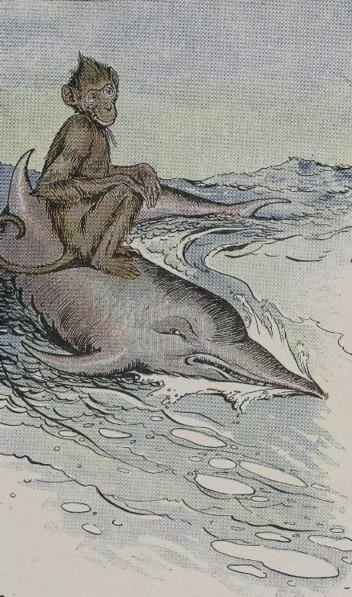
Why One Lie Always Demands Another
The Monkey and the Dolphin is one of Aesop's sharpest fables about deception, and its brilliance lies in the speed with which the monkey's lies unravel. The entire …
Understanding The Monkey And The Dolphin
Why One Lie Always Demands Another
The Monkey and the Dolphin is one of Aesop's sharpest fables about deception, and its brilliance lies in the speed with which the monkey's lies unravel. The entire story turns on a single geographical fact: Piraeus is a port, not a person. Any genuine Athenian would know this instantly, and the dolphin's seemingly casual question is actually a test. The monkey, desperate to maintain his disguise, blunders straight into it.
The fable's structure is a masterclass in comic escalation. The monkey's first lie—claiming to be an Athenian citizen—is bold but survivable. His second lie—asserting noble birth—is reckless but still unfalsifiable. The third lie, however, is catastrophic. By calling Piraeus a person and claiming him as a close friend, the monkey reveals that he knows nothing at all about Athens. Each falsehood required a bigger falsehood to support it, and the chain snapped at exactly the point where ignorance met specificity.
The dolphin is an equally important character. In Greek tradition, dolphins were considered among the most intelligent creatures in the sea, sacred to both Apollo and Poseidon. Aesop draws on this reputation to make the dolphin a discerning judge rather than a gullible victim. The dolphin does not interrogate aggressively; he asks a simple, polite question and lets the monkey's own dishonesty do the rest. His decision to abandon the monkey is not cruelty—it is the natural withdrawal of trust from someone who has proven unworthy of it.
The moral—"One falsehood leads to another"—captures a psychological truth that extends far beyond this story. Liars must remember every fabrication and constantly invent new details to keep the illusion alive. Eventually, as the monkey discovers, reality asks a question that the fiction cannot answer. The fable warns that deception is not merely wrong but structurally unstable: each lie increases the odds that the next one will be the one that collapses the entire facade.
There is also a quieter lesson about pretension. The monkey does not lie to survive—he lies to impress. He wants the dolphin to admire him, so he invents a noble lineage and an important social circle. Had he simply been honest about being a shipwrecked monkey, the dolphin might have carried him to shore anyway. His downfall is not that he was a monkey pretending to be human, but that he was a fraud pretending to be something grander than he was. Authenticity, Aesop suggests, is not just morally superior—it is practically safer.
Find this helpful? Create a free account to bookmark stories and save explanations for quick reference.
Sign Up FreeAlready have an account? Log in