The Double Punishment of Living a Lie
Most readings of this fable stop at a simple warning against vanity, but Aesop's real insight cuts deeper. The Jackdaw does not merely fail to impress …
Understanding The Vain Jackdaw And His Borrowed Feathers
The Double Punishment of Living a Lie
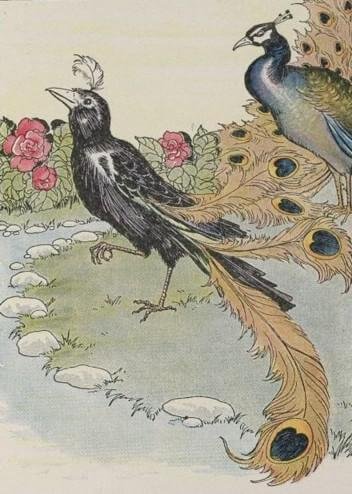
Most readings of this fable stop at a simple warning against vanity, but Aesop's real insight cuts deeper. The Jackdaw does not merely fail to impress the Peacocks—he loses everything, including the community he already had. The fable's cruelest moment is not the Peacocks' attack but the Jackdaw's return home, where his own kind refuse to take him back. His punishment is not embarrassment; it is total exile.
What makes this story psychologically precise is its understanding of how pretense damages trust in both directions. The Peacocks are offended because the Jackdaw tried to deceive them—he was not simply admiring their beauty but claiming it as his own. Meanwhile, his fellow Jackdaws are hurt not by the disguise itself but by the implicit insult: by trying to become a Peacock, he declared that being a Jackdaw was not good enough. His ambition was a rejection of them, and they remember it.
The fable also reveals an uncomfortable truth about social boundaries. The Jackdaw's feathers are literally real Peacock feathers—discarded ones, freely available on the ground. His costume is not entirely fake. Yet the Peacocks recognize him instantly, suggesting that belonging to a group involves far more than surface appearance. Manners, behavior, and genuine identity cannot be borrowed or attached with borrowed plumes.
There is a modern resonance to this story that goes beyond personal vanity. In an age of curated online personas, inflated credentials, and performative identity, the Jackdaw's predicament feels startlingly current. The person who pretends to be something they are not risks losing both the audience they hoped to impress and the community that once accepted them as they were. Aesop's moral—"borrowed feathers do not make fine birds"—is ultimately about the cost of inauthenticity: not just that the disguise fails, but that the attempt itself changes how others see you permanently.
The fable's lasting power comes from its refusal to offer a comfortable resolution. The Jackdaw does not learn his lesson and return to a forgiving flock. He ends the story alone, punished by both worlds. It is one of Aesop's starkest illustrations of a principle that runs through many of his fables: know yourself, accept yourself, and do not trade what you are for what you wish to appear.
Find this helpful? Create a free account to bookmark stories and save explanations for quick reference.
Sign Up FreeAlready have an account? Log in