Fiddler Jones Spoon River Anthology

Previous Chapter Next Chapter

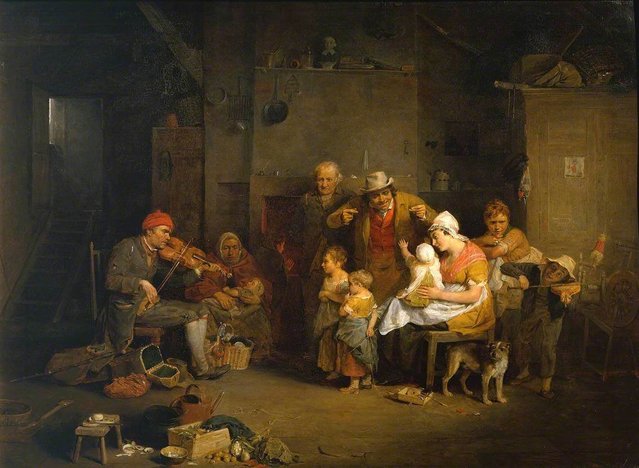
The Blind Fiddler by David Wilkie — a fiddler playing for a family in a cottage
"The Blind Fiddler" by David Wilkie, 1806
Fiddler Jones first appears in The Hill, the anthology’s prologue, as the last and most joyful character named. His neighbor Cooney Potter tells his own contrasting story.

The earth keeps some vibration going
There in your heart, and that is you.
And if the people find you can fiddle,
Why, fiddle you must, for all your life.
What do you see, a harvest of clover?
Or a meadow to walk through to the river?
The wind’s in the corn; you rub your hands
For beeves hereafter ready for market;
Or else you hear the rustle of skirts
Like the girls when dancing at Little Grove.
To Cooney Potter a pillar of dust
Or whirling leaves meant ruinous drouth;
They looked to me like Red-Head Sammy
Stepping it off, to “Toor-a-Loor.”
How could I till my forty acres
Not to speak of getting more,
With a medley of horns, bassoons and piccolos
Stirred in my brain by crows and robins
And the creak of a wind-mill—only these?
And I never started to plow in my life
That some one did not stop in the road
And take me away to a dance or picnic.
I ended up with forty acres;
I ended up with a broken fiddle—
And a broken laugh, and a thousand memories,
And not a single regret.

Frequently Asked Questions about Fiddler Jones from Spoon River Anthology

What is the meaning of "Fiddler Jones" by Edgar Lee Masters?

Fiddler Jones celebrates a life of passion over material success. Jones is a farmer who cannot help but hear music in everything—crows, robins, wind-mills, rustling corn. Where others see profit in a harvest of clover, he sees a meadow to walk through to the river. He never managed to grow his forty acres because neighbors kept pulling him away to dances and picnics. Yet he ends his epitaph with "not a single regret"—one of the most positive final lines in all of Spoon River Anthology.

Who is Fiddler Jones in Spoon River Anthology?

Fiddler Jones is a beloved, eccentric farmer-musician from the fictional town of Spoon River. He appears first in The Hill, the anthology's prologue, as the last character named—"Old Fiddler Jones / Who played with life all his ninety years." His own epitaph expands on that portrait: a man whose soul vibrated with music, who could not plow a field without being interrupted by someone wanting him to play. He represents the artist-as-fool archetype—materially poor but spiritually rich.

What does "The earth keeps some vibration going / There in your heart, and that is you" mean?

These opening lines establish Fiddler Jones's philosophy: each person has an innate rhythm or calling, and that vibration defines who they are. For Jones, the vibration is music—he cannot perceive the world without hearing melodies in it. The lines suggest that identity is not something chosen but something felt, a resonance between the self and the natural world. It is the poem's thesis: once the people discover you can fiddle, "fiddle you must, for all your life."

How does Fiddler Jones contrast with other Spoon River characters?

Most Spoon River epitaphs are tinged with bitterness, regret, or hidden shame—marriages that suffocated, ambitions that failed, secrets that destroyed. Fiddler Jones is a rare exception. He ends with "a broken fiddle— / And a broken laugh, and a thousand memories, / And not a single regret." His neighbor Cooney Potter, mentioned in the poem, sees a pillar of dust and fears drought; Jones sees the same dust and imagines a dancer. Masters uses this contrast to argue that perception, not circumstance, determines happiness.

What is the tone of "Fiddler Jones"?

The tone is exuberant, whimsical, and warmly defiant. Unlike the elegiac or bitter tones that dominate most of Spoon River Anthology, Jones speaks with infectious joy. His catalogue of sounds—"a medley of horns, bassoons and piccolos / Stirred in my brain by crows and robins"—has a giddy, almost manic energy. Even the final image of a "broken fiddle" carries no sadness; it is a badge of a life fully used.


Previous Chapter Next Chapter
Return to the Spoon River Anthology Summary Return to the Edgar Lee Masters Library