The Little Match Girl
by Hans Christian Andersen
The Little Match Girl, also titled, The Little Matchstick Girl is one of our Favorite Fairy Tales. Published by Hans Christian Andersen in 1845, it exemplifies his broad literary talent and ability. I personally like to read this story at least twice a year, once in Autumn as the holiday season comes into focus, and then again around the Christmas holiday. It's a gentle reminder of the value of compassion and charity. The Little Match Girl Study Guide is a resource for teachers and students.
Most terribly cold it was; it snowed, and was nearly quite dark, and evening-- the last evening of the year. In this cold and darkness there went along the street a poor little girl, bareheaded, and with naked feet. When she left home she had slippers on, it is true; but what was the good of that? They were very large slippers, which her mother had hitherto worn; so large were they; and the poor little thing lost them as she scuffled away across the street, because of two carriages that rolled by dreadfully fast.
One slipper was nowhere to be found; the other had been laid hold of by an urchin, and off he ran with it; he thought it would do capitally for a cradle when he some day or other should have children himself. So the little maiden walked on with her tiny naked feet, that were quite red and blue from cold. She carried a quantity of matches in an old apron, and she held a bundle of them in her hand. Nobody had bought anything of her the whole livelong day; no one had given her a single farthing.
She crept along trembling with cold and hunger--a very picture of sorrow, the poor little thing!
The flakes of snow covered her long fair hair, which fell in beautiful curls around her neck; but of that, of course, she never once now thought. From all the windows the candles were gleaming, and it smelt so deliciously of roast goose, for you know it was New Year's Eve; yes, of that she thought.
In a corner formed by two houses, of which one advanced more than the other, she seated herself down and cowered together. Her little feet she had drawn close up to her, but she grew colder and colder, and to go home she did not venture, for she had not sold any matches and could not bring a farthing of money: from her father she would certainly get blows, and at home it was cold too, for above her she had only the roof, through which the wind whistled, even though the largest cracks were stopped up with straw and rags.
Her little hands were almost numbed with cold. Oh! a match might afford her a world of comfort, if she only dared take a single one out of the bundle, draw it against the wall, and warm her fingers by it. She drew one out. "Rischt!" how it blazed, how it burnt! It was a warm, bright flame, like a candle, as she held her hands over it: it was a wonderful light. It seemed really to the little maiden as though she were sitting before a large iron stove, with burnished brass feet and a brass ornament at top. The fire burned with such blessed influence; it warmed so delightfully. The little girl had already stretched out her feet to warm them too; but--the small flame went out, the stove vanished: she had only the remains of the burnt-out match in her hand.
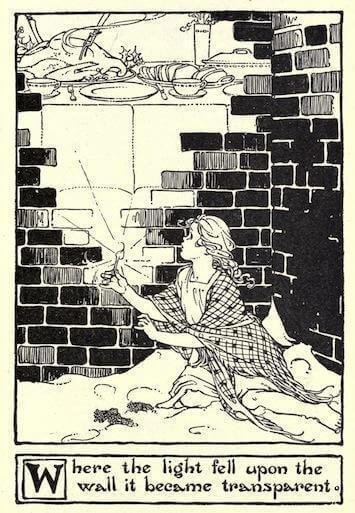
She rubbed another against the wall: it burned brightly, and where the light fell on the wall, there the wall became transparent like a veil, so that she could see into the room. On the table was spread a snow-white tablecloth; upon it was a splendid porcelain service, and the roast goose was steaming famously with its stuffing of apple and dried plums. And what was still more capital to behold was, the goose hopped down from the dish, reeled about on the floor with knife and fork in its breast, till it came up to the poor little girl; when--the match went out and nothing but the thick, cold, damp wall was left behind. She lighted another match. Now there she was sitting under the most magnificent Christmas tree: it was still larger, and more decorated than the one which she had seen through the glass door in the rich merchant's house.
Thousands of lights were burning on the green branches, and gaily-colored pictures, such as she had seen in the shop-windows, looked down upon her. The little maiden stretched out her hands towards them when--the match went out. The lights of the Christmas tree rose higher and higher, she saw them now as stars in heaven; one fell down and formed a long trail of fire.
"Someone is just dead!" said the little girl; for her old grandmother, the only person who had loved her, and who was now no more, had told her, that when a star falls, a soul ascends to God.
She drew another match against the wall: it was again light, and in the lustre there stood the old grandmother, so bright and radiant, so mild, and with such an expression of love.
"Grandmother!" cried the little one. "Oh, take me with you! You go away when the match burns out; you vanish like the warm stove, like the delicious roast goose, and like the magnificent Christmas tree!" And she rubbed the whole bundle of matches quickly against the wall, for she wanted to be quite sure of keeping her grandmother near her. And the matches gave such a brilliant light that it was brighter than at noon-day: never formerly had the grandmother been so beautiful and so tall. She took the little maiden, on her arm, and both flew in brightness and in joy so high, so very high, and then above was neither cold, nor hunger, nor anxiety--they were with God.
But in the corner, at the cold hour of dawn, sat the poor girl, with rosy cheeks and with a smiling mouth, leaning against the wall--frozen to death on the last evening of the old year. Stiff and stark sat the child there with her matches, of which one bundle had been burnt. "She wanted to warm herself," people said. No one had the slightest suspicion of what beautiful things she had seen; no one even dreamed of the splendor in which, with her grandmother she had entered on the joys of a new year.
More works by Hans Christian Andersen, including famous fairy-tales like The Emperor's New Clothes, The Princess and the Pea, and The Ugly Duckling can be found at The Hans Christian Andersen Homepage. Readers that enjoyed this story might wish to read The Last Dream of Old Oak and The Tinder-Box. For a sample of Andersen's lighter and more humorous side, I suggest The Shirt-Collar.
The Little Match Girl is a featured selection in our collection of Christmas Stories and Short-Short Stories.
Frequently Asked Questions
What is "The Little Match Girl" about?
The Little Match Girl is a fairy tale by , first published in 1845. It tells the story of a poor, barefoot girl who wanders the freezing streets on New Year's Eve, trying to sell matches. Too afraid to go home without having sold any — knowing her father will beat her — she huddles in a corner between two buildings and begins lighting her matches one by one. Each flame produces a beautiful vision: a warm iron stove, a festive table with a roast goose, a magnificent Christmas tree, and finally her beloved deceased grandmother. She lights the entire remaining bundle to keep her grandmother's image near, and the grandmother carries her soul to heaven. In the morning, passersby discover the girl frozen to death, smiling, with the spent matches around her.
What are the main themes of "The Little Match Girl"?
The central themes of The Little Match Girl include poverty and social inequality, the innocence of childhood, hope and imagination, and death as transcendence. Andersen contrasts the warmth and abundance inside the houses — roast goose, Christmas trees, candlelight — with the freezing, hungry child outside, highlighting society's indifference to suffering. The girl's visions represent her deepest desires: warmth, food, beauty, and love. The story also carries a strong Christian theme, presenting death not as tragedy but as a release from earthly suffering, with the girl ascending to heaven in the arms of her grandmother.
What do the matches symbolize in "The Little Match Girl"?
The matches in The Little Match Girl symbolize fleeting hope and warmth in an otherwise cold, indifferent world. Each match the girl strikes provides a momentary vision of comfort — a stove, a feast, a Christmas tree, her grandmother — but each flame quickly dies, returning her to her harsh reality. The matches also represent the girl's dwindling life force; as she burns through them, she moves closer to death. When she finally lights the entire remaining bundle at once, it is both a desperate act of hope and an acceptance of her fate. The contrast between the brief, brilliant light and the surrounding darkness mirrors the story's larger theme of fleeting joy amid enduring suffering.
What happens at the end of "The Little Match Girl"?
At the end of the story, the little girl strikes all her remaining matches at once to keep the vision of her beloved grandmother from fading. In the brilliant light, her grandmother appears more beautiful than ever and takes the child in her arms. Together, they fly upward "in brightness and in joy so high" to a place where there is "neither cold, nor hunger, nor anxiety — they were with God." The next morning, people find the girl frozen to death in the corner, her cheeks rosy and a smile on her face, surrounded by spent matches. The bystanders assume she was simply trying to warm herself, never suspecting the beautiful visions she experienced in her final moments.
What is the moral of "The Little Match Girl"?
The moral of The Little Match Girl is a plea for compassion toward the vulnerable. shows an innocent child dying of cold and hunger while the rest of society celebrates New Year's Eve in warmth and plenty — and no one stops to help her. The story asks readers to recognize and respond to suffering rather than remain indifferent. At the same time, the story offers a secondary moral rooted in Christian faith: that death can be a merciful release from earthly suffering, and that the soul finds peace and love in the afterlife. Andersen deliberately leaves readers feeling both sadness at the girl's death and consolation that she is finally free from pain.
When was "The Little Match Girl" written and what inspired it?
The Little Match Girl was first published in 1845 by . The story was partly inspired by Andersen's own impoverished childhood in Odense, Denmark, where his family struggled with poverty. Andersen's mother had been sent out as a child to beg in the streets, an experience that deeply affected the author and informed his portrayal of the little match seller. The story was written during a period when Andersen was already internationally famous for his fairy tales, and it reflects his ongoing concern with social injustice, particularly as it affected children during the Industrial Revolution in Europe.
What literary devices does Hans Christian Andersen use in "The Little Match Girl"?
employs several powerful literary devices in this story. Imagery is central — the vivid descriptions of the warm stove, the steaming roast goose, and the glittering Christmas tree contrast sharply with the cold, dark street. Juxtaposition runs throughout, placing warmth against cold, abundance against poverty, and celebration against isolation. Symbolism appears in the matches (hope), the shooting star (death and transition), and the grandmother (unconditional love). Andersen also uses dramatic irony: readers understand the girl is dying while the passersby the next morning have "not the slightest suspicion of what beautiful things she had seen." The story's third-person omniscient narration draws readers into intimate sympathy with the girl while also revealing the indifference of the wider world.
What does the grandmother represent in "The Little Match Girl"?
The grandmother represents unconditional love, safety, and spiritual salvation. She is described as "the only person who had loved her, and who was now no more," making her the sole source of warmth and affection the girl has ever known. When the grandmother appears in the match-light, she is "so bright and radiant, so mild, and with such an expression of love" — a figure associated with heavenly light rather than earthly suffering. The grandmother ultimately serves as the girl's guide from the mortal world to the afterlife, carrying her to heaven where there is no more cold or hunger. In this way, she functions as both a comforting memory and a spiritual intercessor, embodying Andersen's Christian faith in divine mercy.
Why is "The Little Match Girl" set on New Year's Eve?
The New Year's Eve setting serves multiple thematic purposes. It heightens the contrast between celebration and suffering — while families feast and celebrate inside warm homes, the girl freezes alone in the street. The transition from the old year to the new year also mirrors the girl's own passage from life to death, making the timing symbolically resonant. Andersen writes that the girl enters "the joys of a new year" through death, creating a bittersweet double meaning. Additionally, the holiday setting underscores the story's social critique: the festive atmosphere makes society's indifference to the girl's plight even more striking, as the celebration of abundance happens mere feet from a child dying of poverty.
Save stories, build your reading list, and access all study tools — completely free.
Save The Little Match Girl to your library — it's free!Vocabulary
This story contains 16 vocabulary words worth knowing.
View Vocabulary List →Need help with The Little Match Girl?
Study tools to help with homework, prepare for quizzes, and deepen your understanding.
Flashcards → | Vocabulary →