The Dreamer
by H.H. Munro (SAKI)
The Dreamer was published by SAKI in 1914. "The wondering look deepened in Cyprian's eyes as he followed his aunt; he belonged to a generation that is supposed to be over-fond of the role of mere spectator, but looking at napkins that one did not mean to buy was a pleasure beyond his comprehension."
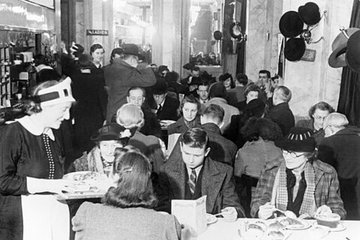
It was the season of sales. The august establishment of Walpurgis and Nettlepink had lowered its prices for an entire week as a concession to trade observances, much as an Arch-duchess might protestingly contract an attack of influenza for the unsatisfactory reason that influenza was locally prevalent. Adela Chemping, who considered herself in some measure superior to the allurements of an ordinary bargain sale, made a point of attending the reduction week at Walpurgis and Nettlepink's.
"I'm not a bargain hunter," she said, "but I like to go where bargains are."
Which showed that beneath her surface strength of character there flowed a gracious undercurrent of human weakness.
With a view to providing herself with a male escort Mrs. Chemping had invited her youngest nephew to accompany her on the first day of the shopping expedition, throwing in the additional allurement of a cinematograph theatre and the prospect of light refreshment. As Cyprian was not yet eighteen she hoped he might not have reached that stage in masculine development when parcel-carrying is looked on as a thing abhorrent.
"Meet me just outside the floral department," she wrote to him, "and don't be a moment later than eleven."
Cyprian was a boy who carried with him through early life the wondering look of a dreamer, the eyes of one who sees things that are not visible to ordinary mortals, and invests the commonplace things of this world with qualities unsuspected by plainer folk - the eyes of a poet or a house agent. He was quietly dressed - that sartorial quietude which frequently accompanies early adolescence, and is usually attributed by novel-writers to the influence of a widowed mother. His hair was brushed back in a smoothness as of ribbon seaweed and seamed with a narrow furrow that scarcely aimed at being a parting. His aunt particularly noted this item of his toilet when they met at the appointed rendezvous, because he was standing waiting for her bare-headed.
"Where is your hat?" she asked.
"I didn't bring one with me," he replied.
Adela Chemping was slightly scandalised.
"You are not going to be what they call a Nut, are you?" she inquired with some anxiety, partly with the idea that a Nut would be an extravagance which her sister's small household would scarcely be justified in incurring, partly, perhaps, with the instinctive apprehension that a Nut, even in its embryo stage, would refuse to carry parcels.
Cyprian looked at her with his wondering, dreamy eyes.
"I didn't bring a hat," he said, "because it is such a nuisance when one is shopping; I mean it is so awkward if one meets anyone one knows and has to take one's hat off when one's hands are full of parcels. If one hasn't got a hat on one can't take it off."
Mrs. Chemping sighed with great relief; her worst fear had been laid at rest.
"It is more orthodox to wear a hat," she observed, and then turned her attention briskly to the business in hand.
"We will go first to the table-linen counter," she said, leading the way in that direction; "I should like to look at some napkins."
The wondering look deepened in Cyprian's eyes as he followed his aunt; he belonged to a generation that is supposed to be over-fond of the role of mere spectator, but looking at napkins that one did not mean to buy was a pleasure beyond his comprehension. Mrs. Chemping held one or two napkins up to the light and stared fixedly at them, as though she half expected to find some revolutionary cypher written on them in scarcely visible ink; then she suddenly broke away in the direction of the glassware department.
"Millicent asked me to get her a couple of decanters if there were any going really cheap," she explained on the way, "and I really do want a salad bowl. I can come back to the napkins later on."
She handled and scrutinised a large number of decanters and a long series of salad bowls, and finally bought seven chrysanthemum vases.
"No one uses that kind of vase nowadays," she informed Cyprian, "but they will do for presents next Christmas."
Two sunshades that were marked down to a price that Mrs. Chemping considered absurdly cheap were added to her purchases.
"One of them will do for Ruth Colson; she is going out to the Malay States, and a sunshade will always be useful there. And I must get her some thin writing paper. It takes up no room in one's baggage."
Mrs. Chemping bought stacks of writing paper; it was so cheap, and it went so flat in a trunk or portmanteau. She also bought a few envelopes - envelopes somehow seemed rather an extragavance compared with notepaper.
"Do you think Ruth will like blue or grey paper?" she asked Cyprian.
"Grey," said Cyprian, who had never met the lady in question.
"Have you any mauve notepaper of this quality?" Adela asked the assistant.
"We haven't any mauve," said the assistant, "but we've two shades of green and a darker shade of grey."
Mrs. Chemping inspected the greens and the darker grey, and chose the blue.
"Now we can have some lunch," she said.
Cyprian behaved in an exemplary fashion in the refreshment department, and cheerfully accepted a fish cake and a mince pie and a small cup of coffee as adequate restoratives after two hours of concentrated shopping. He was adamant, however, in resisting his aunt's suggestion that a hat should be bought for him at the counter where men's headwear was being disposed of at temptingly reduced prices.
"I've got as many hats as I want at home," he said, "and besides, it rumples one's hair so, trying them on."
Perhaps he was going to develop into a Nut after all. It was a disquieting symptom that he left all the parcels in charge of the cloak-room attendant.
"We shall be getting more parcels presently," he said, "so we need not collect these till we have finished our shopping."
His aunt was doubtfully appeased; some of the pleasure and excitement of a shopping expedition seemed to evaporate when one was deprived of immediate personal contact with one's purchases.
"I'm going to look at those napkins again," she said, as they descended the stairs to the ground floor. "You need not come," she added, as the dreaming look in the boy's eyes changed for a moment into one of mute protest, "you can meet me afterwards in the cutlery department; I've just remembered that I haven't a corkscrew in the house that can be depended on."
Cyprian was not to be found in the cutlery department when his aunt in due course arrived there, but in the crush and bustle of anxious shoppers and busy attendants it was an easy matter to miss anyone. It was in the leather goods department some quarter of an hour later that Adela Chemping caught sight of her nephew, separated from her by a rampart of suit-cases and portmanteaux and hemmed in by the jostling crush of human beings that now invaded every corner of the great shopping emporium. She was just in time to witness a pardonable but rather embarrassing mistake on the part of a lady who had wriggled her way with unstayable determination towards the bareheaded Cyprian, and was now breathlessly demanding the sale price of a handbag which had taken her fancy.
"There now," exclaimed Adela to herself, "she takes him for one of the shop assistants because he hasn't got a hat on. I wonder it hasn't happened before."
Perhaps it had. Cyprian, at any rate, seemed neither startled nor embarrassed by the error into which the good lady had fallen. Examining the ticket on the bag, he announced in a clear, dispassionate voice:
"Black seal, thirty-four shillings, marked down to twenty-eight. As a matter of fact, we are clearing them out at a special reduction price of twenty-six shillings. They are going off rather fast."
"I'll take it," said the lady, eagerly digging some coins out of her purse.
"Will you take it as it is?" asked Cyprian; "it will be a matter of a few minutes to get it wrapped up, there is such a crush."
"Never mind, I'll take it as it is," said the purchaser, clutching her treasure and counting the money into Cyprian's palm.
Several kind strangers helped Adela into the open air.
"It's the crush and the heat," said one sympathiser to another; "it's enough to turn anyone giddy."
When she next came across Cyprian he was standing in the crowd that pushed and jostled around the counters of the book department. The dream look was deeper than ever in his eyes. He had just sold two books of devotion to an elderly Canon.
Featured in our collection of Short Stories for Middle School II
Frequently Asked Questions about The Dreamer
What is "The Dreamer" by Saki about?
"The Dreamer" follows Adela Chemping, an upper-class woman who drags her teenage nephew Cyprian along on a department store shopping expedition during a reduction sale at Walpurgis and Nettlepink. She expects him to carry parcels while she browses napkins, decanters, and stacks of writing paper she does not need. Cyprian, described as having "the wondering look of a dreamer" and "the eyes of a poet or a house agent," arrives without a hat. When they separate, a customer mistakes the bare-headed boy for a shop assistant. Instead of correcting her, Cyprian smoothly quotes prices and pockets the money. The story ends with Adela fainting from shock, and Cyprian calmly selling books of devotion to an elderly Canon — the dream look "deeper than ever in his eyes."
What is the theme of "The Dreamer" by Saki?
The central theme is appearances versus reality. Adela assumes Cyprian is a passive, dreamy boy she can exploit as a pack-mule, but beneath his "wondering look" lies a sharp, enterprising mind. A related theme is the satire of consumerism: Adela claims she is "not a bargain hunter" yet buys seven chrysanthemum vases nobody uses, sunshades for a woman she barely knows, and stacks of cheap notepaper. also explores the reversal of power between generations — the supposedly naive teenager outmaneuvers his controlling aunt by turning the shopping expedition to his own profit. As in The Lumber Room, a young person proves far more resourceful than the adult who underestimates them.
What is the twist ending in "The Dreamer"?
The twist comes when Adela sees a customer mistake Cyprian for a shop assistant because he is not wearing a hat. Rather than correcting the error, Cyprian coolly quotes the sale price of a handbag, offers a "special reduction price," and collects the money. Adela is so stunned that "several kind strangers helped her into the open air" — onlookers assume it is the heat and crush that made her faint. The final line delivers the full payoff: when Adela next finds Cyprian, he is in the book department, having just sold two books of devotion to an elderly Canon, the dream look "deeper than ever" in his eyes. The boy she thought needed minding has been running his own con all along.
Why doesn't Cyprian wear a hat in "The Dreamer"?
Cyprian explains that a hat is "such a nuisance when one is shopping" because "if one meets anyone one knows and has to take one's hat off when one's hands are full of parcels" it creates an awkward situation. His logic sounds reasonable — even clever — but the real significance only becomes clear at the story's climax: without a hat, Cyprian looks indistinguishable from a shop assistant, and customers approach him to buy things. What Adela dismisses as a minor social lapse is actually the key to Cyprian's scheme. The hat detail is a masterful example of 's technique of planting an innocent detail early that becomes the engine of the plot twist, much like the open window in The Open Window.
Who is Cyprian in "The Dreamer" by Saki?
Cyprian is Adela Chemping's youngest nephew, not yet eighteen, who accompanies her on a shopping trip. Saki describes him as "a boy who carried with him through early life the wondering look of a dreamer, the eyes of one who sees things that are not visible to ordinary mortals" — "the eyes of a poet or a house agent." That comparison is the story's most telling joke: a poet sees beauty others miss, while a house agent (estate agent) sees profit. Cyprian is firmly the latter. He is quietly dressed, smooth-haired, and polite, but behind his compliant exterior operates a quick, opportunistic intelligence. He belongs to 's gallery of subversive young people — like Doris in The Storyteller and Nicholas in The Lumber Room — who outwit the adults tasked with supervising them.
What literary devices does Saki use in "The Dreamer"?
employs several key literary devices. Irony saturates the story: Adela recruits Cyprian to carry her parcels, but he deposits them in the cloakroom and spends the afternoon selling other people's goods. Foreshadowing is embedded in the opening description — comparing Cyprian's eyes to those of "a poet or a house agent" hints that his dreaminess is actually commercial shrewdness. Satire targets Edwardian shopping culture: Adela's self-deception ("I'm not a bargain hunter, but I like to go where bargains are") and her irrational purchasing decisions mirror the absurdity Cyprian exploits. The story also uses understatement — Cyprian's calm, dispassionate sales patter contrasts with the chaos around him, and the final image of him in the book department is delivered with deadpan restraint.
What is the moral of "The Dreamer" by Saki?
The story delivers a layered moral. On one level, it warns against underestimating others based on appearances: Adela sees a passive, dreamy teenager and assumes he will be an obedient parcel-carrier, never suspecting his entrepreneurial streak. On another level, it satirizes the absurdity of consumer culture — the shoppers are so frenzied that they willingly hand money to a bare-headed boy without questioning his credentials. Saki also suggests that so-called "dreamers" may see the world more clearly than practical people. Adela, the self-proclaimed practical woman, buys things she does not need and never notices what is happening right in front of her. Cyprian, the supposed dreamer, sees an opportunity and seizes it with cool precision.
How does "The Dreamer" compare to other Saki stories?
"The Dreamer" belongs to 's tradition of twist-ending comedies in which the supposedly powerless outwit the powerful. It shares DNA with The Open Window, where a young girl's composed storytelling fools an adult visitor, and with The Lumber Room, where a child systematically outmaneuvers a punitive aunt. It also recalls Tobermory in its exposure of upper-class pretensions through an unexpected agent of chaos. The story's satirical treatment of shopping culture connects it to The Sex That Doesn't Shop. Unlike Saki's darker tales such as Sredni Vashtar, "The Dreamer" keeps the stakes light and comic, though the underlying critique of Edwardian society is no less sharp.
What is the significance of the title "The Dreamer"?
The title operates as deliberate misdirection. "Dreamer" conventionally suggests someone impractical and detached from reality, and that is exactly how Adela perceives Cyprian — a boy with a "wondering look" whose attention wanders during her shopping. But the title is deeply ironic: Cyprian is not lost in fantasy but calculating how to exploit his surroundings. Saki reinforces this throughout the story — "the dreaming look" appears just before Cyprian's most pragmatic moves, like depositing the parcels in the cloakroom or selling a handbag at a discount. The title invites the reader to share Adela's mistake, making the twist more effective. It also echoes 's observation that "a dreamer is one who can only find his way by moonlight" — Cyprian finds his way just fine in broad department-store light.
When was "The Dreamer" by Saki published?
"The Dreamer" was published in 1914 as part of Saki's collection Beasts and Super-Beasts, one of his finest and most popular story collections. The book appeared just months before the outbreak of World War I, which would claim 's life in 1916 at the Battle of the Ancre. Beasts and Super-Beasts also includes some of his most celebrated stories, such as The Open Window, The Storyteller, and The Lumber Room. The collection represents the peak of Saki's satirical art, capturing Edwardian England's social absurdities with wit and precision just as that world was about to vanish.
Save stories, build your reading list, and access all study tools — completely free.
Save The Dreamer to your library — it's free!Need help with The Dreamer?
Study tools to help with homework, prepare for quizzes, and deepen your understanding.
Flashcards →