Araby
by James Joyce
Araby was published in James Joyce's short story collection Dubliners (1914.) It is widely considered to be one of his finest short stories and is featured in our Short Stories for High School collection.
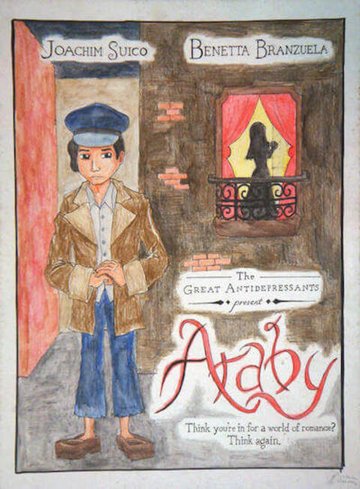
North Richmond Street, being blind, was a quiet street except at the hour when the Christian Brothers' School set the boys free. An uninhabited house of two storeys stood at the blind end, detached from its neighbours in a square ground. The other houses of the street, conscious of decent lives within them, gazed at one another with brown imperturbable faces.
The former tenant of our house, a priest, had died in the back drawing-room. Air, musty from having been long enclosed, hung in all the rooms, and the waste room behind the kitchen was littered with old useless papers. Among these I found a few paper-covered books, the pages of which were curled and damp: The Abbot, by Walter Scott, The Devout Communicant, and The Memoirs of Vidocq. I liked the last best because its leaves were yellow. The wild garden behind the house contained a central apple-tree and a few straggling bushes, under one of which I found the late tenant's rusty bicycle-pump. He had been a very charitable priest; in his will he had left all his money to institutions and the furniture of his house to his sister.
When the short days of winter came, dusk fell before we had well eaten our dinners. When we met in the street the houses had grown sombre. The space of sky above us was the colour of ever-changing violet and towards it the lamps of the street lifted their feeble lanterns. The cold air stung us and we played till our bodies glowed. Our shouts echoed in the silent street. The career of our play brought us through the dark muddy lanes behind the houses, where we ran the gauntlet of the rough tribes from the cottages, to the back doors of the dark dripping gardens where odours arose from the ashpits, to the dark odorous stables where a coachman smoothed and combed the horse or shook music from the buckled harness. When we returned to the street, light from the kitchen windows had filled the areas. If my uncle was seen turning the corner, we hid in the shadow until we had seen him safely housed. Or if Mangan's sister came out on the doorstep to call her brother in to his tea, we watched her from our shadow peer up and down the street. We waited to see whether she would remain or go in and, if she remained, we left our shadow and walked up to Mangan's steps resignedly. She was waiting for us, her figure defined by the light from the half-opened door. Her brother always teased her before he obeyed, and I stood by the railings looking at her. Her dress swung as she moved her body, and the soft rope of her hair tossed from side to side.
Every morning I lay on the floor in the front parlour watching her door. The blind was pulled down to within an inch of the sash so that I could not be seen. When she came out on the doorstep my heart leaped. I ran to the hall, seized my books and followed her. I kept her brown figure always in my eye and, when we came near the point at which our ways diverged, I quickened my pace and passed her. This happened morning after morning. I had never spoken to her, except for a few casual words, and yet her name was like a summons to all my foolish blood.
Her image accompanied me even in places the most hostile to romance. On Saturday evenings when my aunt went marketing I had to go to carry some of the parcels. We walked through the flaring streets, jostled by drunken men and bargaining women, amid the curses of labourers, the shrill litanies of shop-boys who stood on guard by the barrels of pigs' cheeks, the nasal chanting of street-singers, who sang a come-all-you about O'Donovan Rossa, or a ballad about the troubles in our native land. These noises converged in a single sensation of life for me: I imagined that I bore my chalice safely through a throng of foes. Her name sprang to my lips at moments in strange prayers and praises which I myself did not understand. My eyes were often full of tears (I could not tell why) and at times a flood from my heart seemed to pour itself out into my bosom. I thought little of the future. I did not know whether I would ever speak to her or not or, if I spoke to her, how I could tell her of my confused adoration. But my body was like a harp and her words and gestures were like fingers running upon the wires.
One evening I went into the back drawing-room in which the priest had died. It was a dark rainy evening and there was no sound in the house. Through one of the broken panes I heard the rain impinge upon the earth, the fine incessant needles of water playing in the sodden beds. Some distant lamp or lighted window gleamed below me. I was thankful that I could see so little. All my senses seemed to desire to veil themselves and, feeling that I was about to slip from them, I pressed the palms of my hands together until they trembled, murmuring: 'O love! O love!' many times.
At last she spoke to me. When she addressed the first words to me I was so confused that I did not know what to answer. She asked me was I going to Araby. I forgot whether I answered yes or no. It would be a splendid bazaar; she said she would love to go.
'And why can't you?' I asked.
While she spoke she turned a silver bracelet round and round her wrist. She could not go, she said, because there would be a retreat that week in her convent. Her brother and two other boys were fighting for their caps, and I was alone at the railings. She held one of the spikes, bowing her head towards me. The light from the lamp opposite our door caught the white curve of her neck, lit up her hair that rested there and, falling, lit up the hand upon the railing. It fell over one side of her dress and caught the white border of a petticoat, just visible as she stood at ease.
'It's well for you,' she said.
'If I go,' I said, 'I will bring you something.'
What innumerable follies laid waste my waking and sleeping thoughts after that evening! I wished to annihilate the tedious intervening days. I chafed against the work of school. At night in my bedroom and by day in the classroom her image came between me and the page I strove to read. The syllables of the word Araby were called to me through the silence in which my soul luxuriated and cast an Eastern enchantment over me. I asked for leave to go to the bazaar on Saturday night. My aunt was surprised, and hoped it was not some Freemason affair. I answered few questions in class. I watched my master's face pass from amiability to sternness; he hoped I was not beginning to idle. I could not call my wandering thoughts together. I had hardly any patience with the serious work of life which, now that it stood between me and my desire, seemed to me child's play, ugly monotonous child's play.
On Saturday morning I reminded my uncle that I wished to go to the bazaar in the evening. He was fussing at the hallstand, looking for the hat-brush, and answered me curtly:
'Yes, boy, I know.'
As he was in the hall I could not go into the front parlour and lie at the window. I left the house in bad humour and walked slowly towards the school. The air was pitilessly raw and already my heart misgave me.
When I came home to dinner my uncle had not yet been home. Still it was early. I sat staring at the clock for some time and, when its ticking began to irritate me, I left the room. I mounted the staircase and gained the upper part of the house. The high, cold, empty, gloomy rooms liberated me and I went from room to room singing. From the front window I saw my companions playing below in the street. Their cries reached me weakened and indistinct and, leaning my forehead against the cool glass, I looked over at the dark house where she lived. I may have stood there for an hour, seeing nothing but the brown-clad figure cast by my imagination, touched discreetly by the lamplight at the curved neck, at the hand upon the railings and at the border below the dress.
When I came downstairs again I found Mrs Mercer sitting at the fire. She was an old, garrulous woman, a pawnbroker's widow, who collected used stamps for some pious purpose. I had to endure the gossip of the tea-table. The meal was prolonged beyond an hour and still my uncle did not come. Mrs Mercer stood up to go: she was sorry she couldn't wait any longer, but it was after eight o'clock and she did not like to be out late, as the night air was bad for her. When she had gone I began to walk up and down the room, clenching my fists. My aunt said:
'I'm afraid you may put off your bazaar for this night of Our Lord.'
At nine o'clock I heard my uncle's latchkey in the hall door. I heard him talking to himself and heard the hallstand rocking when it had received the weight of his overcoat. I could interpret these signs. When he was midway through his dinner I asked him to give me the money to go to the bazaar. He had forgotten.
'The people are in bed and after their first sleep now,' he said.
I did not smile. My aunt said to him energetically:
'Can't you give him the money and let him go? You've kept him late enough as it is.'
My uncle said he was very sorry he had forgotten. He said he believed in the old saying: 'All work and no play makes Jack a dull boy.' He asked me where I was going and, when I told him a second time, he asked me did I know The Arab's Farewell to His Steed. When I left the kitchen he was about to recite the opening lines of the piece to my aunt.
I held a florin tightly in my hand as I strode down Buckingham Street towards the station. The sight of the streets thronged with buyers and glaring with gas recalled to me the purpose of my journey. I took my seat in a third-class carriage of a deserted train. After an intolerable delay the train moved out of the station slowly. It crept onward among ruinous houses and over the twinkling river. At Westland Row Station a crowd of people pressed to the carriage doors; but the porters moved them back, saying that it was a special train for the bazaar. I remained alone in the bare carriage. In a few minutes the train drew up beside an improvised wooden platform. I passed out on to the road and saw by the lighted dial of a clock that it was ten minutes to ten. In front of me was a large building which displayed the magical name.
I could not find any sixpenny entrance and, fearing that the bazaar would be closed, I passed in quickly through a turnstile, handing a shilling to a weary-looking man. I found myself in a big hall girded at half its height by a gallery. Nearly all the stalls were closed and the greater part of the hall was in darkness. I recognized a silence like that which pervades a church after a service. I walked into the centre of the bazaar timidly. A few people were gathered about the stalls which were still open. Before a curtain, over which the words Caf Chantant were written in coloured lamps, two men were counting money on a salver. I listened to the fall of the coins.
Remembering with difficulty why I had come, I went over to one of the stalls and examined porcelain vases and flowered tea-sets. At the door of the stall a young lady was talking and laughing with two young gentlemen. I remarked their English accents and listened vaguely to their conversation.
'O, I never said such a thing!'
'O, but you did!'
'O, but I didn't!'
'Didn't she say that?'
'Yes. I heard her.'
'O, there's a... fib!'
Observing me, the young lady came over and asked me did I wish to buy anything. The tone of her voice was not encouraging; she seemed to have spoken to me out of a sense of duty. I looked humbly at the great jars that stood like eastern guards at either side of the dark entrance to the stall and murmured:
'No, thank you.'
The young lady changed the position of one of the vases and went back to the two young men. They began to talk of the same subject. Once or twice the young lady glanced at me over her shoulder.
I lingered before her stall, though I knew my stay was useless, to make my interest in her wares seem the more real. Then I turned away slowly and walked down the middle of the bazaar. I allowed the two pennies to fall against the sixpence in my pocket. I heard a voice call from one end of the gallery that the light was out. The upper part of the hall was now completely dark.
Gazing up into the darkness I saw myself as a creature driven and derided by vanity; and my eyes burned with anguish and anger.
Frequently Asked Questions
What is "Araby" by James Joyce about?
Araby follows an unnamed boy in late 19th-century Dublin who develops an intense infatuation with his friend Mangan's sister. When the girl mentions she cannot attend the Araby bazaar, a grand Oriental-themed market, the boy promises to bring her back a gift. He spends days consumed by romantic fantasies, but his uncle comes home late and nearly forgets to give him money for the trip. By the time the boy arrives at the bazaar, it is nearly closing, the stalls are shutting down, and the atmosphere is dull and commercial rather than exotic. Overhearing a flirtatious, trivial conversation between a young saleswoman and two men, the boy experiences a devastating epiphany -- he sees himself "as a creature driven and derided by vanity" and realizes that his romantic quest was foolish all along.
What are the main themes of "Araby"?
The central theme of Araby is disillusionment and the loss of innocence. The boy's journey from romantic idealism to harsh self-awareness mirrors the classic coming-of-age arc that explored throughout Dubliners. The story also examines the gap between fantasy and reality -- the boy builds the bazaar into a symbol of exotic wonder, only to find a dreary, half-closed marketplace. A related theme is escapism and paralysis, a hallmark of Joyce's Dublin stories: the boy longs to escape the drab, brown monotony of North Richmond Street, but Dublin's spiritual and social stagnation pulls him back to earth. Finally, Joyce intertwines romantic love and religious devotion, as the boy frames his feelings for Mangan's sister in the language of worship, carrying her image like "a chalice safely through a throng of foes."
What does the bazaar symbolize in "Araby"?
The Araby bazaar symbolizes the allure of the exotic and the unattainable. To the boy, its very name casts "an Eastern enchantment," representing everything that Dublin is not -- mystery, beauty, and romantic possibility. He imagines the bazaar as a place where he can prove his devotion to Mangan's sister by finding a worthy gift. However, when he arrives, the bazaar is dark, nearly empty, and thoroughly ordinary. The stalls are closing, workers count coins, and the only conversation he overhears is banal flirtation. The gap between what Araby promised and what it delivers mirrors the story's broader theme: the painful collision between youthful ideals and adult reality. In the context of Dubliners, the bazaar also represents the false promises of escape from Dublin's spiritual paralysis.
What literary devices does James Joyce use in "Araby"?
employs several powerful literary devices in Araby. The most prominent is light and dark imagery, which inverts conventional symbolism -- light is associated with the boy's illusions and idealized vision of Mangan's sister, while darkness brings truth and self-knowledge. Joyce uses religious imagery and allusion throughout, comparing the boy's devotion to a form of worship and describing his feelings through language borrowed from Catholic ritual. Personification appears in the famous opening, where the houses "gazed at one another with brown imperturbable faces," establishing Dublin's oppressive atmosphere. Joyce also uses first-person retrospective narration, in which an older narrator looks back on his boyhood, creating an ironic distance between the boy's romantic intensity and the adult's clear-eyed understanding of its folly.
What is the significance of the ending of "Araby"?
The final line of Araby -- "Gazing up into the darkness I saw myself as a creature driven and derided by vanity; and my eyes burned with anguish and anger" -- delivers the story's climactic epiphany, a technique used in each of the fifteen stories in Dubliners. The boy suddenly sees his romantic quest for what it truly was: not noble devotion but self-deluding vanity. His "anguish" comes from recognizing his own foolishness, while his "anger" is directed both at himself and at the adult world that has disappointed him. The darkness of the closing bazaar becomes a metaphor for the extinguishing of his childhood illusions. This moment marks the boy's painful passage into self-awareness, making it one of the most powerful coming-of-age endings in short fiction.
Who is Mangan's sister in "Araby" and why is she important?
Mangan's sister is the unnamed girl who is the object of the narrator's infatuation in Araby. Notably, never gives her a name, which reinforces the idea that the boy does not truly know her as a person -- she exists in his mind as an idealized symbol rather than a real individual. Joyce's physical descriptions of her echo depictions of the Virgin Mary: she is framed by light in the doorway, her figure "defined by the light from the half-opened door," with the light catching "the white curve of her neck." The boy worships her from a distance, following her to school each morning from behind a pulled-down blind. Her brief, casual conversation about the bazaar triggers his entire quest, yet she likely has no idea of the intensity of his feelings. She represents the unattainable ideal that drives the boy's romantic fantasies and ultimate disillusionment.
What role does Dublin play in "Araby"?
Dublin is far more than a backdrop in Araby -- it functions as an antagonist that embodies spiritual and emotional paralysis. described the purpose of Dubliners as writing "a chapter of the moral history of my country," and Araby captures the stifling atmosphere of turn-of-the-century Dublin in vivid detail. The story opens on North Richmond Street, a "blind" (dead-end) street lined with "brown imperturbable" houses -- the blindness and brown drabness symbolize the city's intellectual and spiritual stagnation. The boy's world is enclosed by Catholic institutions, domestic routines, and the "dark muddy lanes" behind the houses. His longing for the exotic bazaar represents a desire to escape this environment, but the bazaar itself turns out to be just as disappointing as Dublin. Joyce uses the city to show that the paralysis of Dublin is inescapable, even within one's own romantic imagination.
How does "Araby" fit into James Joyce's <em>Dubliners</em> collection?
Araby is the third story in 's 1914 collection Dubliners, and it belongs to the opening group of stories that explore childhood and adolescence. Joyce organized the fifteen stories in Dubliners to progress through four stages of life -- childhood, adolescence, maturity, and public life -- and Araby represents the final story of the childhood sequence, following "The Sisters" and "An Encounter." All three childhood stories feature unnamed boy narrators who experience moments of disillusionment. Like every story in the collection, Araby builds toward a Joycean epiphany -- a sudden moment of self-revelation in which the character perceives a truth about themselves or their world. The story's themes of paralysis, failed escape, and the oppressive atmosphere of Dublin recur throughout the entire collection, making Araby an essential introduction to Joyce's literary vision.
What is the role of religion in "Araby"?
Religion permeates every layer of Araby, reflecting the overwhelming influence of Catholicism on Dublin life. The story opens with references to a dead priest who previously lived in the boy's house, and the books he left behind -- including The Devout Communicant -- establish the intertwining of religion and daily existence. The boy attends the Christian Brothers' School, Mangan's sister cannot go to the bazaar because of a convent retreat, and the aunt worries the bazaar might be a "Freemason affair." Most significantly, the boy's romantic feelings are expressed entirely through religious language: he imagines bearing a "chalice safely through a throng of foes," his lips murmur "strange prayers and praises," and he presses his palms together crying "O love! O love!" in a posture of prayer. suggests that in a society so saturated with religious ritual, even a boy's first stirrings of love become a form of confused worship -- devotion misdirected at an idealized human rather than the divine.
What does "Araby" teach about first love and growing up?
Araby captures the universal experience of first love and the inevitable disappointment that follows idealization. The unnamed boy's feelings for Mangan's sister are achingly real to him -- he follows her silently each morning, his heart leaps when she appears, and "her name was like a summons to all my foolish blood." Yet makes clear through the older narrator's retrospective voice that these feelings, while genuine, are built on fantasy rather than connection. The boy has barely spoken to the girl, and his promise to bring her a gift from the bazaar is motivated more by his own romantic self-image than by actual intimacy. The story's lesson is not that first love is foolish, but that growing up requires confronting the gap between who we imagine ourselves to be and who we actually are. The boy's tears of "anguish and anger" at the story's end mark his first, painful step into genuine self-awareness.
Need help with Araby?
Study tools to help with homework, prepare for quizzes, and deepen your understanding.
Flashcards →