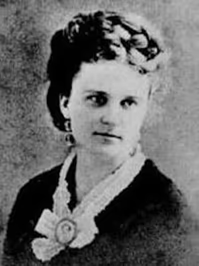
👶 Early Life and Education
Kate Chopin (pronounced "show-PAN") was born Katherine O'Flaherty in St. Louis, Missouri, on February 8, 1850. Her father, Thomas O'Flaherty, was a successful Irish-born businessman, and her mother, Eliza Faris, came from a prominent French Creole family. When Kate was five, her father died in a railroad bridge collapse, and she was raised in a household of strong, independent women — her mother, grandmother, and great-grandmother Victoria Verdon Charleville, who taught her French, music, and storytelling.
Kate was educated at the Academy of the Sacred Heart, a Catholic convent school in St. Louis, where she developed a deep love of reading. She was bookish and imaginative, and graduated in 1868. In 1870, she married Oscar Chopin, a French-born cotton factor from Louisiana.
🏡 Marriage, Louisiana, and Tragedy
After their marriage, Kate and Oscar moved to New Orleans, where they lived for nine years and had six children between 1871 and 1879: Jean Baptiste, Oscar Charles, George Francis, Frederick, Felix Andrew, and Lélia. In 1879, Oscar's cotton business failed, and the family relocated to Cloutierville, a small town in Natchitoches Parish, Louisiana, where Oscar ran a general store and a small plantation.
 These years in Louisiana's Creole and Cajun communities would profoundly shape her fiction. The dialects, customs, and social dynamics of bayou country became the living material of her stories. But in December 1882, Oscar died of malaria at age thirty-four, leaving Kate a widow with six children.
Chopin managed Oscar's store and plantation for over a year before her mother convinced her to return to St. Louis. Tragically, her mother died shortly after Kate's return, plunging her into deep grief. It was her obstetrician and family friend, Dr. Frederick Kolbenheyer, who encouraged her to channel her sorrow into writing — advice that would alter the course of American literature.
✏️ Literary Career
Chopin published her first poem, "If It Might Be," in 1889, and her first short story that same year. By the early 1890s she was writing prolifically, publishing in Vogue, The Atlantic Monthly, The Century, and Harper's Young People.
Her first novel, At Fault (1890), was self-published after being rejected by publishers. It tells the story of a Louisiana widow navigating love, morality, and independence — themes that would define Chopin's entire body of work.
Her short stories were collected in two major volumes: Bayou Folk (1894), containing 23 stories including Désirée's Baby, and A Night in Acadie (1897), containing 21 stories including Regret and A Respectable Woman. A planned third collection, A Vocation and a Voice, was accepted by a publisher but cancelled without explanation; it was not published until 1991.
📖 The Awakening and the Controversy
 Her masterpiece, The Awakening (1899) — originally titled A Solitary Soul — follows Edna Pontellier, a woman who struggles against the confines of marriage and motherhood to find her own identity. The novel was roundly condemned upon publication for its frank depiction of female sexuality and desire. Critics called it "morbid" and "essentially vulgar," and the negative reception devastated Chopin. The book went out of print for more than fifty years.
🌿 Writing Style and Influences
Chopin's writing was profoundly influenced by the French short story master . Commenting on this influence, she wrote: "...I read his stories and marveled at them. Here was life, not fiction; for where were the plots, the old fashioned mechanism and stage trapping that in a vague, unthinkable way I had fancied were essential to the art of story making. Here was a man who had escaped from tradition and authority, who had entered into himself and looked out upon life through his own being and with his own eyes; and who, in a direct and simple way, told us what he saw." [source: Jane Le Marquand, Deep South (1996)]
Her prose style is realistic and economical — direct sentences, restrained emotion, precise observation. She drew on her Irish and French ancestry and her years among Louisiana's Creole and Cajun communities to create fiction that is at once regional and universal. Slavery, race, class, and women's autonomy are woven through her work with subtlety rather than polemic.
✨ Notable Works
Among her most celebrated short stories: The Story of an Hour (1894), a masterpiece of irony and compression in which a wife's reaction to news of her husband's death reveals the hidden cost of her marriage — readers should note how closely this mirrors Chopin's own transformation after the death of her husband Oscar. Désirée's Baby (1893) confronts race and identity in the antebellum South with a devastating twist ending. The Storm (1898), a sequel to At the 'Cadian Ball, was so sexually explicit that Chopin never attempted to publish it in her lifetime. And Regret (1897) — a story blessed with love and borne from a mother's heart — balances the scale with its embrace of tenderness and domestic devotion.
❤️ Death and Legacy
On August 20, 1904, after a day at the St. Louis World's Fair, Kate Chopin suffered a cerebral hemorrhage. She died two days later, on August 22, 1904, at the age of fifty-four. She was buried in Calvary Cemetery in St. Louis.
Her work was largely forgotten for decades after her death. Then in 1969, Norwegian scholar Per Seyersted published a biography and the first edition of her Complete Works, sparking a dramatic reassessment. Feminist scholars recognized The Awakening as a masterwork decades ahead of its time, and today it is one of the most widely taught novels in American literature.
But it would be a grave mistake to dismiss Chopin as exclusively "a feminist" writer. She was a first-class writer whose ability to raise life from a blank page knows few equals. Prepare your heart and your brain before reading — she demands both.
Readers interested in the feminist aspects of Kate Chopin's works will also wish to investigate plays and short stories from and 's semi-autobiographical sketch The Yellow Wallpaper. Visit our Feminist Literature Study Guide and the African American Library for more details about the writing and figures who helped shape America.
⭐ Interesting Facts
- Despite the similar surname, Kate Chopin was not related to the Polish-French composer Frédéric Chopin.
- She wrote approximately 100 short stories, two novels, and twenty poems between 1889 and 1904.
- Her second novel, Young Dr. Gosse and Théo, was rejected by every publisher she tried; she destroyed the manuscript.
- The Awakening has been translated into over twenty languages including Albanian, Arabic, Chinese, Japanese, Korean, and Russian.
- She ran her late husband's general store and plantation for over a year — highly unusual for a widow in the 1880s South.