Caline
by Kate Chopin
Helpful vocabulary terms before you read:
French > except to say that they came from "loin là bas," and were going "Djieu sait é où."
English> except to say that they came from "far away" and were going "God knows where."
A lagniappe is "a small gift given to a customer by a merchant at the time of a purchase", or more broadly, "something given or obtained gratuitously or by way of good measure."
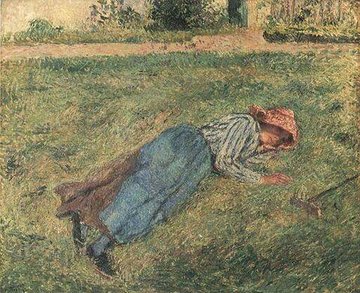
THE sun was just far enough in the west to send inviting shadows. In the centre of a small field, and in the shade of a haystack which was there, a girl lay sleeping. She had slept long and soundly, when something awoke her as suddenly as if it had been a blow. She opened her eyes and stared a moment up in the cloudless sky. She yawned and stretched her long brown legs and arms, lazily. Then she arose, never minding the bits of straw that clung to her black hair, to her red bodice, and the blue cotonade skirt that did not reach her naked ankles.
The log cabin in which she dwelt with her parents was just outside the enclosure in which she had been sleeping. Beyond was a small clearing that did duty as a cotton field. All else was dense wood, except the long stretch that curved round the brow of the hill, and in which glittered the steel rails of the Texas and Pacific road.
When Caline emerged from the shadow she saw a long train of passenger coaches standing in view, where they must have stopped abruptly. It was that sudden stopping which had awakened her; for such a thing had not happened before within her recollection, and she looked stupid, at first, with astonishment. There seemed to be something wrong with the engine; and some of the passengers who dismounted went forward to investigate the trouble. Others came strolling along in the direction of the cabin, where Caline stood under an old gnarled mulberry tree, staring. Her father had halted his mule at the end of the cotton row, and stood staring also, leaning upon his plow.
There were ladies in the party. They walked awkwardly in their high-heeled boots over the rough, uneven ground, and held up their skirts mincingly. They twirled parasols over their shoulders, and laughed immoderately at the funny things which their masculine companions were saying.
They tried to talk to Caline, but could not understand the French patois with which she answered them.
One of the men - a pleasant-faced youngster - drew a sketch book from his pocket and began to make a picture of the girl. She stayed motionless, her hands behind her, and her wide eyes fixed earnestly upon him.
Before he had finished there was a summons from the train; and all went scampering hurriedly away. The engine screeched, it sent a few lazy puffs into the still air, and in another moment or two had vanished, bearing its human cargo with it.
Caline could not feel the same after that. She looked with new and strange interest upon the trains of cars that passed so swiftly back and forth across her vision, each day; and wondered whence these people came, and whither they were going.
Her mother and father could not tell her, except to say that they came from “loin là bas,” and were going “Djieu sait é où.”
One day she walked miles down the track to talk with the old flagman, who stayed down there by the big water tank. Yes, he knew. Those people came from the great cities in the north, and were going to the city in the south. He knew all about the city; it was a grand place. He had lived there once. His sister lived there now; and she would be glad enough to have so fine a girl as Caline to help her cook and scrub, and tend the babies. And he thought Caline might earn as much as five dollars a month, in the city.
So she went; in a new cotonade, and her Sunday shoes; with a sacredly guarded scrawl that the flagman sent to his sister.
The woman lived in a tiny, stuccoed house, with green blinds, and three wooden steps leading down to the banquette. There seemed to be hundreds like it along the street. Over the house tops loomed the tall masts of ships, and the hum of the French market could be heard on a still morning.
Caline was at first bewildered. She had to readjust all her preconceptions to fit the reality of it. The flagman's sister was a kind and gentle task-mistress. At the end of a week or two she wanted to know how the girl liked it all. Caline liked it very well, for it was pleasant, on Sunday afternoons, to stroll with the children under the great, solemn sugar sheds; or to sit upon the compressed cotton bales, watching the stately steamers, the graceful boats, and noisy little tugs that plied the waters of the Mississippi. And it filled her with agreeable excitement to go to the French market, where the handsome Gascon butchers were eager to present their compliments and little Sunday bouquets to the pretty Acadian girl; and to throw fistfuls of lagniappe into her basket.
When the woman asked her again after another week if she were still pleased, she was not so sure. And again when she questioned Caline the girl turned away, and went to sit behind the big, yellow cistern, to cry unobserved. For she knew now that it was not the great city and its crowds of people she had so eagerly sought; but the pleasant-faced boy, who had made her picture that day under the mulberry tree.
This story is featured in our collection of Short-Short Stories to read when you have five minutes to spare.
Frequently Asked Questions about Caline
What is "Caline" by Kate Chopin about?
Caline tells the story of a young Cajun girl living in rural Louisiana who is awakened from a nap when a passenger train unexpectedly stops near her family's log cabin. Among the passengers is a pleasant-faced young man who sketches her portrait. After the train departs, Caline becomes consumed with curiosity about the world beyond her small clearing and eventually travels to New Orleans to work as a domestic servant. Though she initially enjoys the sights of the city — the Mississippi River steamers, the French Market, the Gascon butchers — she gradually realizes that what she truly longed for was not the city itself but the young man who drew her picture under the mulberry tree.
What are the main themes of "Caline" by Kate Chopin?
The central theme of Caline is desire versus reality — Caline mistakes a romantic longing for a desire for adventure and city life, only to discover her true feelings too late. The story also explores the theme of awakening, a signature concern of 's fiction: Caline's encounter with the train passengers stirs new awareness in her, pulling her from the innocence of childhood into the first stirrings of womanhood. Additional themes include social class and isolation, as the gulf between Caline's barefoot rural existence and the parasol-twirling city visitors underscores the vast inequalities of late-nineteenth-century Louisiana, and the tension between tradition and progress, symbolized by the railroad cutting through Caline's pastoral world.
What does the train symbolize in "Caline"?
The train in Caline symbolizes progress, change, and the allure of the unknown. Before the train stops, Caline's world is bounded by her family's cabin, the cotton field, and the dense surrounding woods. The sudden appearance of the passengers — with their fine clothes, parasols, and incomprehensible English — represents a window into a world she never knew existed. After the encounter, the daily passing trains become objects of fascination, each one carrying the promise of something beyond her experience. The train also functions as a symbol of disruption: it awakens Caline literally from sleep and figuratively from the unconscious contentment of her isolated life. Notably, the train brings people into Caline's world only to snatch them away, mirroring the fleeting nature of the connection she felt with the young artist.
What happens at the end of "Caline" and what does the ending mean?
At the end of the story, Caline sits behind a large yellow cistern and cries. She has come to understand that it was not the great city and its crowds of people she had so eagerly sought, but "the pleasant-faced boy, who had made her picture that day under the mulberry tree." The ending is a moment of bittersweet self-knowledge — Caline finally recognizes her true desire, but that recognition comes with the realization that the young man is forever out of reach. leaves the story unresolved, never revealing whether Caline returns home or remains in the city, emphasizing the poignancy of a longing that can neither be fulfilled nor fully understood by a girl on the threshold of adulthood.
When was "Caline" by Kate Chopin written and published?
wrote Caline on December 2, 1892. It was first published in Vogue magazine on May 20, 1893, and was later collected in her 1897 anthology A Night in Acadie. The story belongs to Chopin's prolific early period in which she produced dozens of short stories drawing on her experiences living in Cloutierville, Louisiana, among the Creole and Cajun communities that populate so much of her fiction. At roughly 1,000 words, it is one of her more compressed works — closer in form to a sketch or vignette than a traditional short story.
What literary devices does Kate Chopin use in "Caline"?
employs several literary devices in Caline. Irony is the most prominent: Caline believes she is drawn to the excitement of city life, but discovers that her real longing was for a person, not a place. Symbolism pervades the story — the train represents progress and the outside world, the mulberry tree marks the site of Caline's awakening, and the yellow cistern behind which she cries suggests the confined domestic world she now inhabits. Chopin also uses sensory detail to contrast Caline's two worlds: the rural opening scene is rendered in natural imagery (haystack, cotton field, cloudless sky) while the city scenes feature steamers, compressed cotton bales, and the hum of the French Market. Foreshadowing appears in the flagman's modest promise that Caline "might earn as much as five dollars a month" — hinting that the reality of city life will fall far short of her romantic expectations.
What is the moral lesson of "Caline"?
The moral lesson of Caline is that we sometimes misidentify the source of our own desires. Caline is stirred by her encounter with the young artist but interprets her feelings as a longing for the wider world rather than recognizing them as a first experience of romantic attraction. She uproots her entire life based on this misunderstanding, only to find that no amount of city excitement can satisfy what was always a personal, emotional need. The story cautions against making life-altering decisions based on feelings we do not yet fully understand, while also acknowledging with compassion that such misreadings are a natural part of growing up. treats Caline's mistake with sympathy rather than judgment, portraying it as an inevitable consequence of innocence encountering experience for the first time.
How does "Caline" connect to Kate Chopin's other works?
Caline shares key concerns with many of 's other stories and her novel The Awakening. Like The Story of an Hour and A Respectable Woman, it centers on a woman's sudden recognition of desires she had not previously acknowledged. The Cajun and Creole Louisiana setting connects it to stories such as At the 'Cadian Ball and Beyond the Bayou, which also explore characters at the boundary between an insular rural world and the forces of modernity. Caline's journey from unconscious contentment to painful self-awareness prefigures the more complex awakening of Edna Pontellier in Chopin's masterwork, making it a compact early study of the theme that would define her literary legacy.
Who is Caline and what is her background?
Caline is a young Acadian (Cajun) girl living with her parents in a log cabin near the Texas and Pacific Railroad in rural Louisiana. She speaks only French patois and cannot communicate with the English-speaking train passengers who briefly enter her world. Her daily existence is shaped by the rhythms of subsistence farming — her father plows a small cotton field — and the dense woods that surround the family's small clearing. She is depicted as unselfconscious and natural: she sleeps in a haystack with straw in her hair, wears a red bodice and a blue cotonade skirt that does not reach her bare ankles. When she later moves to New Orleans, the Gascon butchers at the French Market find her attractive and offer her bouquets and lagniappe, suggesting she is a pretty young woman only beginning to understand her own appeal. Her name, Caline, evokes the French word câline, meaning "affectionate" or "cuddly" — a fitting name for a character whose story revolves around an unspoken emotional longing.
What is the significance of the setting in "Caline"?
The setting of Caline is central to its meaning. The story opens in the isolated Louisiana countryside — a log cabin, a haystack, a cotton field, dense woods — establishing a world of quiet simplicity. The only intrusion of modernity is the Texas and Pacific Railroad, whose steel rails glitter on the brow of a nearby hill. This juxtaposition of pastoral isolation and industrial connection creates the tension that drives the plot: the railroad is simultaneously part of Caline's landscape and a conduit to a world she cannot access. When Caline moves to New Orleans, Chopin renders the city through vivid regional details — the stuccoed houses with green blinds, the tall masts of ships, the French Market, the sugar sheds along the Mississippi — grounding the story in the specific geography of late-nineteenth-century Louisiana. The contrast between the two settings underscores the story's theme of displacement: Caline belongs to neither world completely, having left the rural life she outgrew but unable to find in the city what she truly seeks.
Save stories, build your reading list, and access all study tools — completely free.
Save Caline to your library — it's free!Need help with Caline?
Study tools to help with homework, prepare for quizzes, and deepen your understanding.
Flashcards →