The Californian's Tale
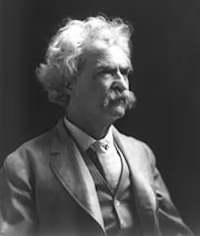
by Mark Twain
The Californian's Tale is a poignant story set in a lonely mining settlement, where a man's elaborate preparations for his wife's return conceal a heartbreaking secret that his neighbors work together to protect. "Nineteen years she's been gone, now."
Thirty-five years ago I was out prospecting on the Stanislaus, tramping all day long with pick and pan and horn, and washing a hatful of dirt here and there, always expecting to make a rich strike, and never doing it. It was a lovely reason, woodsy, balmy, delicious, and had once been populous, long years before, but now the people had vanished and the charming paradise was a solitude. They went away when the surface diggings gave out. In one place, where a busy little city with banks and newspapers and fire companies and a mayor and aldermen had been, was nothing but a wide expanse of emerald turf, with not even the faintest sign that human life had ever been present there. This was down toward Tuttletown. In the country neighborhood thereabouts, along the dusty roads, one found at intervals the prettiest little cottage homes, snug and cozy, and so cobwebbed with vines snowed thick with roses that the doors and windows were wholly hidden from sight--sign that these were deserted homes, forsaken years ago by defeated and disappointed families who could neither sell them nor give them away. Now and then, half an hour apart, one came across solitary log cabins of the earliest mining days, built by the first gold-miners, the predecessors of the cottage-builders. In some few cases these cabins were still occupied; and when this was so, you could depend upon it that the occupant was the very pioneer who had built the cabin; and you could depend on another thing, too--that he was there because he had once had his opportunity to go home to the States rich, and had not done it; had rather lost his wealth, and had then in his humiliation resolved to sever all communication with his home relatives and friends, and be to them thenceforth as one dead. Round about California in that day were scattered a host of these living dead men-- pride-smitten poor fellows, grizzled and old at forty, whose secret thoughts were made all of regrets and longings--regrets for their wasted lives, and longings to be out of the struggle and done with it all.
It was a lonesome land! Not a sound in all those peaceful expanses of grass and woods but the drowsy hum of insects; no glimpse of man or beast; nothing to keep up your spirits and make you glad to be alive. And so, at last, in the early part of the afternoon, when I caught sight of a human creature, I felt a most grateful uplift. This person was a man about forty-five years old, and he was standing at the gate of one of those cozy little rose-clad cottages of the sort already referred to. However, this one hadn't a deserted look; it had the look of being lived in and petted and cared for and looked after; and so had its front yard, which was a garden of flowers, abundant, gay, and flourishing. I was invited in, of course, and required to make myself at home-- it was the custom of the country..
It was delightful to be in such a place, after long weeks of daily and nightly familiarity with miners' cabins--with all which this implies of dirt floor, never-made beds, tin plates and cups, bacon and beans and black coffee, and nothing of ornament but war pictures from the Eastern illustrated papers tacked to the log walls. That was all hard, cheerless, materialistic desolation, but here was a nest which had aspects to rest the tired eye and refresh that something in one's nature which, after long fasting, recognizes, when confronted by the belongings of art, howsoever cheap and modest they may be, that it has unconsciously been famishing and now has found nourishment. I could not have believed that a rag carpet could feast me so, and so content me; or that there could be such solace to the soul in wall-paper and framed lithographs, and bright-colored tidies and lamp-mats, and Windsor chairs, and varnished what-nots, with sea-shells and books and china vases on them, and the score of little unclassifiable tricks and touches that a woman's hand distributes about a home, which one sees without knowing he sees them, yet would miss in a moment if they were taken away. The delight that was in my heart showed in my face, and the man saw it and was pleased; saw it so plainly that he answered it as if it had been spoken.
"All her work," he said, caressingly; "she did it all herself-- every bit," and he took the room in with a glance which was full of affectionate worship. One of those soft Japanese fabrics with which women drape with careful negligence the upper part of a picture-frame was out of adjustment. He noticed it, and rearranged it with cautious pains, stepping back several times to gauge the effect before he got it to suit him. Then he gave it a light finishing pat or two with his hand, and said: "She always does that. You can't tell just what it lacks, but it does lack something until you've done that--you can see it yourself after it's done, but that is all you know; you can't find out the law of it. It's like the finishing pats a mother gives the child's hair after she's got it combed and brushed, I reckon. I've seen her fix all these things so much that I can do them all just her way, though I don't know the law of any of them. But she knows the law. She knows the why and the how both; but I don't know the why; I only know the how."
He took me into a bedroom so that I might wash my hands; such a bedroom as I had not seen for years: white counterpane, white pillows, carpeted floor, papered walls, pictures, dressing-table, with mirror and pin-cushion and dainty toilet things; and in the corner a wash-stand, with real china-ware bowl and pitcher, and with soap in a china dish, and on a rack more than a dozen towels--towels too clean and white for one out of practice to use without some vague sense of profanation. So my face spoke again, and he answered with gratified words:
"All her work; she did it all herself--every bit. Nothing here that hasn't felt the touch of her hand. Now you would think-- But I mustn't talk so much."
By this time I was wiping my hands and glancing from detail to detail of the room's belongings, as one is apt to do when he is in a new place, where everything he sees is a comfort to his eye and his spirit; and I became conscious, in one of those unaccountable ways, you know, that there was something there somewhere that the man wanted me to discover for myself. I knew it perfectly, and I knew he was trying to help me by furtive indications with his eye, so I tried hard to get on the right track, being eager to gratify him. I failed several times, as I could see out of the corner of my eye without being told; but at last I knew I must be looking straight at the thing--knew it from the pleasure issuing in invisible waves from him. He broke into a happy laugh, and rubbed his hands together, and cried out:
"That's it! You've found it. I knew you would. It's her picture."
I went to the little black-walnut bracket on the farther wall, and did find there what I had not yet noticed--a daguerreotype-case. It contained the sweetest girlish face, and the most beautiful, as it seemed to me, that I had ever seen. The man drank the admiration from my face, and was fully satisfied.
"Nineteen her last birthday," he said, as he put the picture back; "and that was the day we were married. When you see her--ah, just wait till you see her!"
"Where is she? When will she be in?"
"Oh, she's away now. She's gone to see her people. They live forty or fifty miles from here. She's been gone two weeks today."
"When do you expect her back?"
"This is Wednesday. She'll be back Saturday, in the evening-- about nine o'clock, likely."
I felt a sharp sense of disappointment.
"I'm sorry, because I'll be gone then," I said, regretfully.
"Gone? No--why should you go? Don't go. She'll be disappointed."
She would be disappointed--that beautiful creature! If she had said the words herself they could hardly have blessed me more. I was feeling a deep, strong longing to see her--a longing so supplicating, so insistent, that it made me afraid. I said to myself: "I will go straight away from this place, for my peace of mind's sake."
"You see, she likes to have people come and stop with us-- people who know things, and can talk--people like you. She delights in it; for she knows--oh, she knows nearly everything herself, and can talk, oh, like a bird--and the books she reads, why, you would be astonished. Don't go; it's only a little while, you know, and she'll be so disappointed."
I heard the words, but hardly noticed them, I was so deep in my thinkings and strugglings. He left me, but I didn't know. Presently he was back, with the picture case in his hand, and he held it open before me and said:
"There, now, tell her to her face you could have stayed to see her, and you wouldn't."
That second glimpse broke down my good resolution. I would stay and take the risk. That night we smoked the tranquil pipe, and talked till late about various things, but mainly about her; and certainly I had had no such pleasant and restful time for many a day. The Thursday followed and slipped comfortably away. Toward twilight a big miner from three miles away came--one of the grizzled, stranded pioneers--and gave us warm salutation, clothed in grave and sober speech. Then he said:
"I only just dropped over to ask about the little madam, and when is she coming home. Any news from her?"
"Oh, yes, a letter. Would you like to hear it, Tom?"
"Well, I should think I would, if you don't mind, Henry!"
Henry got the letter out of his wallet, and said he would skip some of the private phrases, if we were willing; then he went on and read the bulk of it--a loving, sedate, and altogether charming and gracious piece of handiwork, with a postscript full of affectionate regards and messages to Tom, and Joe, and Charley, and other close friends and neighbors.
As the reader finished, he glanced at Tom, and cried out:
"Oho, you're at it again! Take your hands away, and let me see your eyes. You always do that when I read a letter from her. I will write and tell her."
"Oh no, you mustn't, Henry. I'm getting old, you know, and any little disappointment makes me want to cry. I thought she'd be here herself, and now you've got only a letter."
"Well, now, what put that in your head? I thought everybody knew she wasn't coming till Saturday."
"Saturday! Why, come to think, I did know it. I wonder what's the matter with me lately? Certainly I knew it. Ain't we all getting ready for her? Well, I must be going now. But I'll be on hand when she comes, old man!"
Late Friday afternoon another gray veteran tramped over from his cabin a mile or so away, and said the boys wanted to have a little gaiety and a good time Saturday night, if Henry thought she wouldn't be too tired after her journey to be kept up.
"Tired? She tired! Oh, hear the man! Joe, you know she'd sit up six weeks to please any one of you!"
When Joe heard that there was a letter, he asked to have it read, and the loving messages in it for him broke the old fellow all up; but he said he was such an old wreck that that would happen to him if she only just mentioned his name. "Lord, we miss her so!" he said.
Saturday afternoon I found I was taking out my watch pretty often. Henry noticed it, and said, with a startled look:
"You don't think she ought to be here soon, do you?"
I felt caught, and a little embarrassed; but I laughed, and said it was a habit of mine when I was in a state of expenctancy. But he didn't seem quite satisfied; and from that time on he began to show uneasiness. Four times he walked me up the road to a point whence we could see a long distance; and there he would stand, shading his eyes with his hand, and looking. Several times he said:
"I'm getting worried, I'm getting right down worried. I know she's not due till about nine o'clock, and yet something seems to be trying to warn me that something's happened. You don't think anything has happened, do you?"
I began to get pretty thoroughly ashamed of him for his childishness; and at last, when he repeated that imploring question still another time, I lost my patience for the moment, and spoke pretty brutally to him. It seemed to shrivel him up and cow him; and he looked so wounded and so humble after that, that I detested myself for having done the cruel and unnecessary thing. And so I was glad when Charley, another veteran, arrived toward the edge of the evening, and nestled up to Henry to hear the letter read, and talked over the preparations for the welcome. Charley fetched out one hearty speech after another, and did his best to drive away his friend's bodings and apprehensions.
"Anything happened to her? Henry, that's pure nonsense. There isn't anything going to happen to her; just make your mind easy as to that. What did the letter say? Said she was well, didn't it? And said she'd be here by nine o'clock, didn't it? Did you ever know her to fail of her word? Why, you know you never did. Well, then, don't you fret; she'll be here, and that's absolutely certain, and as sure as you are born. Come, now, let's get to decorating-- not much time left."
Pretty soon Tom and Joe arrived, and then all hands set about adoring the house with flowers. Toward nine the three miners said that as they had brought their instruments they might as well tune up, for the boys and girls would soon be arriving now, and hungry for a good, old-fashioned break-down. A fiddle, a banjo, and a clarinet-- these were the instruments. The trio took their places side by side, and began to play some rattling dance-music, and beat time with their big boots.
It was getting very close to nine. Henry was standing in the door with his eyes directed up the road, his body swaying to the torture of his mental distress. He had been made to drink his wife's health and safety several times, and now Tom shouted:
"All hands stand by! One more drink, and she's here!"
Joe brought the glasses on a waiter, and served the party. I reached for one of the two remaining glasses, but Joe growled under his breath:
"Drop that! Take the other."
Which I did. Henry was served last. He had hardly swallowed his drink when the clock began to strike. He listened till it finished, his face growing pale and paler; then he said:
"Boys, I'm sick with fear. Help me--I want to lie down!"
They helped him to the sofa. He began to nestle and drowse, but presently spoke like one talking in his sleep, and said: "Did I hear horses' feet? Have they come?"
One of the veterans answered, close to his ear: "It was Jimmy Parish come to say the party got delayed, but they're right up the road a piece, and coming along. Her horse is lame, but she'll be here in half an hour."
"Oh, I'm so thankful nothing has happened!"
He was asleep almost before the words were out of his mouth. In a moment those handy men had his clothes off, and had tucked him into his bed in the chamber where I had washed my hands. They closed the door and came back. Then they seemed preparing to leave; but I said: "Please don't go, gentlemen. She won't know me; I am a stranger."
They glanced at each other. Then Joe said:
"She? Poor thing, she's been dead nineteen years!"
"Dead?"
"That or worse. She went to see her folks half a year after she was married, and on her way back, on a Saturday evening, the Indians captured her within five miles of this place, and she's never been heard of since."
"And he lost his mind in consequence?"
"Never has been sane an hour since. But he only gets bad when that time of year comes round. Then we begin to drop in here, three days before she's due, to encourage him up, and ask if he's heard from her, and Saturday we all come and fix up the house with flowers, and get everything ready for a dance. We've done it every year for nineteen years. The first Saturday there was twenty-seven of us, without counting the girls; there's only three of us now, and the girls are gone. We drug him to sleep, or he would go wild; then he's all right for another year--thinks she's with him till the last three or four days come round; then he begins to look for her, and gets out his poor old letter, and we come and ask him to read it to us. Lord, she was a darling!"
Frequently Asked Questions about The Californian's Tale
What is "The Californian's Tale" by Mark Twain about?
The Californian's Tale is a poignant story set in the abandoned gold-mining country of California's Stanislaus River. The narrator, a prospector, stumbles upon a beautifully kept cottage amid miles of desolation and meets its owner, Henry, who proudly shows off his home — especially the feminine touches his wife has added. Henry invites the narrator to stay until Saturday, when his wife will return from a visit to relatives. As the days pass, neighbors Tom, Joe, and Charley arrive to help "celebrate" her return. But on Saturday, instead of the wife appearing, the men pour Henry a drugged glass of whiskey, and the narrator learns the devastating truth: Henry's wife was captured by Native Americans nineteen years ago, and he has never recovered. Every year his friends return to play out this ritual to ease him through the anniversary of her loss.
What is the theme of "The Californian's Tale"?
The primary theme is grief and the inability to accept loss. Henry's mind has created a reality in which his wife is merely away visiting — a permanent psychological defense against unbearable truth. A second theme is compassion and community: Henry's neighbors Tom, Joe, and Charley return every year to participate in his delusion, drugging him into sleep rather than forcing him to confront his wife's death. Their annual ritual is an extraordinary act of sustained kindness. also explores the devastating loneliness of the frontier — the abandoned towns, the "living dead men" who stayed behind, and the isolation that can break even the strongest spirit. The story is unusually dark and emotional for Twain, with no comic relief.
What is the twist ending of "The Californian's Tale"?
The twist is revealed on Saturday evening, when Henry's wife is supposed to arrive. Instead of the wife appearing, Tom and Joe give Henry a glass of whiskey that has been drugged with a sedative. As Henry falls asleep, the narrator — bewildered and alarmed — asks what is happening. Joe explains: Henry's wife was captured by Native Americans nineteen years earlier, and Henry lost his mind from grief. He lives in a permanent delusion that she is merely away on a visit and will return on Saturday. Every year, his friends come to play along with the fiction, celebrating her imminent "return" until they can drug Henry into sleep. "He only gets bad when that time of year comes round," Joe explains. The narrator realizes that everything Henry told him about his wife's habits, her embroidery, her return — all of it was the product of a shattered mind replaying the same scenario endlessly.
What literary devices does Mark Twain use in "The Californian's Tale"?
builds toward the twist with careful craft. Foreshadowing appears in subtle moments: the narrator notices the neighbors seem oddly invested in the wife's return, and their faces show "a shadow of anxiety" that seems out of proportion. Contrast between the desolate landscape and Henry's immaculate cottage creates an eerie dissonance that something is wrong. Dramatic irony operates on rereading: every detail Henry shares about his wife — her arrival time, her habits, her personality — takes on a tragic dimension once the reader knows the truth. The setting of abandoned mining towns full of "living dead men" who lost everything mirrors Henry's condition — he too is a living ghost. The story's restrained tone — no jokes, no comic relief — is itself a device, signaling that this is a different kind of Twain story.
When was "The Californian's Tale" published?
The Californian's Tale was first published in 1893 and was later collected in The $30,000 Bequest and Other Stories (1906). The story draws on 's own experiences prospecting in California's Gold Country in the early 1860s, particularly along the Stanislaus River in Tuolumne County. The setting accurately reflects the post-Gold Rush landscape of the 1890s, when many mining towns had been abandoned for decades. The story is notable as one of Twain's most purely emotional works — a departure from his characteristic humor that demonstrates his range as a writer capable of genuine pathos and psychological insight.
Who is Henry in "The Californian's Tale"?
Henry is a middle-aged man, about forty-five, who lives alone in a beautifully maintained cottage in the abandoned California goldfields. He is warm, hospitable, and eager for company — qualities that initially seem merely friendly but take on a desperate quality as the story progresses. His cottage is filled with feminine touches — embroidery, flowers, careful decoration — which he attributes to his wife. He speaks of her with intense pride and love, reads her letters aloud, and counts the hours until her return on Saturday. The revelation that his wife has been gone for nineteen years reframes everything: Henry is not a happy husband but a man trapped in a permanent psychological loop, reliving the same week of anticipation every year, protected from reality only by the drugged sleep his compassionate neighbors provide.
Save stories, build your reading list, and access all study tools — completely free.
Save The Californian's Tale to your library — it's free!Need help with The Californian's Tale?
Study tools to help with homework, prepare for quizzes, and deepen your understanding.
Flashcards →