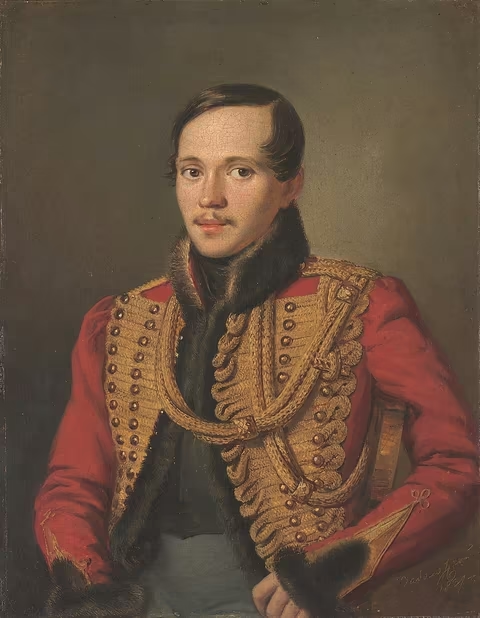
Quick Facts
Mikhail Yuryevich Lermontov
Born: 1814
Died: 1841
Nationality: Russian
Genres: Psychological Fiction, Romanticism, Novel, Poetry
Notable Works: A Hero of Our Time
Mikhail Lermontov (1814–1841)
Mikhail Yuryevich Lermontov (1814–1841) was Russia’s greatest Romantic poet after Pushkin and the author of A Hero of Our Time, widely regarded as the first great Russian novel. Killed in a duel at just twenty-six, Lermontov left behind a body of work that would profoundly shape Russian literature for generations. His penetrating psychological insight, his brooding lyricism, and his creation of the archetypal “superfluous man” in Pechorin made him one of the most influential writers in the Russian canon.
👶 Early Life and Education
Born in Moscow in 1814 to a minor noble family, Lermontov endured a turbulent childhood. His mother died when he was three, and his wealthy grandmother, Elizaveta Arsenyeva, raised him on her estate at Tarkhany, largely cutting his father out of his life. This early loss and family conflict left deep marks on his temperament—a melancholy intensity that would suffuse his poetry and prose. He was educated by private tutors and showed prodigious talent early, writing poetry from the age of fourteen. He attended Moscow University briefly before transferring to the School of Guard Ensigns in Saint Petersburg, where he trained as a military officer.
⚔️ Military Career and Exile
Lermontov’s literary career ignited with a single explosive act. When Alexander Pushkin was killed in a duel in 1837, Lermontov wrote “Death of a Poet,” a furious elegy that accused Russia’s aristocratic elite of complicity in Pushkin’s death. The poem circulated in manuscript across Saint Petersburg and brought Lermontov instant fame—and the wrath of Tsar Nicholas I, who exiled him to the Caucasus with a frontline regiment. The wild mountains, fierce tribal warfare, and dramatic landscapes of the Caucasus became the setting for his masterpiece and much of his finest poetry.
📖 Career and Literary Contributions
Lermontov was both a supreme lyric poet and a revolutionary prose stylist. His poetry—passionate, defiant, and suffused with Romantic longing—earned him the title of Pushkin’s true successor. But it was in prose that he made his most lasting innovation. A Hero of Our Time shattered the conventions of the traditional novel with its fragmented structure, unreliable narration, and ruthlessly honest portrait of its protagonist, Pechorin—a brilliant, bored, self-destructive officer who destroys everyone around him while searching for meaning he can never find. The novel invented the Russian psychological tradition that Dostoevsky and Tolstoy would later bring to its full flowering.
✍️ Notable Works
- A Hero of Our Time (1840)—his masterpiece, a groundbreaking psychological novel told through five interlocking stories about the enigmatic Pechorin
- Demon (1829–1839)—a long narrative poem about a fallen angel who falls in love with a mortal woman, considered one of the supreme achievements of Russian Romantic poetry
- Death of a Poet (1837)—the explosive elegy for Pushkin that made Lermontov famous overnight and earned his exile
- Mtsyri (1840)—a passionate narrative poem about a young monk’s desperate bid for freedom in the Caucasus mountains
- A Song About Tsar Ivan Vasilyevich (1838)—a narrative poem in folk style set during the reign of Ivan the Terrible
- Masquerade (1835)—a verse drama of jealousy and murder in Saint Petersburg high society
❤️ Personal Life and Legacy
Lermontov was recalled from exile but his sharp tongue and provocative manner made powerful enemies. After a quarrel with a fellow officer, Nikolai Martynov, he was challenged to a duel at the foot of Mount Mashuk near Pyatigorsk. On July 27, 1841, Lermontov was shot and killed. He was twenty-six years old. His death, like Pushkin’s four years earlier, was mourned as a catastrophic loss for Russian letters. In his brief career he had written over 400 poems, a novel that changed the course of Russian fiction, and several plays and narrative poems that remain staples of the Russian literary tradition. Dostoevsky, Tolstoy, Chekhov, and Nabokov all acknowledged their debt to his pioneering work.
⭐ Interesting Facts
- Lermontov was also a talented visual artist—his paintings and sketches of Caucasian landscapes are held in Russian museums and show genuine skill.
- He wrote A Hero of Our Time at age twenty-five, making him one of the youngest authors of a universally acknowledged literary masterpiece.
- The city of Pyatigorsk, where Lermontov was killed, has preserved the duel site and his final residence as a museum. The “Lermontov Gallery” is one of the oldest concert halls in Russia.
- Tsar Nicholas I reportedly said upon hearing of Lermontov’s death: “A dog’s death for a dog.” Others in the court responded differently—the Empress wept.
- Nabokov, who translated A Hero of Our Time into English, called it “the first Russian novel worthy of the name.”