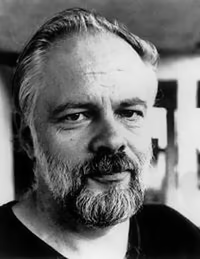
Quick Facts
Philip Kindred Dick
Pen Name: Philip K. Dick
Born: December 16, 1928
Died: March 2, 1982
Nationality: American
Genres: Science Fiction, Speculative Fiction, Dystopian
Notable Works: Do Androids Dream of Electric Sheep?, The Man in the High Castle, Ubik, A Scanner Darkly, VALIS
👶 Early Life
Philip Kindred Dick was born on December 16, 1928, in Chicago, Illinois, alongside his twin sister, Jane Charlotte Dick. Tragically, Jane died just six weeks later on January 26, 1929 — a loss that haunted Dick throughout his life and profoundly shaped his fiction's recurring themes of doubling, absence, and the unseen. His parents, Joseph Edgar Dick and Dorothy Kindred, divorced in 1933, and Dick moved with his mother to the San Francisco Bay Area, where he would spend much of his life.
📚 Education and Early Influences
Dick attended Berkeley High School, where he began devouring the science fiction pulp magazines that would later publish his own work. He briefly enrolled at the University of California, Berkeley in 1949 but dropped out, choosing instead to work at a record store while immersing himself in philosophy, psychology, and classical music. These wide-ranging intellectual interests — from Plato to Carl Jung — became the philosophical bedrock of his fiction.
📖 Literary Career
Dick's first published story, Beyond Lies the Wub, appeared in Planet Stories in July 1952. Over the next three decades, he produced an astonishing body of work: 44 published novels and approximately 121 short stories. His early career was defined by feverish productivity in the science fiction pulp magazines of the 1950s, writing stories for Galaxy Science Fiction, If, Amazing Stories, and Imagination, among others.
His breakthrough came with The Man in the High Castle (1962), an alternate history novel imagining a world where the Axis powers won World War II. It earned him the Hugo Award for Best Novel — one of science fiction's highest honors. Dick followed with a remarkable string of novels throughout the 1960s, including The Three Stigmata of Palmer Eldritch (1965), Do Androids Dream of Electric Sheep? (1968), and Ubik (1969) — the latter named by Time magazine as one of the hundred greatest English-language novels since 1923.
✒️ Notable Works
Among his best-known short stories, Second Variety explores autonomous weapons that evolve beyond human control, while The Hanging Stranger depicts an alien invasion hiding in plain sight. Adjustment Team imagines shadowy forces manipulating everyday reality — a premise later adapted into the film The Adjustment Bureau (2011). Other notable stories include The Eyes Have It, a brief comic masterpiece, and the chilling The Defenders, in which robots conspire to end a nuclear war.
Dick's major novels remain pillars of the science fiction canon. Do Androids Dream of Electric Sheep? asks what separates humans from artificial beings in a world of manufactured empathy. A Scanner Darkly (1977), drawn from Dick's own experiences with drug culture, follows an undercover narcotics agent who can no longer distinguish his true identity from his cover. VALIS (1981), his most autobiographical novel, blurs the line between fiction and revelation.
🌿 Themes and Writing Style
Dick's fiction relentlessly interrogates the nature of reality itself. His characters inhabit worlds where the ground shifts beneath their feet — where memories may be implanted, identities manufactured, and the seemingly solid fabric of everyday life revealed as a carefully maintained illusion. As Dick reflected: "In my writing I even question the universe; I wonder out loud if it is real, and I wonder out loud if all of us are real."
His prose style is deceptively accessible — clear, conversational, and propulsive — yet it carries profound philosophical weight. He has been called the poet of paranoia, presenting unsettling scenarios with such cool rationality that even the sanest reader recognizes something true in his characters' unease. Recurring themes include authoritarian governments, monopolistic corporations, altered states of consciousness, and the thin line between human and artificial intelligence.
❤️ Personal Life
Dick's personal life was turbulent. He married five times: to Jeanette Marlin (1948), Kleo Apostolides (1950), Anne Williams Rubenstein (1959), Nancy Hackett (1966), and Leslie "Tessa" Busby (1973). All five marriages ended in divorce. He had three children: Laura, Isolde (Isa), and Christopher.
Throughout much of his career, Dick struggled with amphetamine use, which fueled both his extraordinary productivity and his deteriorating health. In February 1974, he experienced a series of visions he called "2-3-74" — a transformative mystical experience that consumed his final years and produced the massive, unfinished philosophical work Exegesis, running to over 8,000 handwritten pages.
✨ Death and Legacy
On February 18, 1982, Dick suffered a stroke at his home in Santa Ana, California. Further strokes followed, and he was removed from life support after his brain activity ceased. Philip K. Dick died on March 2, 1982, at the age of 53 — just weeks before the release of Blade Runner, the landmark film adaptation of Do Androids Dream of Electric Sheep? directed by Ridley Scott.
The posthumous recognition Dick never fully received in his lifetime has been extraordinary. Numerous novels and stories have been adapted into major films and television series, including Blade Runner (1982), Total Recall (1990), Minority Report (2002), A Scanner Darkly (2006), The Man in the High Castle (Amazon, 2015–2019), and Philip K. Dick's Electric Dreams (Amazon, 2017–2018). In 2007, the Library of America inducted Dick into its canon — a rare honor for a science fiction writer, placing him alongside Herman Melville, Mark Twain, and Willa Cather.
⭐ Interesting Facts
- Dick wrote 11 novels in a two-year period (1963–1964), sometimes completing a novel in just two weeks.
- He spent most of his career earning very little from his writing — he reportedly earned just $12,000 from all his work in 1974, despite being one of the genre's most prolific authors.
- The annual Philip K. Dick Award, established in 1983, honors the best original science fiction paperback published in the United States.
- Dick's twin sister Jane died at six weeks old. He was eventually buried beside her in Fort Morgan, Colorado — her headstone had always included a space reserved for his name.
- Dick claimed to have been visited by a "vast active living intelligence system" (VALIS) in 1974, an experience that inspired his final trilogy of novels.
Frequently Asked Questions about Philip K. Dick
Where can I find study guides for Philip K. Dick's stories?
We offer free interactive study guides for the following Philip K. Dick stories:
- Second Variety — comprehension questions, vocabulary review, and discussion prompts
- The Eyes Have It — comprehension questions, vocabulary review, and discussion prompts
- The Hanging Stranger — comprehension questions, vocabulary review, and discussion prompts