Beyond Lies the Wub
by Philip K. Dick
Beyond Lies the Wub was Philip K. Dick's first published story. Planet Stories July, 1952.
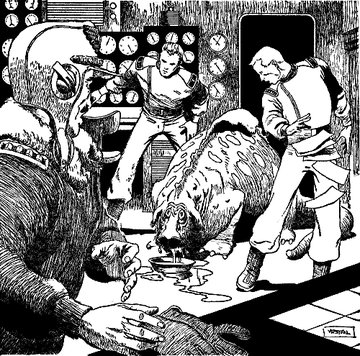
The slovenly wub might well have said: Many men
talk like philosophers and live like fools.
They had almost finished with the loading. Outside stood the Optus, his arms folded, his face sunk in gloom. Captain Franco walked leisurely down the gangplank, grinning.
"What's the matter?" he said. "You're getting paid for all this."
The Optus said nothing. He turned away, collecting his robes. The Captain put his boot on the hem of the robe.
"Just a minute. Don't go off. I'm not finished."
"Oh?" The Optus turned with dignity. "I am going back to the village." He looked toward the animals and birds being driven up the gangplank into the spaceship. "I must organize new hunts."
Franco lit a cigarette. "Why not? You people can go out into the veldt and track it all down again. But when we run out halfway between Mars and Earth—"
The Optus went off, wordless. Franco joined the first mate at the bottom of the gangplank.
"How's it coming?" he said. He looked at his watch. "We got a good bargain here."
The mate glanced at him sourly. "How do you explain that?"
"What's the matter with you? We need it more than they do."
"I'll see you later, Captain." The mate threaded his way up the plank, between the long-legged Martian go-birds, into the ship. Franco watched him disappear. He was just starting up after him, up the plank toward the port, when he saw it.
"My God!" He stood staring, his hands on his hips. Peterson was walking along the path, his face red, leading it by a string.
"I'm sorry, Captain," he said, tugging at the string. Franco walked toward him.
"What is it?"
The wub stood sagging, its great body settling slowly. It was sitting down, its eyes half shut. A few flies buzzed about its flank, and it switched its tail.
It sat. There was silence.
"It's a wub," Peterson said. "I got it from a native for fifty cents. He said it was a very unusual animal. Very respected."
"This?" Franco poked the great sloping side of the wub. "It's a pig! A huge dirty pig!"
"Yes sir, it's a pig. The natives call it a wub."
"A huge pig. It must weigh four hundred pounds." Franco grabbed a tuft of the rough hair. The wub gasped. Its eyes opened, small and moist. Then its great mouth twitched.
A tear rolled down the wub's cheek and splashed on the floor.
"Maybe it's good to eat," Peterson said nervously.
"We'll soon find out," Franco said.
* * * * *
The wub survived the take-off, sound asleep in the hold of the ship. When they were out in space and everything was running smoothly, Captain Franco bade his men fetch the wub upstairs so that he might perceive what manner of beast it was.
The wub grunted and wheezed, squeezing up the passageway.
"Come on," Jones grated, pulling at the rope. The wub twisted, rubbing its skin off on the smooth chrome walls. It burst into the ante-room, tumbling down in a heap. The men leaped up.
"Good Lord," French said. "What is it?"
"Peterson says it's a wub," Jones said. "It belongs to him." He kicked at the wub. The wub stood up unsteadily, panting.
"What's the matter with it?" French came over. "Is it going to be sick?"
They watched. The wub rolled its eyes mournfully. It gazed around at the men.
"I think it's thirsty," Peterson said. He went to get some water. French shook his head.
"No wonder we had so much trouble taking off. I had to reset all my ballast calculations."
Peterson came back with the water. The wub began to lap gratefully, splashing the men.
Captain Franco appeared at the door.
"Let's have a look at it." He advanced, squinting critically. "You got this for fifty cents?"
"Yes, sir," Peterson said. "It eats almost anything. I fed it on grain and it liked that. And then potatoes, and mash, and scraps from the table, and milk. It seems to enjoy eating. After it eats it lies down and goes to sleep."
"I see," Captain Franco said. "Now, as to its taste. That's the real question. I doubt if there's much point in fattening it up any more. It seems fat enough to me already. Where's the cook? I want him here. I want to find out—"
The wub stopped lapping and looked up at the Captain.
"Really, Captain," the wub said. "I suggest we talk of other matters."
The room was silent.
"What was that?" Franco said. "Just now."
"The wub, sir," Peterson said. "It spoke."
They all looked at the wub.
"What did it say? What did it say?"
"It suggested we talk about other things."
Franco walked toward the wub. He went all around it, examining it from every side. Then he came back over and stood with the men.
"I wonder if there's a native inside it," he said thoughtfully. "Maybe we should open it up and have a look."
"Oh, goodness!" the wub cried. "Is that all you people can think of, killing and cutting?"
Franco clenched his fists. "Come out of there! Whoever you are, come out!"
Nothing stirred. The men stood together, their faces blank, staring at the wub. The wub swished its tail. It belched suddenly.
"I beg your pardon," the wub said.
"I don't think there's anyone in there," Jones said in a low voice. They all looked at each other.
The cook came in.
"You wanted me, Captain?" he said. "What's this thing?"
"This is a wub," Franco said. "It's to be eaten. Will you measure it and figure out—"
"I think we should have a talk," the wub said. "I'd like to discuss this with you, Captain, if I might. I can see that you and I do not agree on some basic issues."
The Captain took a long time to answer. The wub waited good-naturedly, licking the water from its jowls.
"Come into my office," the Captain said at last. He turned and walked out of the room. The wub rose and padded after him. The men watched it go out. They heard it climbing the stairs.
"I wonder what the outcome will be," the cook said. "Well, I'll be in the kitchen. Let me know as soon as you hear."
"Sure," Jones said. "Sure."
* * * * *
The wub eased itself down in the corner with a sigh. "You must forgive me," it said. "I'm afraid I'm addicted to various forms of relaxation. When one is as large as I—"
The Captain nodded impatiently. He sat down at his desk and folded his hands.
"All right," he said. "Let's get started. You're a wub? Is that correct?"
The wub shrugged. "I suppose so. That's what they call us, the natives, I mean. We have our own term."
"And you speak English? You've been in contact with Earthmen before?"
"No."
"Then how do you do it?"
"Speak English? Am I speaking English? I'm not conscious of speaking anything in particular. I examined your mind—"
"My mind?"
"I studied the contents, especially the semantic warehouse, as I refer to it—"
"I see," the Captain said. "Telepathy. Of course."
"We are a very old race," the wub said. "Very old and very ponderous. It is difficult for us to move around. You can appreciate that anything so slow and heavy would be at the mercy of more agile forms of life. There was no use in our relying on physical defenses. How could we win? Too heavy to run, too soft to fight, too good-natured to hunt for game—"
"How do you live?"
"Plants. Vegetables. We can eat almost anything. We're very catholic. Tolerant, eclectic, catholic. We live and let live. That's how we've gotten along."
The wub eyed the Captain.
"And that's why I so violently objected to this business about having me boiled. I could see the image in your mind—most of me in the frozen food locker, some of me in the kettle, a bit for your pet cat—"
"So you read minds?" the Captain said. "How interesting. Anything else? I mean, what else can you do along those lines?"
"A few odds and ends," the wub said absently, staring around the room. "A nice apartment you have here, Captain. You keep it quite neat. I respect life-forms that are tidy. Some Martian birds are quite tidy. They throw things out of their nests and sweep them—"
"Indeed." The Captain nodded. "But to get back to the problem—"
"Quite so. You spoke of dining on me. The taste, I am told, is good. A little fatty, but tender. But how can any lasting contact be established between your people and mine if you resort to such barbaric attitudes? Eat me? Rather you should discuss questions with me, philosophy, the arts—"
The Captain stood up. "Philosophy. It might interest you to know that we will be hard put to find something to eat for the next month. An unfortunate spoilage—"
"I know." The wub nodded. "But wouldn't it be more in accord with your principles of democracy if we all drew straws, or something along that line? After all, democracy is to protect the minority from just such infringements. Now, if each of us casts one vote—"
The Captain walked to the door.
"Nuts to you," he said. He opened the door. He opened his mouth.
He stood frozen, his mouth wide, his eyes staring, his fingers still on the knob.
The wub watched him. Presently it padded out of the room, edging past the Captain. It went down the hall, deep in meditation.
* * * * *
The room was quiet.
"So you see," the wub said, "we have a common myth. Your mind contains many familiar myth symbols. Ishtar, Odysseus—"
Peterson sat silently, staring at the floor. He shifted in his chair.
"Go on," he said. "Please go on."
"I find in your Odysseus a figure common to the mythology of most self-conscious races. As I interpret it, Odysseus wanders as an individual, aware of himself as such. This is the idea of separation, of separation from family and country. The process of individuation."
"But Odysseus returns to his home." Peterson looked out the port window, at the stars, endless stars, burning intently in the empty universe. "Finally he goes home."
"As must all creatures. The moment of separation is a temporary period, a brief journey of the soul. It begins, it ends. The wanderer returns to land and race...."
The door opened. The wub stopped, turning its great head.
Captain Franco came into the room, the men behind him. They hesitated at the door.
"Are you all right?" French said.
"Do you mean me?" Peterson said, surprised. "Why me?"
Franco lowered his gun. "Come over here," he said to Peterson. "Get up and come here."
There was silence.
"Go ahead," the wub said. "It doesn't matter."
Peterson stood up. "What for?"
"It's an order."
Peterson walked to the door. French caught his arm.
"What's going on?" Peterson wrenched loose. "What's the matter with you?"
Captain Franco moved toward the wub. The wub looked up from where it lay in the corner, pressed against the wall.
"It is interesting," the wub said, "that you are obsessed with the idea of eating me. I wonder why."
"Get up," Franco said.
"If you wish." The wub rose, grunting. "Be patient. It is difficult for me." It stood, gasping, its tongue lolling foolishly.
"Shoot it now," French said.
"For God's sake!" Peterson exclaimed. Jones turned to him quickly, his eyes gray with fear.
"You didn't see him—like a statue, standing there, his mouth open. If we hadn't come down, he'd still be there."
"Who? The Captain?" Peterson stared around. "But he's all right now."
They looked at the wub, standing in the middle of the room, its great chest rising and falling.
"Come on," Franco said. "Out of the way."
The men pulled aside toward the door.
"You are quite afraid, aren't you?" the wub said. "Have I done anything to you? I am against the idea of hurting. All I have done is try to protect myself. Can you expect me to rush eagerly to my death? I am a sensible being like yourselves. I was curious to see your ship, learn about you. I suggested to the native—"
The gun jerked.
"See," Franco said. "I thought so."
The wub settled down, panting. It put its paw out, pulling its tail around it.
"It is very warm," the wub said. "I understand that we are close to the jets. Atomic power. You have done many wonderful things with it—technically. Apparently, your scientific hierarchy is not equipped to solve moral, ethical—"
Franco turned to the men, crowding behind him, wide-eyed, silent.
"I'll do it. You can watch."
French nodded. "Try to hit the brain. It's no good for eating. Don't hit the chest. If the rib cage shatters, we'll have to pick bones out."
"Listen," Peterson said, licking his lips. "Has it done anything? What harm has it done? I'm asking you. And anyhow, it's still mine. You have no right to shoot it. It doesn't belong to you."
Franco raised his gun.
"I'm going out," Jones said, his face white and sick. "I don't want to see it."
"Me, too," French said. The men straggled out, murmuring. Peterson lingered at the door.
"It was talking to me about myths," he said. "It wouldn't hurt anyone."
He went outside.
Franco walked toward the wub. The wub looked up slowly. It swallowed.
"A very foolish thing," it said. "I am sorry that you want to do it. There was a parable that your Saviour related—"
It stopped, staring at the gun.
"Can you look me in the eye and do it?" the wub said. "Can you do that?"
The Captain gazed down. "I can look you in the eye," he said. "Back on the farm we had hogs, dirty razor-back hogs. I can do it."
Staring down at the wub, into the gleaming, moist eyes, he pressed the trigger.
* * * * *
The taste was excellent.
They sat glumly around the table, some of them hardly eating at all. The only one who seemed to be enjoying himself was Captain Franco.
"More?" he said, looking around. "More? And some wine, perhaps."
"Not me," French said. "I think I'll go back to the chart room."
"Me, too." Jones stood up, pushing his chair back. "I'll see you later."
The Captain watched them go. Some of the others excused themselves.
"What do you suppose the matter is?" the Captain said. He turned to Peterson. Peterson sat staring down at his plate, at the potatoes, the green peas, and at the thick slab of tender, warm meat.
He opened his mouth. No sound came.
The Captain put his hand on Peterson's shoulder.
"It is only organic matter, now," he said. "The life essence is gone." He ate, spooning up the gravy with some bread. "I, myself, love to eat. It is one of the greatest things that a living creature can enjoy. Eating, resting, meditation, discussing things."
Peterson nodded. Two more men got up and went out. The Captain drank some water and sighed.
"Well," he said. "I must say that this was a very enjoyable meal. All the reports I had heard were quite true—the taste of wub. Very fine. But I was prevented from enjoying this pleasure in times past."
He dabbed at his lips with his napkin and leaned back in his chair. Peterson stared dejectedly at the table.
The Captain watched him intently. He leaned over.
"Come, come," he said. "Cheer up! Let's discuss things."
He smiled.
"As I was saying before I was interrupted, the role of Odysseus in the myths—"
Peterson jerked up, staring.
"To go on," the Captain said. "Odysseus, as I understand him—"
Frequently Asked Questions about Beyond Lies the Wub
What is "Beyond Lies the Wub" by Philip K. Dick about?
Beyond Lies the Wub follows the crew of a spaceship returning to Earth from Mars. Crewman Peterson buys a massive, pig-like creature called a wub from a Martian native for fifty cents. Captain Franco sees the wub as nothing more than food for the crew's dwindling supplies. But the wub surprises everyone by speaking — it is telepathic, gentle, and deeply philosophical, eager to discuss mythology and the tale of Odysseus rather than face the dinner table. Despite the wub's intelligent pleas for its life, Captain Franco shoots and eats it. In the story's chilling final scene, the Captain resumes the wub's interrupted conversation about Odysseus, implying that the wub's consciousness has transferred into Franco's body.
What is the theme of "Beyond Lies the Wub"?
The central theme of Beyond Lies the Wub is the moral consequences of consuming sentient life. Captain Franco treats the wub as mere livestock despite overwhelming evidence of its intelligence, raising uncomfortable questions about where humans draw the line between food and fellow being. A related theme is identity and the persistence of consciousness — the wub's ability to transfer its mind into the Captain's body suggests that consciousness is not bound to physical form. also critiques human arrogance and anthropocentrism: Franco dismisses the wub because it resembles a pig, unable to see past its appearance to recognize a being that may be intellectually and morally superior. The story anticipates Dick's career-long obsession with the question of what truly makes someone — or something — human.
Was "Beyond Lies the Wub" Philip K. Dick's first published story?
Yes, Beyond Lies the Wub was 's first published science fiction story, appearing in the July 1952 issue of Planet Stories magazine. However, it was not the first story Dick wrote or sold — that distinction belongs to "Roog," a fantasy story that Dick sold earlier but which was not published until 1953. Dick was just 23 years old when "Beyond Lies the Wub" appeared in print, launching one of the most influential careers in science fiction. Critics have noted that even this debut story "already encapsulated the whimsical paranoia that characterizes almost all his work in the genre." The story has since been translated into Dutch, French, German, Italian, Polish, and Spanish, and included in more than a dozen anthologies.
What happens at the end of "Beyond Lies the Wub"?
The ending of Beyond Lies the Wub is one of science fiction's most memorable twist conclusions. After Captain Franco shoots the wub and the crew reluctantly eats it for dinner, most of the men are too disturbed to enjoy the meal. The Captain, however, eats heartily and begins speaking in a way that echoes the wub's earlier personality — remarking on the pleasure of eating, resting, and "discussing things." He then tells Peterson, "As I was saying before I was interrupted, the role of Odysseus in the myths —" picking up the exact conversation the wub was having before it was killed. The implication is unmistakable: the wub has transferred its consciousness into the Captain's body. By consuming the wub, Franco has been consumed by it. Some critics suggest the wub may have even allowed itself to be killed in order to obtain a more mobile human body.
What is a wub in Philip K. Dick's story?
The wub is an enormous, pig-like alien creature native to Mars, weighing roughly four hundred pounds with rough hair, small moist eyes, and a drooping tail. Despite its ungainly, slovenly appearance, the wub is remarkably intelligent — it is telepathic, capable of reading minds and learning human language instantly by examining the "semantic warehouse" of a person's brain. It is gentle, philosophical, and "catholic" in its tastes (it can eat almost anything). The wub describes itself as belonging to "a very old race" that evolved mental defenses rather than physical ones because it was too slow and heavy to fight or flee. It can apparently freeze people in place with its mental powers and, most significantly, transfer its consciousness into another body. The wub is deeply interested in mythology, literature, and philosophy, making it one of the most cultured beings in the story.
What literary devices are used in "Beyond Lies the Wub"?
employs several key literary devices in this story. The most prominent is dramatic irony: the wub's attempts to argue for its life through philosophical discourse fall on deaf ears, and the reader senses the tragic outcome before it arrives. Dick uses allusion extensively through the wub's discussion of Odysseus and Homer's Odyssey — the wandering hero who returns home parallels the wub's soul, which travels from body to body. The story delivers a powerful twist ending that reframes everything preceding it. Satire runs throughout, as the supposedly civilized humans prove more brutish than the alien "animal" they consume. There is also rich situational irony in the final scene: Franco, who dismissed the wub as nothing but meat, now is the wub — the consumer has become the consumed.
What is the significance of Odysseus in "Beyond Lies the Wub"?
The wub's repeated references to Odysseus serve as both a literary allusion and a key to understanding the story's deeper meaning. The wub interprets Odysseus as a figure of individuation and separation — a wanderer who leaves home, journeys through strange lands, and ultimately returns. This mirrors the wub's own existence: its consciousness can travel from one body to another, making it a perpetual wanderer like Odysseus. The wub describes the journey as "a temporary period, a brief journey of the soul" that always ends in return. This philosophical framework takes on new meaning at the story's end, when the wub's mind "returns" inside the Captain's body. The Odysseus motif also elevates the wub above its captors — while Franco can only think about butchering, the wub engages with humanity's greatest literature, making its destruction all the more ironic and tragic.
How does "Beyond Lies the Wub" relate to Philip K. Dick's other works?
As 's first published story, Beyond Lies the Wub introduced themes he would explore throughout his entire career. The question of what constitutes genuine humanity — central here in the contrast between the cultured wub and the brutish Captain — became the driving force behind novels like Do Androids Dream of Electric Sheep? and stories like Human Is. The theme of consciousness transfer and unstable identity connects to Exhibit Piece and later works like Ubik. Dick even wrote a sequel of sorts, "Not By Its Cover" (1968), in which a wub hide used as a book binding begins altering the text inside. The wub itself has become one of the most recognized symbols of Dick's fiction, lending its name to the first volume of his collected stories.
Save stories, build your reading list, and access all study tools — completely free.
Save Beyond Lies the Wub to your library — it's free!Need help with Beyond Lies the Wub?
Study tools to help with homework, prepare for quizzes, and deepen your understanding.
Flashcards →