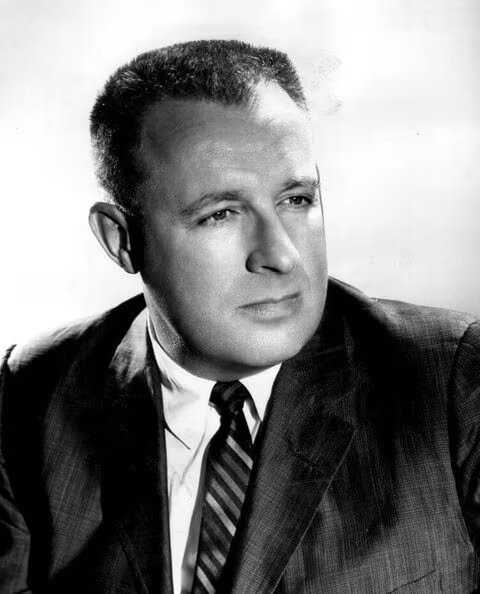
Photo by Alan Light
Quick Facts
Ray Douglas Bradbury
Pen Name: Ray Bradbury
Born: August 22, 1920
Died: June 5, 2012
Nationality: American
Genres: Science Fiction, Fantasy, Horror, Mystery
Notable Works: Fahrenheit 451, The Martian Chronicles, The Illustrated Man, Something Wicked This Way Comes, The October Country
👶 Early Life and Education
Ray Douglas Bradbury (August 22, 1920 – June 5, 2012) was born in Waukegan, Illinois, the third son of Leonard Spaulding Bradbury and Esther Marie Moberg. His childhood in Waukegan — later fictionalized as "Green Town" in his novels — left a lasting imprint on his imagination, filling his work with nostalgia for small-town Midwestern life. In 1934, during the Great Depression, the Bradbury family moved to Los Angeles, California, where Ray would spend the rest of his life.
Bradbury never attended college. Instead, he educated himself at public libraries, later declaring, "Libraries raised me." He spent three days a week at the Los Angeles Public Library for roughly ten years, reading voraciously and teaching himself to write. This self-education gave him an eclectic literary sensibility that blended the poetic with the fantastical.
📖 Career and Literary Breakthrough
Bradbury began writing as a teenager, publishing his first story in a fan magazine in 1938. He quickly moved into the pulp magazine world, selling stories to Weird Tales, Planet Stories, and Thrilling Wonder Stories. Many of these early tales — including The Pendulum (1939), Lazarus Come Forth (1944), and Defense Mech (1946) — are now in the public domain and can be read on this site.
His breakthrough came with The Martian Chronicles (1950), an acclaimed short story cycle portraying humanity's colonization of Mars. Rather than action-heavy sci-fi, Bradbury used lyrical prose and allegory to examine the human condition, cultural conflict, and ecological devastation. Critics praised its blend of mythology, science fiction, and social satire, and the collection elevated him to national prominence.
✒️ Notable Works
Bradbury's most famous novel, Fahrenheit 451 (1953), is a chilling exploration of censorship and conformity set in a dystopian future where books are banned and "firemen" burn any that are found. Its prophetic warnings about technology, censorship, and cultural amnesia remain urgently relevant in the digital age. The novel has been studied in schools and universities worldwide and adapted into film, stage, and radio productions.
The Illustrated Man (1951) is a haunting collection of interconnected short stories framed by a mysterious tattooed man whose living illustrations each tell a tale. Stories like The Veldt and Zero Hour explore technology's impact on human relationships with uncanny foresight.
Other landmark works include The October Country (1955), a collection of dark fantasy tales; Dandelion Wine (1957), a nostalgic novel based on his Illinois boyhood; and Something Wicked This Way Comes (1962), a dark fantasy about a sinister traveling carnival. Bradbury also wrote for television, contributing teleplays to Alfred Hitchcock Presents and The Twilight Zone, and adapted Herman Melville's Moby Dick for director John Huston's 1956 film.
🌿 Writing Style
Bradbury's writing is distinguished by its poetic, lyrical prose — unusual for science fiction. He brought literary flair and psychological depth to speculative fiction, blending sharp social commentary with an emotional warmth that made his work accessible to readers who might never pick up conventional sci-fi. His stories often begin in the ordinary and escalate into the extraordinary, using vivid sensory imagery to create atmosphere. He famously wrote every day of his life, producing over 600 short stories, nearly 30 novels, and dozens of plays, screenplays, and poems across a career spanning more than 70 years.
❤️ Personal Life and Legacy
In 1947, Bradbury married Marguerite "Maggie" McClure, whom he met at a Los Angeles bookstore. They remained married for 56 years until her death in 2003, and had four daughters: Susan, Ramona, Bettina, and Alexandra. Bradbury famously never learned to drive a car and never flew in an airplane, preferring trains and writing to modern transportation — a telling irony for a man who imagined humanity colonizing Mars.
His honors include a Pulitzer Prize Special Citation (2007), the National Medal of Arts (2004), and an Emmy Award. Ray Bradbury died on June 5, 2012, in Los Angeles at the age of 91 from an undisclosed long illness.
Bradbury's legacy extends far beyond genre fiction. He brought speculative themes into mainstream literary culture, influencing generations of writers, filmmakers, and readers. We feature many of his early public domain stories, including Rocket Summer, Asleep in Armageddon, and Pillar of Fire, in our Science Fiction Stories collection.
⭐ Interesting Facts
- Bradbury wrote Fahrenheit 451 in the basement of the UCLA library on a rented typewriter that cost ten cents for every half-hour of use — spending a total of .80 to complete the first draft.
- He never drove a car or flew in an airplane, yet wrote extensively about space travel and future transportation.
- A crater on the Moon is named in his honor (Dandelion Crater), and NASA's Mars rover Curiosity landed at a site named "Bradbury Landing" in 2012.
- He began his career selling newspapers on Los Angeles street corners while writing stories at night.
Frequently Asked Questions about Ray Bradbury
Where can I find study guides for Ray Bradbury's stories?
We offer free interactive study guides for the following Ray Bradbury stories:
- All Summer in a Day — comprehension questions, vocabulary review, and discussion prompts
- Asleep in Armageddon — comprehension questions, vocabulary review, and discussion prompts
- The Pendulum — comprehension questions, vocabulary review, and discussion prompts
- Zero Hour — comprehension questions, vocabulary review, and discussion prompts