The Pendulum
by Ray Bradbury
The Pendulum (1939) is Ray Bradbury's very first published story, co-written with Henry Hasse. A man is strapped to a giant pendulum as punishment by a future society, forced to swing endlessly as a living exhibit — a haunting debut that foreshadows Bradbury's lifelong fascination with technology's dehumanizing potential. "Back and forth, back and forth... and his screaming."
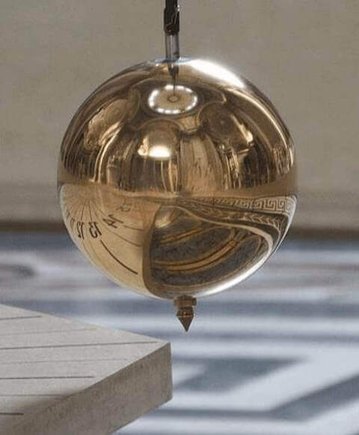
Up and down, back and forth, up and down. First the quick flite skyward, gradually slowing, reaching the pinnacle of the curve, poising a moment, then flashing earthward again, faster and faster at a nauseating speed, reaching the bottom and hurtling aloft on the opposite side. Up and down. Back and forth. Up and down.
How long it had continued this way Layeville didn't know. It might have been millions of years he'd spent sitting here in the massive glass pendulum watching the world tip one way and another, up and down, dizzily before his eyes until they ached. Since first they had locked him in the pendulum's round glass head and set if swinging it had never stopped or changed. Continuous, monotonous movements over and above the ground. So huge was this pendulum that it shadowed one hundred feet or more with every majestic sweep of its gleaming shape, dangling from the metal intestines of the shining machine overhead. It took three or four seconds for it to traverse the one hundred feet one way, three or four seconds to come back.
THE PRISONER OF TIME! That's what they called him now! Now, fettered to the very machine he had planned and constructed. A pri—son—er—of—time! A—pris—on—er—of—Time! With every swing of the pendulum it echoed in his thoughts. For ever like this until he went insane. He tried to focus his eyes on the arching hotness of the earth as it swept past beneath him.
They had laughed at him a few days before. Or was it a week? A month? A year? He didn't know. This ceaseless pitching had filled him with an aching confusion. They had laughed at him when he said, some time before all this, he could bridge time gaps and travel into futurity. He had designed a huge machine to warp space, invited thirty of the worlds most gifted scientists to help him finish his colossal attempt to scratch the future wall of time.
The hour of the accident spun back to him now thru misted memory. The display of the time machine to the public. The exact moment when he stood on the platform with the thirty scientists and pulled the main switch! The scientists, all of them, blasted into ashes from wild electrical flames! Before the eyes of two million witnesses who had come to the laboratory or were tuned in by television at home! He had slain the world's greatest scientists!
He recalled the moment of shocked horror that followed. Something radically wrong had happened to the machine. He, Layeville, the inventor of the machine, had staggered backward, his clothes flaming and eating up about him. No time for explanations. Then he had collapsed in the blackness of pain and numbing defeat.
Swept to a hasty trial, Layeville faced jeering throngs calling out for his death. “Destroy the Time Machine!” they cried. “And destroy this MURDERER with it!”
Murderer! And he had tried to help humanity. This was his reward.
One man had leaped onto the tribunal platform at the trial, crying, “No! Don't destroy the machine! I have a better plan! A revenge for this—this man!” His finger pointed at Layeville where the inventor sat unshaven and haggard, his eyes failure glazed. “We shall rebuild his machine, take his precious metals, and put up a monument to his slaughtering! We'll put him on exhibition for life within his executioning device!” The crowd roared approval like thunder shaking the tribunal hall.
Then, pushing hands, days in prison, months. Finally, led forth into the hot sunshine, he was carried in a small rocket car to the center of the city. The shock of what he saw brought him back to reality. THEY had rebuilt his machine into a towering timepiece with a pendulum. He stumbled forward, urged on by thrusting hands, listening to the roar of thousands of voices damning him. Into the transparent pendulum head they pushed him and clamped it tight with weldings.
Then they set the pendulum swinging and stood back. Slowly, very slowly, it rocked back and forth, increasing in speed. Layeville had pounded futilely at the glass, screaming. The faces became blurred, were only tearing pink blobs before him.
On and on like this—for how long?
He hadn't minded it so much at first, that first nite. He couldn't sleep, but it was not uncomfortable. The lites of the city were comets with tails that pelted from rite to left like foaming fireworks. But as the nite wore on he felt a gnawing in his stomach, that grew worse. He got very sick and vomited. The next day he couldn't eat anything.
They never stopped the pendulum, not once. Instead of letting him eat quietly, they slid the food down the stem of the pendulum in a special tube, in little round parcels that plunked at his feet. The first time he attempted eating he was unsuccessful, it wouldn't stay down. In desperation he hammered against the cold glass with his fists until they bled, crying hoarsely, but he heard nothing but his own weak, fear-wracked words muffled in his ears.
After some time had elapsed he got so that he could eat, even sleep while travelling back and forth this way. They allowed him small glass loops on the floor and leather thongs with which he tied himself down at nite and slept a soundless slumber without sliding.
People came to look at him. He accustomed his eyes to the swift flite and followed their curiosity-etched faces, first close by in the middle, then far away to the right, middle again, and to the left.
He saw the faces gaping, speaking soundless words, laughing and pointing at the prisoner of time traveling forever nowhere. But after awhile the town people vanished and it was only tourists who came and read the sign that said: THIS IS THE PRISONER OF TIME—JOHN LAYEVILLE—WHO KILLED THIRTY OF THE WORLDS FINEST SCIENTISTS! The school children, on the electrical moving sidewalk stopped to stare in childish awe. THE PRISONER OF TIME!
Often he thot of that title. God, but it was ironic, that he should invent a time machine and have it converted into a clock, and that he, in its pendulum, should mete out the years—traveling with Time.
He couldn't remember how long it had been. The days and nites ran together in his memory. His unshaven checks had developed a short beard and then ceased growing. How long a time? How long?
Once a day they sent down a tube after he ate and vacuumed up the cell, disposing of any wastes. Once in a great while they sent him a book, but that was all.
The robots took care of him now. Evidently the humans thot it a waste of time to bother over their prisoner. The robots brot the food, cleaned the pendulum cell, oiled the machinery, worked tirelessly from dawn until the sun crimsoned westward. At this rate it could keep on for centuries.
But one day as Layeville stared at the city and its people in the blur of ascent and descent, he perceived a swarming darkness that extended in the heavens. The city rocket ships that crossed the sky on pillars of scarlet flame darted helplessly, frightenedly for shelter. The people ran like water splashed on tiles, screaming soundlessly. Alien creatures fluttered down, great gelatinous masses of black that sucked out the life of all. They clustered thickly over everything, glistened momentarily upon the pendulum and its body above, over the whirling wheels and roaring bowels of the metal creature once a Time Machine. An hour later they dwindled away over the horizon and never came back. The city was dead.
Up and down, Layeville went on his journey to nowhere, in his prison, a strange smile etched on his lips. In a week or more, he knew, he would be the only man alive on earth.
Elation flamed within him. This was his victory! Where the other men had planned the pendulum as a prison it had been an asylum against annihilation now!
Day after day the robots still came, worked, unabated by the visitation of the black horde. They came every week, brot food, tinkered, checked, oiled, cleaned. Up and down, back and forth—THE PENDULUM!
…a thousand years must have passed before the sky again showed life over the dead Earth. A silvery bullet of space dropped from the clouds, steaming, and hovered over the dead city where now only a few solitary robots performed their tasks. In the gathering dusk the lites of the metropolis glimmered on. Other automatons appeared on the rampways like spiders on twisting webs, scurrying about, checking, oiling, working in their crisp mechanical manner.
And the creatures in the alien projectile found the time mechanism, the pendulum swinging up and down, back and forth, up and down. The robots still cared for it, oiled it, tinkering.
A thousand years this pendulum had swung. Made of glass the round disk at the bottom was, but now when food was lowered by the robots through the tube it lay untouched. Later, when the vacuum tube came down and cleaned out the cell it took that very food with it.
Back and forth—up and down.
The visitors saw something inside the pendulum. Pressed closely to the glass side of the cell was the face of a whitened skull—a skeleton visage that stared out over the city with empty sockets and an enigmatical smile wreathing its lipless teeth.
Back and forth—up and down.
The strangers from the void stopped the pendulum in its course, ceased its swinging and cracked open the glass cell, exposing the skeleton to view. And in the gleaming light of the stars the skull face continued its weird grinning as if it knew that it had conquered something. Had conquered time.
The Prisoner Of Time, Layeville, had indeed travelled along the centuries.
And the journey was at an end.
Frequently Asked Questions
What is "The Pendulum" by Ray Bradbury about?
The Pendulum tells the story of John Layeville, an inventor who builds a time machine and invites thirty of the world's greatest scientists to witness its first demonstration. When a catastrophic malfunction kills all thirty scientists before two million witnesses, the enraged public sentences Layeville to a uniquely cruel punishment: he is sealed inside the glass head of his own machine, which has been rebuilt as a massive pendulum clock. Swinging endlessly back and forth, Layeville becomes "The Prisoner of Time," a living exhibit for tourists and schoolchildren. As years pass, robots replace humans in maintaining his prison. An alien invasion wipes out all human life on Earth, but the robots continue their work. A thousand years later, alien visitors finally stop the pendulum—only to find Layeville's grinning skeleton still pressed against the glass, having traveled through the centuries after all.
Was "The Pendulum" Ray Bradbury's first published story?
The Pendulum holds the distinction of being 's first published story. It was co-written with Henry Hasse and appeared in the Fall 1939 issue of Futuria Fantasia, a small science fiction fanzine. Bradbury was just nineteen years old at the time. A revised version was later published in Super Science Stories in November 1941. Though clearly an early work—with rougher prose than his later masterpieces—the story already displays Bradbury's characteristic preoccupations: the dangers of scientific hubris, the cruelty of mob justice, and the ironic twists of fate. It also reveals his deep engagement with Edgar Allan Poe, whose The Pit and the Pendulum clearly influenced the story's central image.
What are the main themes of "The Pendulum"?
The most prominent theme is ironic punishment and poetic justice: the man who built a time machine is condemned to serve as its prisoner, marking time with his own body for centuries. Closely related is the theme of scientific hubris and its consequences—Layeville's ambition to conquer time leads directly to the destruction of thirty brilliant minds and his own eternal imprisonment. The story also explores mob justice and the cruelty of crowds: rather than seeking to understand the accident, the public demands spectacular revenge, turning an inventor into a sideshow attraction. Finally, there is a dark irony of vindication: Layeville's punishment inadvertently saves him from the alien invasion that destroys all other human life, making him, in death, the one person who truly "traveled through time"—though not in the way he intended.
What is the significance of the ending of "The Pendulum"?
The ending of The Pendulum delivers a multilayered irony. When alien visitors finally stop the pendulum a thousand years after the story begins, they find Layeville's skeleton "with an enigmatical smile wreathing its lipless teeth." That grin carries enormous significance: Layeville has, in a grotesque sense, achieved exactly what he set out to do—he has traveled through time. The punishment designed to humiliate him became the very thing that preserved him through the centuries, while his persecutors were wiped out by an alien invasion he survived only because he was sealed inside his indestructible prison. The robots, continuing their maintenance for a millennium after humanity's extinction, add another layer of irony: the mindless machines proved more faithful than the humans who built them. The ending suggests that time ultimately vindicated Layeville, even though he didn't live to appreciate it.
How does "The Pendulum" reference Edgar Allan Poe?
The story's title and central image are a direct allusion to Edgar Allan Poe's classic The Pit and the Pendulum (1842), in which a prisoner of the Inquisition is tortured by a slowly descending, swinging blade. transposes Poe's Gothic horror into a science fiction setting: instead of a prisoner strapped beneath a pendulum, the prisoner is sealed inside one. Both stories explore themes of unjust imprisonment, psychological torment through repetitive motion, and the experience of time becoming nightmarishly distorted. The connection to Poe is fitting given Bradbury's lifelong admiration for the author—an admiration he would explore most fully in Pillar of Fire, where the last dead man on Earth identifies himself as the living embodiment of Poe's works.
What role do the robots play in "The Pendulum"?
The robots in The Pendulum serve both a practical and thematic function. Practically, they are the automatons assigned to maintain Layeville's prison—delivering food through tubes, vacuuming the cell, oiling the machinery. When humans lose interest in their prisoner, the robots take over entirely. Their true significance emerges after the alien invasion destroys all human life: the robots continue their duties without interruption, tirelessly feeding a dead man and maintaining a pointless mechanism for a thousand years. They represent the mindless persistence of technology after its creators are gone—a theme Bradbury would return to powerfully in his later story "There Will Come Soft Rains." The image of robots endlessly serving a skeleton is both darkly comic and deeply unsettling, suggesting that machines, unlike humans, have no capacity to recognize when their purpose has ended.
What literary devices does Ray Bradbury use in "The Pendulum"?
The most striking device is repetition, used to mirror the pendulum's ceaseless motion. The phrase "up and down, back and forth" recurs throughout, creating a hypnotic, claustrophobic rhythm that places the reader inside Layeville's experience. Situational irony drives the entire plot: a time machine inventor becomes time's prisoner, a punishment meant to humiliate him preserves him through an apocalypse, and his skeleton's grin suggests victory rather than defeat. Bradbury employs allusion to Poe's The Pit and the Pendulum through the title and central conceit. The story also uses dramatic time compression: centuries pass in a few paragraphs as the narrative leaps from Layeville's daily misery to the alien invasion to the discovery of his skeleton a millennium later. The personification of the pendulum—described as having "metal intestines" and "roaring bowels"—makes the machine seem like a living creature that has consumed its creator.
What is the genre of "The Pendulum" by Ray Bradbury?
The Pendulum is best classified as science fiction with elements of horror. Its science fiction elements include the time machine, robots, rocket ships, television broadcasts, and alien invasion—all standard fixtures of the pulp SF magazines where it was originally published. However, the story's emotional core is pure horror: the claustrophobic imprisonment, the loss of time perception, the slow psychological deterioration, and the image of a skeleton eternally swinging through empty space all evoke Gothic dread. The story also contains elements of dark satire, particularly in its depiction of the mob's appetite for spectacular punishment and the tourists who gawk at a suffering man as entertainment. This blending of science fiction and horror would become one of 's signature approaches throughout his career.
Save stories, build your reading list, and access all study tools — completely free.
Save The Pendulum to your library — it's free!Need help with The Pendulum?
Study tools to help with homework, prepare for quizzes, and deepen your understanding.
Flashcards → | Study Guide →