A Little Journey
by Ray Bradbury
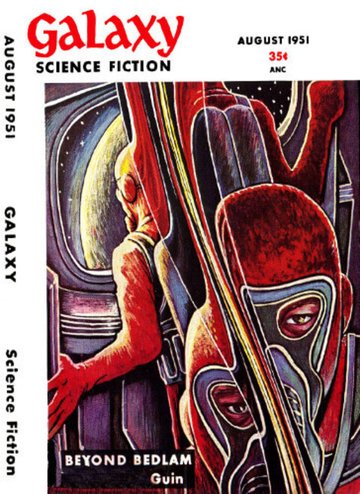
While Ray Bradbury's best known works are not yet in the public domain, enjoy A Little Journey, published in the August 1951 edition of the magazine, Galaxy Science Fiction. We feature it in Science Fiction.
She'd paid good money to see the inevitable ... and then had to work to make it happen!
There were two important things—one, that she was very old; two, that Mr. Thirkell was taking her to God. For hadn't he patted her hand and said: "Mrs. Bellowes, we'll take off into space in my rocket, and go to find Him together."
And that was how it was going to be. Oh, this wasn't like any other group Mrs. Bellowes had ever joined. In her fervor to light a path for her delicate, tottering feet, she had struck matches down dark alleys, and found her way to Hindu mystics who floated their flickering, starry eyelashes over crystal balls. She had walked on the meadow paths with ascetic Indian philosophers imported by daughters-in-spirit of Madame Blavatsky. She had made pilgrimages to California's stucco jungles to hunt the astrological seer in his natural habitat. She had even consented to signing away the rights to one of her homes in order to be taken into the shouting order of a temple of amazing evangelists who had promised her golden smoke, crystal fire, and the great soft hand of God coming to bear her home.
None of these people had ever shaken Mrs. Bellowes' faith, even when she saw them sirened away in a black wagon in the night, or discovered their pictures, bleak and unromantic, in the morning tabloids. The world had roughed them up and locked them away because they knew too much, that was all.
And then, two weeks ago, she had seen Mr. Thirkell's advertisement in New York City:
COME TO MARS!
Stay at the Thirkell Restorium for one week. And then,
on into space on the greatest adventure life can offer!
Send for Free Pamphlet: "Nearer My God To Thee."
Excursion rates. Round trip slightly lower.
"Round trip," Mrs. Bellowes had thought. "But who would come back after seeing Him?" And so she had bought a ticket and flown off to Mars and spent seven mild days at Mr. Thirkell's Restorium, the building with the sign on it which flashed: THIRKELL'S ROCKET TO HEAVEN! She had spent the week bathing in limpid waters and erasing the care from her tiny bones, and now she was fidgeting, ready to be loaded into Mr. Thirkell's own special private rocket, like a bullet, to be fired on out into space beyond Jupiter and Saturn and Pluto. And thus—who could deny it?—you would be getting nearer and nearer to the Lord. How wonderful! Couldn't you just feel Him drawing near? Couldn't you just sense His breath, His scrutiny, His Presence?
"Here I am," said Mrs. Bellowes, "an ancient rickety elevator, ready to go up the shaft. God need only press the button."
Now, on the seventh day, as she minced up the steps of the Restorium, a number of small doubts assailed her.
"For one thing," she said aloud to no one, "it isn't quite the land of milk and honey here on Mars that they said it would be. My room is like a cell, the swimming pool is really quite inadequate, and, besides, how many widows who look like mushrooms or skeletons want to swim? And, finally, the whole Restorium smells of boiled cabbage and tennis shoes!"
She opened the front door and let it slam, somewhat irritably.
She was amazed at the other women in the auditorium. It was like wandering in a carnival mirror-maze, coming again and again upon yourself—the same floury face, the same chicken hands, and jingling bracelets. One after another of the images of herself floated before her. She put out her hand, but it wasn't a mirror; it was another lady shaking her fingers and saying:
"We're waiting for Mr. Thirkell. Sh!" "Ah," whispered everyone.
The velvet curtains parted.
Mr. Thirkell appeared, fantastically serene, his Egyptian eyes upon everyone. But there was something, nevertheless, in his appearance which made one expect him to call "Hi!" while fuzzy dogs jumped over his legs, through his hooped arms, and over his back. Then, dogs and all, he should dance with a dazzling piano-keyboard smile off into the wings.
Mrs. Bellowes, with a secret part of her mind which she constantly had to grip tightly, expected to hear a cheap Chinese gong sound when Mr. Thirkell entered. His large liquid dark eyes were so improbable that one of the old ladies had facetiously claimed she saw a mosquito cloud hovering over them as they did around summer rain-barrels. And Mrs. Bellowes sometimes caught the scent of the theatrical mothball and the smell of calliope steam on his sharply pressed suit.
But with the same savage rationalization that had greeted all other disappointments in her rickety life, she bit at the suspicion and whispered, "This time it's real. This time it'll work. Haven't we got a rocket?"
Mr. Thirkell bowed. He smiled a sudden Comedy Mask smile. The old ladies looked in at his epiglottis and sensed chaos there. Before he even began to speak, Mrs. Bellowes saw him picking up each of his words, oiling it, making sure it ran smooth on its rails. Her heart squeezed in like a tiny fist, and she gritted her porcelain teeth.
"Friends," said Mr. Thirkell, and you could hear the frost snap in the hearts of the entire assemblage.
"No!" said Mrs. Bellowes ahead of time. She could hear the bad news rushing at her, and herself tied to the track while the immense black wheels threatened and the whistle screamed, helpless.
"There will be a slight delay," said Mr. Thirkell.
In the next instant, Mr. Thirkell might have cried, or been tempted to cry, "Ladies, be seated!" in minstrel-fashion, for the ladies had come up at him from their chairs, protesting and trembling.
"Not a very long delay." Mr. Thirkell put up his hands to pat the air.
"How long?"
"Only a week."
"A week!"
"Yes. You can stay here at the Restorium for seven more days, can't you? A little delay won't matter, will it, in the end? You've waited a lifetime. Only a few more days."
At twenty dollars a day, thought Mrs. Bellowes, coldly. "What's the trouble?" a woman cried.
"A legal difficulty," said Mr. Thirkell.
"We've a rocket, haven't we?" "Well, ye-ess."
"But I've been here a whole month, waiting," said one old lady. "Delays, delays!"
"That's right," said everyone.
"Ladies, ladies," murmured Mr. Thirkell, smiling serenely.
"We want to see the rocket!" It was Mrs. Bellowes forging ahead, alone, brandishing her fist like a toy hammer.
Mr. Thirkell looked into the old ladies' eyes, a missionary among albino cannibals. "Well, now," he said.
"Yes, now!" cried Mrs. Bellowes.
"I'm afraid—" he began.
"So am I!" she said. "That's why we want to see the ship!"
"No, no, now, Mrs.—" He snapped his fingers for her name.
"Bellowes!" she cried. She was a small container, but now all the seething pressures that had been built up over long years came steaming through the delicate vents of her body. Her cheeks became incandescent. With a wail that was like a melancholy factory whistle, Mrs. Bellowes ran forward and hung to him, almost by her teeth, like a summer-maddened Spitz. She would not and never could let go, until he died, and the other women followed, jumping and yapping like a pound let loose on its trainer, the same one who had petted them and to whom they had squirmed and whined joyfully an hour before, now milling about him, creasing his sleeves and frightening the Egyptian serenity from his gaze.
"This way!" cried Mrs. Bellowes, feeling like Madame Lafarge. "Through the back! We've waited long enough to see the ship. Every day he's put us off, every day we've waited, now let's see."
"No, no, ladies!" cried Mr. Thirkell, leaping about.
They burst through the back of the stage and out a door, like a flood, bearing the poor man with them into a shed, and then out, quite suddenly, into an abandoned gymnasium.
"There it is!" said someone. "The rocket."
And then a silence fell that was terrible to entertain.
There was the rocket.
Mrs. Bellowes looked at it and her hands sagged away from Mr. Thirkell's collar.
The rocket was something like a battered copper pot. There were a thousand bulges and rents and rusty pipes and dirty vents on and in it. The ports were clouded over with dust, resembling the eyes of a blind hog. Everyone wailed a little sighing wail.
"Is that the rocket ship Glory Be to the Highest?" cried Mrs. Bellowes, appalled.
Mr. Thirkell nodded and looked at his feet.
"For which we paid out our one thousand dollars apiece and came all the way to Mars to get on board with you and go off to find Him?" asked Mrs. Bellowes.
"Why, that isn't worth a sack of dried peas," said Mrs. Bellowes.
"It's nothing but junk!"
Junk, whispered everyone, getting hysterical.
"Don't let him get away!"
Mr. Thirkell tried to break and run, but a thousand possum traps closed on him from every side. He withered. Everybody walked around in circles like blind mice. There was a confusion and a weeping that lasted for five minutes as they went over and touched the Rocket, the Dented Kettle, the Rusty Container for God's Children.
"Well," said Mrs. Bellowes. She stepped up into the askew doorway of the rocket and faced everyone. "It looks as if a terrible thing has been done to us," she said. "I haven't any money to go back home to Earth and I've too much pride to go to the Government and tell them a common man like this has fooled us out of our life's savings. I don't know how you feel about it, all of you, but the reason all of us came is because I'm eighty-five, and you're eighty-nine, and you're seventy-eight, and all of us are nudging on toward a hundred, and there's nothing on Earth for us, and it doesn't appear there's anything on Mars either. We all expected not to breathe much more air or crochet many more doilies or we'd never have come here. So what I have to propose is a simple thing—to take a chance."
She reached out and touched the rusted hulk of the rocket. "This is our rocket. We paid for our trip. And we're going to take our trip!"
Everyone rustled and stood on tiptoes and opened an astonished mouth. Mr. Thirkell began to cry. He did it quite easily and very effectively.
"We're going to get in this ship," said Mrs. Bellowes, ignoring him. "And we're going to take off to where we were going." Mr. Thirkell stopped crying long enough to say, "But it was all a fake. I don't know anything about space. He's not out there, anyway. I lied. I don't know where He is, and I couldn't find Him if I wanted to. And you were fools to ever take my word on it."
"Yes," said Mrs. Bellowes, "we were fools. I'll go along on that. But you can't blame us, for we're old, and it was a lovely, good and fine idea, one of the loveliest ideas in the world. Oh, we didn't really fool ourselves that we could get nearer to Him physically. It was the gentle, mad dream of old people, the kind of thing you hold onto for a few minutes a day, even though you know it's not true. So, all of you who want to go, you follow me in the ship."
"But you can't go!" said Mr. Thirkell. "You haven't got a navigator. And that ship's a ruin!"
"You," said Mrs. Bellowes, "will be the navigator."
She stepped into the ship, and after a moment, the other old ladies pressed forward. Mr. Thirkell, windmilling his arms frantically, was nevertheless pressed through the port, and in a minute the door slammed shut. Mr. Thirkell was strapped into the navigator's seat, with everyone talking at once and holding him down. The special helmets were issued to be fitted over every gray or white head to supply extra oxygen in case of a leakage in the ship's hull, and at long last the hour had come and Mrs. Bellowes stood behind Mr. Thirkell and said, "We're ready, sir."
He said nothing. He pleaded with them silently, using his great, dark, wet eyes, but Mrs. Bellowes shook her head and pointed to the control.
"Takeoff," agreed Mr. Thirkell morosely, and pulled a switch. Everybody fell. The rocket went up from the planet Mars in a great fiery glide, with the noise of an entire kitchen thrown down an elevator shaft, with a sound of pots and pans and kettles and fires boiling and stews bubbling, with a smell of burned incense and rubber and sulphur, with a color of yellow fire, and a ribbon of red stretching below them, and all the old women singing and holding to each other, and Mrs. Bellowes crawling upright in the sighing, straining, trembling ship.
"Head for space, Mr. Thirkell."
"It can't last," said Mr. Thirkell, sadly. "This ship can't last. It will—"
It did.
The rocket exploded.
Mrs. Bellowes felt herself lifted and thrown about dizzily, like a doll. She heard the great screamings and saw the flashes of bodies sailing by her in fragments of metal and powdery light.
"Help, help!" cried Mr. Thirkell, far away, on a small radio beam.
The ship disintegrated into a million parts, and the old ladies, all one hundred of them, were flung straight on ahead with the same velocity as the ship.
As for Mr. Thirkell, for some reason of trajectory, perhaps, he had been blown out the other side of the ship. Mrs. Bellowes saw him falling separate and away from them, screaming, screaming.
There goes Mr. Thirkell, thought Mrs. Bellowes.
And she knew where he was going. He was going to be burned and roasted and broiled good, but very good. Mr. Thirkell was falling down into the Sun.
And here we are, thought Mrs. Bellowes. Here we are, going on out, and out, and out. There was hardly a sense of motion at all, but she knew that she was traveling at fifty thousand miles an hour and would continue to travel at that speed for an eternity, until....
She saw the other women swinging all about her in their own trajectories, a few minutes of oxygen left to each of them in their helmets, and each was looking up to where they were going.
Of course, thought Mrs. Bellowes. Out into space. Out and out, and the darkness like a great church, and the stars like candles, and in spite of everything, Mr. Thirkell, the rocket, and the dishonesty, we are going toward the Lord.
And there, yes, there, as she fell on and on, coming toward her, she could almost discern the outline now, coming toward her was His mighty golden hand, reaching down to hold her and comfort her like a frightened sparrow....
"I'm Mrs. Amelia Bellowes," she said quietly, in her best company voice. "I'm from the planet Earth."
Frequently Asked Questions about A Little Journey
What is "A Little Journey" by Ray Bradbury about?
A Little Journey follows Mrs. Amelia Bellowes, an eighty-five-year-old widow who has spent her life savings on a ticket to ride Mr. Thirkell's rocket from Mars into deep space—supposedly to find God. Mrs. Bellowes is one of a hundred elderly women who have gathered at Thirkell's "Restorium" on Mars, lured by his advertisement promising a journey to heaven. When Thirkell announces yet another delay and the women discover his rocket is a battered, rusted wreck, Mrs. Bellowes leads a revolt. She forces the con man to pilot the ship, knowing full well it may not survive the trip. The rocket launches but quickly explodes, scattering the women into space. In the story's transcendent final moments, Mrs. Bellowes, drifting through the stars with only minutes of oxygen left, sees what she believes is God's golden hand reaching down to receive her.
What are the main themes of "A Little Journey"?
The central theme is faith and the hunger for transcendence in the face of mortality. Mrs. Bellowes and the other elderly women are not naive—they know Thirkell is likely a fraud, just as all the mystics, evangelists, and astrologers before him were. But they choose to believe because, as Mrs. Bellowes explains, "it was a lovely, good and fine idea, one of the loveliest ideas in the world." A related theme is the dignity and courage of old age: far from being helpless victims, the women seize control of their fate and choose their own ending. The story also explores the relationship between fraud and genuine spiritual experience—Thirkell's scheme is a complete sham, yet it accidentally delivers the women to something that feels, in their final moments, like the divine. Finally, there is a theme of self-deception as a form of grace, where the "gentle, mad dream of old people" proves more sustaining than any rational truth.
Who is Mrs. Bellowes in "A Little Journey"?
Mrs. Amelia Bellowes is the story's protagonist—an eighty-five-year-old widow from Earth with a long history of following spiritual charlatans. She has consulted Hindu mystics, Indian philosophers, California astrologers, and evangelical temples, signing away property and spending her savings in a lifelong search for God. She describes herself as "an ancient rickety elevator, ready to go up the shaft. God need only press the button." Despite her pattern of being deceived, Mrs. Bellowes is neither foolish nor pitiful. She is sharp-tongued, observant, and fiercely determined. When she discovers Thirkell's fraud, she doesn't collapse in despair—she leads the other women in storming the rocket and forcing the launch. Her final act, introducing herself to what she perceives as God with "I'm Mrs. Amelia Bellowes... I'm from the planet Earth," is one of 's most poignant character moments.
What happens at the end of "A Little Journey"?
The ending of A Little Journey is both devastating and transcendent. After the rocket explodes, the hundred elderly women are flung into deep space, each traveling at fifty thousand miles an hour with only a few minutes of oxygen in their helmets. Mr. Thirkell is blown in the opposite direction—falling into the Sun, receiving the fiery judgment the women are spared. Mrs. Bellowes, drifting through the darkness "like a great church, and the stars like candles," sees what she believes is God's "mighty golden hand, reaching down to hold her and comfort her like a frightened sparrow." Whether this vision is real, hallucination, or dying grace is left deliberately ambiguous. The story ends with Mrs. Bellowes introducing herself to God in her "best company voice"—a final gesture of dignity, civility, and unshakable faith that transforms what should be a scene of horror into one of quiet beauty.
What literary devices does Ray Bradbury use in "A Little Journey"?
employs rich simile and metaphor to characterize Mrs. Bellowes and her world: she is "an ancient rickety elevator," the other women are like walking through a "carnival mirror-maze," and the rocket resembles "a battered copper pot" with eyes like "a blind hog." Dark humor pervades the story, particularly in the descriptions of Mr. Thirkell—his Egyptian eyes, his carnival-barker manner, and the "Chinese gong" Mrs. Bellowes half-expects to hear when he appears. Irony is central: a fraudulent scheme to find God actually delivers the women into the cosmos, and the con man who promised heaven ends up falling into the Sun. Bradbury uses tonal contrast masterfully, shifting from satirical comedy to genuine pathos in the final paragraphs, where the language becomes hymn-like: "the darkness like a great church, and the stars like candles." The allusion to the hymn "Nearer My God to Thee" in Thirkell's pamphlet title also evokes the sinking of the Titanic, adding layers of ironic meaning.
When was "A Little Journey" by Ray Bradbury published?
A Little Journey was published in the August 1951 issue of Galaxy Science Fiction, one of the most prestigious science fiction magazines of its era. The story appeared during a remarkably productive period for , who had recently published The Martian Chronicles (1950) and was developing the stories that would become Fahrenheit 451. The 1950s saw Bradbury increasingly recognized as a literary writer who transcended the pulp origins of science fiction, and "A Little Journey" exemplifies this—it is less concerned with technology or space travel than with the human heart's desperate need for meaning. The story is now in the public domain and available through Project Gutenberg.
Who is Mr. Thirkell in "A Little Journey"?
Mr. Thirkell is the con man who lures elderly women to Mars with the promise of a rocket trip to God. He is described with theatrical imagery—"large liquid dark eyes" like rain-barrels, a "Comedy Mask smile," and the scent of "theatrical mothball and calliope steam" clinging to his suit. He operates a "Restorium" on Mars where women pay twenty dollars a day while he delays the launch with excuses about "legal difficulties." His rocket, the Glory Be to the Highest, turns out to be a rusted wreck barely fit to fly. When the women discover his fraud, Thirkell confesses: "It was all a fake. I don't know anything about space. He's not out there, anyway." In a moment of poetic justice, when the rocket explodes, Thirkell is flung not into the stars with the women but downward into the Sun—a fiery fate that contrasts sharply with the gentle cosmic end the women experience.
Is "A Little Journey" a satire of religion?
A Little Journey satirizes religious exploitation rather than religion itself. skewers the long line of charlatans who prey on the elderly and the desperate—the "Hindu mystics," "ascetic Indian philosophers," "astrological seers," and "amazing evangelists" who have taken Mrs. Bellowes' money throughout her life. Mr. Thirkell is simply the latest in this procession of frauds. However, the story treats Mrs. Bellowes' actual faith with deep tenderness and respect. She knows the con artists are fake, yet her underlying spiritual longing is presented as genuine, beautiful, and ultimately validated—at least on an emotional level—by her final vision of God's golden hand. The story suggests that the human need for transcendence is real and dignified even when the institutions and individuals who exploit it are not.
Save stories, build your reading list, and access all study tools — completely free.
Save A Little Journey to your library — it's free!Need help with A Little Journey?
Study tools to help with homework, prepare for quizzes, and deepen your understanding.
Flashcards →