A House in the Country
by Richard Connell
A House in the Country (1924) tells the story of a city dweller's lifelong dream of rural escape and the bittersweet reality that awaits. "Yes, some day I'll have a house in the country."
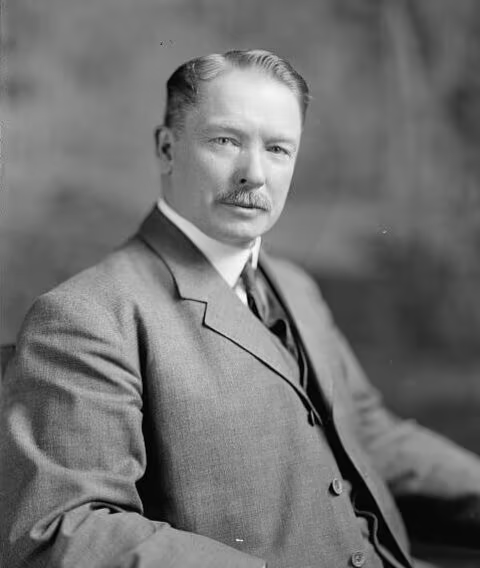
I MET him again in this way: The revolving door of the excessively fashionable St. Erdman Hotel was spinning around furiously—and yet no one came forth. My eye spied this phenomenon; and, ever curious, I paused on Fifth Avenue and watched. Round and round sped the door like the Ferris Wheel in a squirrel cage propelled by an athletic squirrel gone mad. So fast did the door revolve that with difficulty I made out a small figure in a brown suit in one of the compartments. It was he who was making a whirligig of the door. Then I saw another figure, very bulky and cholerically red in the face and wearing the purple-and-gold livery of the hotel, stop the buzzing door and with outraged thumb and forefinger pick up the little man in brown by the collar, pop him out of the door like a tiddleywink and send him bouncing across the sidewalk in my direction. The little man picked himself up, apparently not in the least angry, cast not a single malediction at the broad purple back of the doorman, but began to brush himself off thoughtfully. Then I saw that he was Hosmer Appleby, with whom I had had a casual acquaintance in college some five years before.
“Why hello, Appleby,” I greeted him. “Are you hurt?”
“I shall not have one,” was his reply. “I do not like them.”
I stared at Appleby, uncertain whether he was dazed by his recent experience, or was perhaps psychopathic, or had been drinking.
“You do not like what?” I queried.
“Revolving doors,” he said. “I’ve tried them in seven buildings now, and I don’t like any of them. No; I shan’t have one. That’s settled.”
He addressed me as if I were trying to compel him to have a revolving door, willy-nilly.
“There, there,” I said soothingly, convinced now that his mind was affected. “You need not have revolving doors if you don’t want them.”
“But what kind shall I have?” he demanded, looking at me anxiously. “What kind would you have?”
“Have? For what?”
“Why, for your house, of course,” he said.
“But I have no house, Appleby.”
I fancied that he looked at me pityingly.
“Neither have I,” he said; “but I am going to have one.”
“Are you? Where?”
“In the country.”
“Whereabouts in the country?”
“I don’t know yet.” Then, in a tone that was rapt, if not actually reverent, he said, “Yes, some day I’ll have a house in the country.”
“When?”
“I wish I knew,” Appleby said. “As soon as I save enough to build the house and to provide a small income for myself.”
“You’re married then?”
“Oh, no; no, indeed. Nothing like that,” he assured me hastily.
“Then what the dickens do you want with a house in the country?”
“I’ll tell you,” said Appleby. “Where can we go and talk?”
I suggested a certain coffee house, hidden away in a side street.
“The coffee,” I said, as we started there, “is the best Java in New York. It is raised for the exclusive use of a royal family in Europe; but now and then the royal steward sells a bag to this coffee house. It has to be smuggled in, bean by bean; the man said so.”
“Smuggled in, bean by bean,” repeated Appleby. “Do you think I could get a bag?”
“A whole bag? What for?”
“For my house, of course,” he said. “I could serve it at the housewarming.”
“Well,” I said, “it strikes me that a fellow who plans what sort of coffee he’ll serve at the housewarming of a house that isn’t even started yet must like to peer into the future.”
“I do,” said Appleby seriously.
As we neared the coffee house he suddenly darted from my side. With some apprehension I saw him, by a somewhat hazardous display of gymnastic ability, mount a window ledge that he might examine closely one of the old ship lanterns that served to light the sign of the coffee house.
He climbed down, shaking his head.
“It won’t do,” he said.
“It won’t do what?” I asked.
“It won’t do for my house,” he replied.
As we entered the vestibule he dropped to his knees and ran an appraising hand over the doormat.
“Too prickly,” he announced. “For me, at any rate.”
We took a table in the little back room, and while Appleby inquisitively fingered the curtain material and searched the bottom of the sugar bowl for the maker’s mark, I examined him. Save for the addition of a blond snippet of mustache, he was much the same as he had been in college. He wore the same sort of assiduously brushed brown suit, the same careful necktie, the same intent, intense air.
“Did you see the Yale game this year?” I asked.
“No; but let me tell you about my house,” he answered. “Just now it’s to be a rather simple affair of, say, ten rooms; a low, rambling house of the English type, with plaster walls showing the trowel marks; or I may have it of field stone, with a beamed ceiling in the living room and——”
“But why are you going to build it, Appleby?”
He looked solemn.
“Because of my philosophy of life,” he said.
“I don’t see——”
“This is what I mean,” he explained: “I came out of college about as well prepared for life as a snake is prepared to ride a bicycle. I’d no idea what I wanted to do. First, I thought I’d like to be a painter; I lived on art and sausages for five months; then I ran out of paint and sausages. So I went to work in an advertising agency. I’m not just sure now why I did. I think I ran into some fellow who said advertising was a young giant still in its infancy and advised me to get in on the ground floor; I remember the metaphor, if not the fellow. I did get in on the ground floor and I stayed there for four months. Then I lost interest in the superlative merits of the hair restorer my company advertised, and left the young giant still in its infancy.”
The coffee came; he absent-mindedly, drank some.
“I entered finance,” he went on. “That is to say, I trekked all over town trying to find someone feeble-minded enough to buy a bond from me. Not finding anyone, I entered foreign trade; meaning, I sat at a desk and tried to sell dolls in gross lots to Peruvian importers. I did this for some endless months. One day I found myself looking out of my ninth-story window and wondering why I didn’t jump. ‘Why,’ I found myself asking myself, ‘do I continue to live? Do I care a snap about dolls in gross lots? I do not! Do I like Peruvians? Not at all! In fact, they both bore me. Life,’ I said to myself, ‘is as empty as a used cantaloupe.’ What had I to live for?”
Appleby sipped his coffee, and I said I didn’t know.
“Nothing,” he said; “nothing. What was my life? Same routine. Get up in the morning; miserable business, getting up. Shave myself; always painful; tender skin, you know. Breakfast; same old coffee, same old cereal, same old eggs. Jostle down to the office. Same dolls; same Peruvians. Lunch with earnest young exporters; same oatmeal crackers and milk; same talk about profits and markets. Back to the office; ‘Miss Gurry, take a letter: “Yours of the fourteenth received, and in reply would say in re shipment of 325 gross of best India-rubber dolls, style 7BB—squeaking—am shipping same f.o.b., Wappingers Falls, N. Y., at once.”’ Oh, you know the line. Home to my apartment, the size of a police patrol. Read the papers. Same old bunk. ‘Strike Situation Serious.’ ‘International Situation Serious.’ ‘Pugilistic Situation Serious.’ Everything serious, everybody serious. Dinner; that’s serious too. Same old question: What shall I do to kill the evening? Read a book? The usual bunk; either romance about people who are too happy, or realism about people who are not happy enough. Go to a show? The old plots, the old lines, the old girls. Same banalities; same strutting hams spouting moss-covered buckets of bunk. Call on a girl? Ghastly bore. Same old ‘Have you seen this or have you read that? Isn’t it shocking about the Warps getting a divorce, or nice about the Woofs getting married? Do you believe a man and a girl can really be friends in the strictest sense of the word, and how is your golf game getting on?’ Home to bed, wind the alarm clock; same old dreams, and then—br-r-ring—7:30 same thing all over again. I was slaving at work I hated, and what was I getting out of it? What was it all leading to?”
Again he sipped coffee; again I said I didn’t know; again he launched himself.
“Nothing,” he said; “nothing. There I was at twenty-four doing work I loathed in order to lead a life that bored me. The whole business seemed as pointless as an aquarium without fish. What could I do to make life worth living?”
“Well, what did you do?” I asked.
“First, I analyzed the situation. I always was analytic, you know. Then I decided what I must do. I must have some definite object to work for. I must set some goal for myself.”
He tossed off his coffee with a triumphant air; his eyes sparkled. I signaled for more coffee and looked at him interrogatorily.
“And the goal?” I questioned.
His voice was alive with excitement as he said, “To have a house in the country; to retire and live there and raise roses.”
“You’re pretty young to retire,” I remarked.
“Oh, I won’t be able to do that for years and years,” Appleby said. “I’ll not only have to earn enough for a house but enough to bring me in a modest income.”
“Well, you have your definite object.”
“I have,” said Appleby. “And you’ve no idea how it has bucked me up. I’ve gained ten pounds since I thought of it. And my whole outlook has changed; I’m as happy as a cat in a fish store these days. You see, I’m going to build a perfect house. I take all the building magazines. Every Sunday I go walking in the country looking for sites. And as for my job——”
“You like it now?”
“I do not. I’m still distinctly bored by dolls in gross lots, and Peruvians; but I take them seriously now. They’re pawns in my game, you see. Now, every time I sell a gross of dolls I say to myself, ‘Ah, 144 dolls means a commission to me of $4.77, or enough to pay for one electric outlet in my house.’ Or, if I sell ten gross I say to myself, ‘Good work, old boy! The commission will buy andirons, or bricks for the chimney, or so many gallons of paint.’ I’m three times as good a business man as I was. Indeed, I should be at my office this minute, but I got thinking about revolving doors and could not be easy in my mind till I tried some. I don’t think they’d be appropriate for a country house, do you?”
“Decidedly not.”
He looked relieved.
“Good! Glad you agree. I’ll cross them off.”
He took out a fat memorandum book and crossed words off a list.
“When do you expect to make this dream a reality?” I asked.
A wistful look came to his face.
“If I do it by the time I’m fifty I’ll be lucky,” he said. “There isn’t much money in dolls. It will take years. But”—and he brightened—“I have already set aside enough money to pay for one window with leaded glass, one foot scraper, three electric outlets and part of the coal bin. Have you any ideas about coal bins?”
Before I could give him the benefit of my thought on this subject he vanished from my sight. I perceived that he had dived under the table and was subjecting the floor to a microscopic scrutiny. Presently he looked up.
“Wanted to be sure whether the floor is painted or stained,” he explained. “I think I’ll have my floors painted.” There was pride in his voice as he accented the word “my.” He got to his feet.
“Well, I must rush along. Hope I can sell a few gross of dolls before the market closes. Glad I ran into you. By the way, if you hear of anybody who wants to buy dolls——”
He did not finish his sentence, for his attention was caught by the door-knob of the front door and he bent over to see how it worked.
Then he went out. I did not see Hosmer Appleby again for six years.
New York eats men. It ate Appleby. At least I did not encounter him. He may have ridden in the same cars or lived in the same block; but our paths did not cross until one afternoon at the art museum. It was, as I recall it, just six years after we drank coffee together and he told me about his aim in life. I was in one gallery of the museum looking at a new exhibition of etchings, when I heard a commotion in the next gallery. A bass voice was in somewhat violent controversy with a tenor voice.
“But you can’t lie in that there bed,” the bass voice protested loudly.
“Why can’t I?”
“That there bed,” declared the bass voice, “was slep’ in by Napoleon. It’s worth twenty thousand dollars. We can’t have people layin’ in it, now can we?”
“But I’m only trying it.”
“It’s against the rules of the museum,” stated the bass voice.
I entered the gallery at this moment and saw a fat and agitated museum attendant, owner of the bass voice, expostulating with a small man in a brown suit, the tenor, who was reclining on an enormous gilt, canopied, four-poster bed of florid design.
“Oh, very well,” said the man on the bed. “I don’t think much of it as a bed, anyhow. I wouldn’t have it in my house.”
Saying this, he rose from the bed and I saw that he was Hosmer Appleby.
“Oh, you wouldn’t, wouldn’t you?” said the attendant, loyal to his charge. “Well, it was good enough for Napoleon, that there bed was.”
“Steel beds are more sanitary,” said Appleby. Then turning to me, “Don’t you think so?”
He spoke as if I’d been with him all the time. He had the same absorbed expression, the same intent, intense look.
“How’s the house?” I asked. “Are you enjoying living in it?”
“Living in it? Why, I haven’t started to build it yet!” he told me as we strolled through the collection of Sheraton furniture, which he now and then stopped to poke.
“No,” he continued, “I haven’t found a site. Haven’t the money, anyhow. But I’m looking. I suppose I’ve looked at five hundred sites since I saw you, and have got forty earaches listening to real-estate agents. I’m in no great hurry. The perfect house on the perfect site—that’s my plan.”
He said it as if he were annunciating a religious principle.
“And the dolls?” I asked.
He made a wry face.
“Oh, I still sell the little beasts,” he replied. “I’m assistant sales manager now, you know.”
“Good work!”
“Beastly grind,” he said. “I detest dolls. But they’re going to build me a house in the country.”
“A doll house?” I suggested.
He did not smile; his look said that his house was too sacred a matter for facetiousness.
“How are you, anyhow? Married, or anything like that?” I inquired.
“The living room is going to be thirty-five by twenty,” he said.
I stopped to admire a Fuller landscape.
“Aren’t those shadows lovely?” I said.
“My living room is going to be very bright,” said Hosmer Appleby. “Splotches of brilliant color everywhere. Old Spanish.” He said this in a confidential whisper, as if he were imparting a secret. “And, do you know,” he concluded, “I’ve earned almost enough to furnish the living room.”
I congratulated him. He shook a rather woeful head.
“It’s fearfully slow work,” he said. “Sometimes I think I’ll never make it. Sometimes I fear that the house is a mirage that can never be reached. But I conquer these fits of despair; I put on full steam and sell dolls like a fiend incarnate.” He made a face. “Little bores,” he added. We had reached the front door of the museum.
“Well, good-by,” Appleby said. “Glad I saw you. Let’s have lunch sometime. Have to go back downtown and cable Peru. Just dropped in here to try that Napoleonic bed. Now I can cross canopied beds off my list.” He did so.
Then I saw him make a hasty exit, and I saw his brown-suited back disappear in pursuit of a bus.
We never did have that lunch; he disappeared from my life and it was some years before I saw him again. It was at an auction. I heard an excited tenor voice bidding on a dragon-sprinkled Chinese rug.
Appleby shook hands with me vigorously, without taking his eyes off the auctioneer. He seemed in excellent health and spirits; he had color in his cheeks and a spark in his eyes. He bought the rug.
“This makes the seventh rug I’ve bought,” he whispered to me breathlessly.
“How’s the house?” I asked.
“Still in the blue-print stage,” he said, a little sadly. “But I’ve earned nearly enough to pay for the first floor. And I’ve got my eye on a wonderful site in Connecticut. You should see the hanging lamp I picked up at a sale last week! Very French and cubistic.” His eyes glowed.
“For your old-Spanish room?” I asked with a smile.
“Oh, now it’s going to be a modern French room,” he said.
“Still selling dolls, Appleby?”
“Yes, worse luck. I mean I still get no thrill out of the work. But I’m to be made sales manager the first of the year. That means more money, and every dollar I make brings me nearer my house in the country, and freedom.”
I left him bidding feverishly on a plum-colored Cabistan.
I had almost forgotten Hosmer Appleby and his house. A good many years had passed since our last meeting—seventeen years, I think; or maybe eighteen. Then one day last spring I received a note inviting me to the housewarming of Briar Farm, near Noroton, Connecticut; it was a very cordial little note, and it was signed “Hosmer Appleby.” Then I knew that he had attained his goal at last.
I went out to Briar Farm to the housewarming. The site was, indeed, perfect; five acres or so of rolling land, with a view across Long Island Sound; and the house itself was a gem. Hosmer Appleby, white-haired now, but as bright-eyed and interested as ever, greeted me warmly. He skipped from guest to guest, rubbing his hands, bowing acknowledgments of the compliments they offered him on the perfection of his house. Now and then he pointed out some perfections that might have escaped our attention—that chair was from a sixteenth-century monastery near Seville; that fireplace was his own design; the beams in that ceiling he had discovered in an old manor house in Somersetshire; he invented that especially efficient shower bath; and didn’t we think that Matisse in his library rather good?
He took me to the library window, showed me gleefully how the patent casement windows worked, and said: “You see that garden out there? It’s to be a rose garden. There I’m going to spend the rest of my days; at night I’ll read in this room. It’s been a long pull, I can tell you; but here I am.”
“You’ve deserted the dolls?” I asked.
He made the face of one who has just taken unpleasant medicine.
“Don’t remind me of them,” he said. “I hope I’ll never see one of the little brutes again. When I think of the years I spent worrying and sweating over them—still they helped me attain my objective. I was president of the company, you know, when I resigned.”
When I was leaving his house he said to me, “You must come up when the roses are blooming. They ought to be beauties; I’ve been studying books on rose growing for the last ten years.”
Three months later I was driving near Briar Farm, and I stopped in to see Appleby and his house and the roses. I saw a figure in old clothes pottering about in the garden. It seemed to me as I watched him that his walk sagged. He would pick a rose bug from a leaf, look at it for a whole minute or more, put it into a can, and then pick off another rose bug. He saw me standing there and came slowly toward me. I thought he seemed pale. He shook hands with me limply.
“How well the roses are getting on!” I said.
“Do you think so?” he said without enthusiasm.
We went into his living room—he had done it in old-Spanish style, after all. I admired a venerable refectory table. Appleby shrugged his shoulders. There were long silences in the course of our conversation, during which Appleby would sit with head on chest, staring at a rug; and yet I felt somehow that he did not see the rug.
“What a stunning lamp!” I said.
“Oh, it’ll do,” said Appleby; his tone seemed dull.
“Don’t you feel well, Appleby?” I asked.
“Not particularly,” he said in that same blunted voice.
A week later I heard through a mutual friend that Hosmer Appleby had taken to his bed, and that his doctors were shaking their heads and looking grave. I had it in mind to go out to see him, but business called me suddenly to England for a flying trip. I was gone a month. I came back to New York on the newest and largest of liners, the Steamship Gigantic. We tied up at a New York pier, and while waiting for the customs inspectors to delve into our baggage I decided to take a last stroll about the vast ship.
I had penetrated into its depths and had come to the place where one could peer down and see the mighty engines, great polished and black giants crouching in their cave. As I stood there I became aware that a man, at no small peril to his safety, was hanging out over the rail and studying the engines with fascinated eyes. He was shaking his head and muttering to himself as if he were in the midst of calculation or inner debate. He heard my step and swung around. It was Appleby. He bounded toward me and shook hands with me with a hearty violence. His face was full of color, and I have never seen brighter eyes.
“Well, well, well!” he cried. “How are you?”
“Fine, thanks. And you?”
“Bully!” he said. “Bully!”
“But what are you doing here, Appleby?”
“I got a pass and came aboard just as soon as the boat docked,” he explained. His manner was alert, almost jaunty, one would say. “You see, I know the president of the line. I use his boats to export some of my dolls.”
“Your dolls?” I exclaimed.
“Certainly. I’m back in the doll business. And I’ll bet you a good cigar we’ll sell half a million dollars’ worth of dolls this year.”
His voice was brisk, his air determined.
“But your house in the country, Appleby.”
“Oh, I sold that. Tell me, how did these new oil-burning engines work on the trip coming over? You see, I’m going to build myself a yacht. I’m working like a beaver to earn the money. It’s going to be the finest yacht that was ever built—the newest oil-burning engine, mahogany decks, cabins for twenty or more, elevators——”
Frequently Asked Questions about A House in the Country
What is "A House in the Country" by Richard Connell about?
A House in the Country follows Hosmer Appleby, a young doll salesman who gives his life a sense of purpose by setting a single goal: to save enough money to build the perfect house in the country and retire there to grow roses. The story is told through a series of chance encounters between the narrator and Appleby over a span of roughly twenty-five years. Each time they meet, Appleby is obsessively researching some aspect of his future house -- testing revolving doors, lying in Napoleon's bed at a museum, buying rugs at auction -- while grinding away at the doll business he despises. When he finally achieves his dream, complete with a perfect Connecticut home and blooming roses, the narrator visits and finds Appleby listless, pale, and depressed. The twist ending reveals that Appleby has sold the house and gone back to selling dolls -- this time saving up to build a yacht.
What is the theme of "A House in the Country"?
The central theme is that happiness lies in the pursuit of a goal, not its achievement. For decades, Appleby is energized, purposeful, and "happy as a cat in a fish store" precisely because his dream house is always in the future. The moment he achieves it, he collapses into depression. suggests that humans need something to strive for -- the anticipation of fulfillment is more sustaining than fulfillment itself. Related themes include the hedonic treadmill (the tendency to return to a baseline level of happiness regardless of achievement) and the emptiness of modern life without purpose. Appleby describes his pre-goal existence as pointless: "Life is as empty as a used cantaloupe." Once the house gives him direction, the same dull work becomes meaningful. The irony is that the specific goal doesn't matter -- dolls, houses, yachts are all interchangeable; what matters is the striving.
Who is Hosmer Appleby in "A House in the Country"?
Hosmer Appleby is the protagonist, a small man in a brown suit who sells rubber dolls in gross lots to Peruvian importers. He is described as having "the same intent, intense air" throughout the decades the narrator knows him. Appleby is single-minded to the point of comedy: he tests revolving doors at hotels, lies in Napoleon's bed at a museum, crawls under tables to inspect floor finishes, and buys rugs at auctions -- all for a house that doesn't exist yet. Despite hating his work ("I detest dolls"), he rises from salesman to assistant sales manager to sales manager to president of the company, driven entirely by the dream of his house. Appleby represents 's insight that the most productive people are often motivated not by love of their work but by a private dream that their work finances.
What literary devices does Richard Connell use in "A House in the Country"?
structures the story around episodic time jumps, with each encounter between the narrator and Appleby separated by years, creating a compressed biography that spans decades in a few pages. Irony is central: Appleby hates dolls but becomes president of the doll company; he builds the perfect house but finds it meaningless; he claims to want freedom from work but immediately returns to it. Repetition builds comic momentum -- each meeting follows the same pattern (chance encounter, Appleby testing something, asking about his house, Appleby vanishing). Connell uses vivid similes that reflect Appleby's quirky worldview: "Life is as empty as a used cantaloupe" and "happy as a cat in a fish store." The circular ending -- Appleby back to selling dolls, now saving for a yacht -- transforms the story from a simple success narrative into a meditation on human nature, making the reader reinterpret everything that came before.
What happens at the end of "A House in the Country"?
The ending delivers the story's central ironic twist. After finally building his perfect house in Connecticut -- "Briar Farm" with its rose garden, beamed ceilings, and Matisse in the library -- Appleby becomes depressed and physically ill. The narrator visits and finds him listless, shrugging at his beautiful furniture, staring at rugs without seeing them. Then, weeks later, the narrator encounters Appleby on the steamship Gigantic, hanging over a railing to study the ship's oil-burning engines. Appleby is vibrant, brisk, and full of color again. He has sold the house, gone back to selling dolls, and is now saving up to build "the finest yacht that was ever built." The ending reveals that Appleby's happiness was never about the house -- it was about having a goal to work toward. The yacht is simply the next version of the same dream.
When was "A House in the Country" published?
A House in the Country was published in 1924, the same year as 's most famous work, The Most Dangerous Game. While that story is a dark survival thriller, A House in the Country showcases Connell's talent for gentle, philosophical humor. The story was part of Connell's prolific output during the 1920s, when he was a regular contributor to major American magazines including The Saturday Evening Post and Collier's. Its theme of finding purpose through goals resonated with the aspirational culture of the Roaring Twenties, while its ironic ending quietly subverts the era's faith in material achievement.
What does the house symbolize in the story?
The house functions as a symbol of purpose itself rather than any specific material desire. For Appleby, the house is never really about architecture, roses, or Connecticut views -- it is a reason to get out of bed, a framework that gives meaning to tedious work. Each doll sold becomes "enough to pay for one electric outlet"; each year of grinding labor translates into bricks, rugs, and beamed ceilings. When the house is finally built and the symbol becomes reality, it loses its power. The fact that Appleby immediately replaces it with a yacht -- an equally elaborate, equally distant goal -- reveals that the house was always interchangeable. suggests that humans are not goal-achieving creatures but goal-pursuing creatures, and that the objects of our ambition matter far less than the act of working toward them.
Save stories, build your reading list, and access all study tools — completely free.
Save A House in the Country to your library — it's free!Need help with A House in the Country?
Study tools to help with homework, prepare for quizzes, and deepen your understanding.
Flashcards →