Son of a Sloganeer
by Richard Connell
Son of a Sloganeer (1924) follows the son of an advertising genius who must navigate the absurd world of slogans, salesmanship, and family expectations. Connell's sharp satire of American commercial culture. "His father could sell anything to anybody."
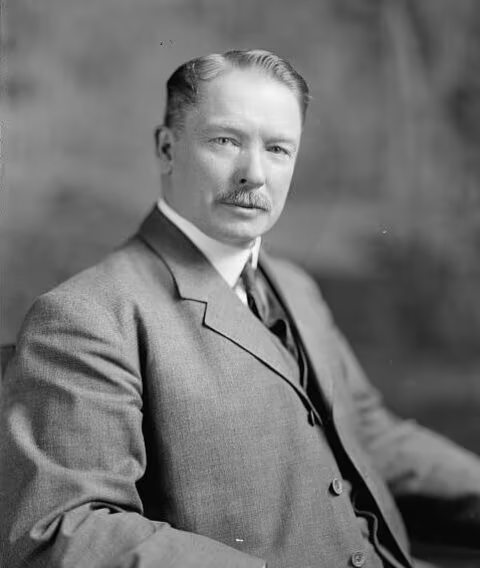
MR. BOWSER thumbed a buzzer. His secretary popped into his office. All his staff popped when Mr. Bowser buzzed. “Minktakmemo,” commanded that high-powered executive. Translated this meant, “Mink, take memo.” Mr. Bowser avoided the use of useless words such as “a” and “the”; he had calculated that they waste from twenty-one to twenty-seven minutes of a busy man’s time per month. To get into the habit of eliminating these words might have proved difficult for an ordinary man, but not for J. Sanford Bowser. He was not ordinary, and he was, distinctly, a doer. There was a doing air about him from hair tonic to rubber heels.
“Get-There Men have the Get-Things-Done Habit,” he liked to say. As president of The Bowsers, Inc., publicity engineers, “Let The Bowsers Put You on the Map!”—slogans leaped from his lips as naturally as rabbits have children, and with even less effort. He was passionately devoted to the science of slogan making; to coin a striking trade name for a new can opener, and couple with it some pregnant selling epigram—that, to Mr. Bowser, was almost the apex of human achievement. His mind, by long training, plucked from the air pithy punch phrases—his own expression—as swiftly and subconsciously as a man tottering on the brink of a sneeze reaches for his handkerchief.
“Minktakmemo.”
Miss Mink poised her silver-plated pencil—it was a Bowser-advertised product—a Rite-Riter, “The Pencil That Does Everything But Think”—over her book. Mr. Bowser cleared his throat.
“Memo to Mrs. Bowser,” he dictated staccatoly, “in re teething ring for baby. I have personally tried all advertised brands of teething rings. My tests show most scientific ring to be Cohnco Ring, Toy Efficient for Teething Tots. (N. B. Pretty good slogan). Cohnco Rings are (a) less rubbery in taste, (b) more durable, and (c) fit well in the mouth. If you check with me on Cohnco Rings I’ll order one gross sent to our house at once.
“(Signed) J. Sanford Bowser, President.”
Mr. Bowser lit a Marlborough-Somerset, “Each Puff Has a Pedigree,” smoothed his straw colored hair, and swooped down on a pile of mail.
“Minktakletter.”
Miss Mink prepared to take a letter.
“Woonsocket Kumfee-Fit Undervest Co., Woonsocket, R. I. Attention Mr. Snedecker——”
And, thus launched, Mr. Bowser whizzed through his correspondence like a buzz saw through a ladyfinger, ejecting punch-laden sentences even as a machine gun ejects used cartridges.
A person unfamiliar with the principles of high-speed efficiency on which Mr. Bowser conducted his life, business and domestic, might have thought that Mrs. Bowser was in Fiji or Lapland or some equally remote spot. As a matter of fact the surveyed distance between Mr. Bowser and Mrs. Bowser at that precise moment was twelve feet, for she occupied the office next to his, and, as his partner and associate publicity engineer, herself daily coined Slogans That Sell and mothered Phrases That Put Products on the Map.
She would have been the first to reject with scorn the suggestion that he should stick his head through the doorway that connected their offices, and tell her, verbally, about the teething rings.
“The Secret of our Success,” she would have said—for she, too, talked like a twenty-four-sheet poster—“is Organization. Nothing is Too Small to be Organized. In our country home, Caslon Farm, we have a model kitchen and by motion study we have cut down the motions our cook uses in making rice pudding from forty-three to seven, or, with raisins, eight. Organization! It used to take our nurse twenty-six minutes by stop watch to bathe our baby; now she does it in fourteen; we saved seven minutes just by using blotters instead of towels. Yes, Henry T. Organization is first vice-president of Success, Progress & Co.”
Mr. Bowser’s memo in re teething rings reached Mrs. Bowser’s desk within an hour. Mrs. Bowser—she had been Pandora Irene Kunkle, of Dingman, Tinney & Kunkle, “Advertising in All Its Arteries,” until a mutual devotion to slogans had brought her and Mr. Bowser into partnership, commercial and matrimonial—was a well-developed, copper-haired woman, hovering around thirty-five. She had a sharp chin and wore a stiff linen collar.
“Gussing, take a memo,” she directed.
Miss Gussing also wore a stiff collar and had a light blond mustache, but at heart she was a woman. The Bowsers always called the women of their company by their last names; Mrs. Bowser was an ardent feminist and felt that to call the female slogan makers Ruth or Hattie or Olivia was too feminine, and to call them Miss not in keeping with the spirit of camaraderie which prevailed about the Bowser office except during one short painful period each year when increases in salaries were being discussed. Mrs. Bowser stared thoughtfully from the window of the lofty Bowser Building—“Built—like the Himalayas—for the Ages,” and her gray-green eyes roved over the kaleidoscope of New York’s roofs—red, green, brown, purple.
“Memo to Mr. Bowser,” she said, “in re teething ring for baby. Cohnco Rings may be O. K. scientifically, but our Mr. Hencastle reports that he is soliciting the account of the Ess-Bee-Dee people who make Kiddie-Kutter Rings. I therefore think it wise to choose Kiddie-Kutter Rings for our son because of the effect on the trade. I do not check with your suggestion that we get a gross. One ring will be enough. This proves my contention that no man understands children or the Feminine Appeal in Advertising Copy.
“(Signed) P. I. Bowser, Associate President.”
Having discharged this wood-pulp arrow at her spouse, Mrs. Bowser tapped her front teeth with her pencil for three seconds; then, briskly: “Gussing, take another memo.”
“Yes, Bowser,” said Miss Gussing, who had a bass voice. Mrs. Bowser herself insisted on this method of address; it gave her a hearty man-to-man feeling with Miss Gussing. With Mr. Bowser the case was somewhat different; his male hired help with salaries of more than five thousand dollars a year called him J. S. B. as more intimate than Mister and not so presumptuous as Sanford. Lesser employees called him Chief, and still lesser ones Mistered him.
“Memo,” dictated Mrs. Bowser, “to Mr. Bowser.”
“Shall I incorporate it with the first one?” asked Miss Gussing.
Mrs. Bowser gave her a look fraught more with pain than anger.
“Gussing,” she said, the sweetness of patience struggling with the vinegar of reproof, “must I remind you that the rule of The Bowsers, Inc., is: One subject to one memo? Simplicity, Gussing, is one of the First Flowers in the Garden of Organization. M-m-m-m-m—not bad, that. Take that down, Gussing. I may be able to use that phrase in the Bedfello—the Hot Water Bottle Beautiful—campaign. Now take a memo—a separate one if you please, to Mr. Bowser.”
The chastened Gussing suspended her pencil over a virgin sheet.
“In re name for new cleaning powder,” said Mrs. Bowser. “I have noted with care list of names for new cleaning powder suggested by you. I do not check with any of them.
“‘GARFINKLE’S Pride of the Bathroom’ has a high-class appeal but is too long.
“‘KLASSIC-KLEENER—Out, darned spot’—is good and would permit a tie-up with Shakespere in the ads, but the profanity might offend some possible buyers.
“‘TUB-PUP—Just Sic it on the Dirt’—is snappy but hardly serious enough for a product that retails at one dollar a can. Humor has no place in business.
“‘ROSE-DUST—The Powder That Perfumes as it Cleans’—is the best on your list because it suggests quality and also Hammers Home” (caps, Gussing) “the one distinctive point about the new powder—i.e., the fact that it has a pleasant smell. It is rather more like fresh pine shavings than roses, I think. In the name and slogan we must put across the punch idea that this good-smelling powder is also a cleaning agent with a kick. I attach list of names I have developed.
“Please let me have your reactions to these names very soon as Peabody Garfinkle called up today to ask when he can go ahead and order cans and labels for the new powder. He wants to get it on the dealers’ shelves in time for spring house cleaning. Action please.
“(Signed) P. I. Bowser, Associate President.”
Mrs. Bowser skimmed with agile eye her list headed “Things To Get Done This Day,” then dictated:
“Memo to Mr. Bowser. In re christening baby. Please note that baby will be one year old tomorrow. He should be christened then. It is not intelligent to continue to call him Baby and Junior indefinitely. I suggest that you send me without delay list of names you consider suitable for him. I will give them my careful attention and I hope we can reach an agreement today on this subject.
“(Signed) P. I. Bowser, Associate President.”
Mrs. Bowser tapped her teeth for two seconds, glanced at her watch—a Krafty-Kronometer, “The Personality Timepiece with the Different Tick” (her own slogan)—and then became all animation.
“Gussing,” she shot out, “get the Chicago and Salt Lake City offices on the long distance, send Meldrum, O’Grady and Kitchell to me at once, and order a taxi to be here in fifteen minutes to take me to a conference with Miss Switzer of the I-Say-Ma-Ma Mechanical Doll Company at the Jill Club.”
Miss Gussing bustled out and Mrs. Bowser tore into her work like a tornado through a picnic of paper dolls.
When Mrs. Bowser returned from her luncheon conference glowing with triumph over the fact that she had sold Miss Switzer the idea of making some of the dolls say “Pa-pa,” she found on her broad, plate-glassed-topped, thoroughly organized desk two memos on the bright orange paper Mr. Bowser used so that memos emanating from the presidential office might not be confused with the pallid blue and punchless pink of lesser memoranda. She read them.
“In re slogan for new cleaning powder. I do not like any names you have suggested.
“‘LILY-LAVA—Makes Your Bathroom a Conservatory’ has possibilities, but my opinion is that many housewives do not know what a conservatory is.”
Mrs. Bowser, as a fighting feminist, frowned at this slight on the vocabulary of her sex, and read on:
“‘GARFINKO NOSTINKO—Easy on the Nostrils but Hard on the Dirt’—is the best, but it just misses hitting me hard enough. Somehow it lacks dignity; I FEEL this lack. I shall concentrate on this problem tonight after dinner and see if I can evolve a Clarion Phrase That Will Shout Its Message from the Shelves. I will let you know my final choice tomorrow.
“(Signed) J. Sanford Bowser, President.”
Mrs. Bowser emitted a sound resembling “Humph.”
“His final choice!” she remarked, frowning at the buzzer buttons on her desk, of which there were enough to make a vest. “His final choice! As if I personally did not sell Peabody Garfinkle the Bowsers’ Big Idea—Words That Hit Buyers in the Pocketbook! As if I myself didn’t get his signature on a three-hundred-thousand-dollar contract. Now Bowser acts as if it were his product. Humph! Just like a man. Garfinko Nostinko does not lack dignity. Printed in orange-red on a deep purple background it would Hit Any Housewife in the Buying Eye. I’m going to fight for it. He is getting too bossy lately, anyhow.”
She was in a decidedly truculent frame of mind as she picked up the second orange memo from her spouse:
“To Mrs. Bowser. In re christening baby. Have given this matter much thought. Have decided that the following points must be considered in choosing name:
“A. Our baby is no ordinary baby. An Unusual Child should have an Unusual Name.
“B. Obviously, ordinary names, such as Robert, Henry and Thomas, will not do; they are for ordinary infants.
“C. Our baby will be much in the public eye. As the son of The Bowsers, Inc., he will receive much publicity. Later when he is head of the company his name will be a household word. His name must be one that leaps out of a printed page and has strong memory value.
“D. To get a really distinctive name for him we must COIN ONE! We must use just as much scientific care in coining it as if it were the name of a product for which we were trying to create a National Market.
“E. Therefore, in considering names for baby, ask yourself these questions:
“1. Does it express baby’s personality?
“2. Is it distinctively individual?
“3. Is it easy to spell?
“4. Is it easy to say?
“5. Is it easy to get over the telephone?
“6. Does it look well in type? (N. B. Have all names set up in 12-point Caslon, new style.)
“7. Has it a flowing, harmonious sound?
“8. Does it begin with some incisive, unusual, INTEREST-GRABBING letter, like K, U, Y, V or Z?
“9. Has it that Can’t-Be-Forgotten PUNCH that makes it Bite into a Man’s Memory and STICK there?
“F. I attach list of names that answer these requirements. These names have been selected from more than six hundred coined by myself and the staff of the Product-Naming Department. To which one do you react most strongly? Action, please!
“(Signed) J. Sanford Bowser, President.”
Mrs. Bowser, with frosty eye scrutinized the list, then tossed it on her desk with unmistakable petulance. She had read:
“Names for Baby:
“Ugobono Bowser “Veekar Bowser “Zail Bowser “Zazzar Bowser “Zerric Bowser “Yondo Bowser “Vindo Bowser “Yubar Bowser “Kinzo Bowser.”
If it is possible for a lady, a sloganeer and a college graduate, to snort, Mrs. Bowser, at that moment, snorted. She pronged at one of the buzzer buttons with an outraged finger. Miss Gussing shot in as if from a pneumatic tube.
“Gussing, take a memo. To Mr. Bowser. In re christening baby. I have noted with care your lists of names (baby). I emphatically do not check with you on any of them. There is only one name I want to have baby christened. It is not on your list.
“(Signed) P. I. Bowser, Associate President.
“Gussing,” snapped Mrs. Bowser, “please deliver this memo to Mr. Bowser personally.”
Miss Gussing vanished as if she had seen a boojum, but reappeared again after a brief interval, in her hand one of the sacred orange memos. Mrs. Bowser examined it.
“Memo to Mrs. Bowser. In re christening baby. I am always open to GOOD suggestions. What is yours?
“(Signed) J. Sanford Bowser, President.”
Mrs. Bowser’s eyes sparkled with determination.
“Gussing, take a memo,” she said in a crossing-the-Rubicon voice. “Memo to Mr. Bowser. In re christening baby.
“(Signed) P. I. Bowser, Associate President.”
Miss Gussing regarded her chief blankly.
“John?” queried Miss Gussing. “John what?”
“Nothing. Just ‘JOHN.’ All caps, Gussing,” said Mrs. Bowser, and her protruded chin symbolized a made-up mind.
She signed the memo so fiercely that she broke her pen—a Bowser-sold Product—“The Last-a-Lifetime Pen—Shakspere Would Have Used One.”
“Now,” ordered Mrs. Bowser, “take this to Mr. Bowser at once and see that it is called to his attention.”
Miss Gussing bounded from the room on her rubber heels—they were “Spine-Pals—Your Backbone’s Best Buddy.” Soon she bounded back. She carried reverently an orange memo which she placed on the desk. Mrs. Bowser plucked it up, read it, scowled.
“Memo to Mrs. Bowser. In re christening baby. I cannot permit my son to be named John. Suggest conference on this subject in Quiet Room at 4:40. Do you check?
“(Signed) J. Sanford Bowser, President.”
“Memo, Gussing.” Mrs. Bowser was almost feverish. “To Mr. Bowser. In re christening baby. Must remind you baby is my son as well as yours. I insist on John. I will have conference with you in Quiet Room at 4:40.
“(Signed) P. I. Bowser, Associate President.”
The Quiet Room was a Bowser institution. It was his idea, and he was proud of it.
“It’s Psychological!” he exclaimed. “I Believe in Psychology. Do you know”—here he lowered his voice as one imparting a confidence—“Psychology Plays a Big Part in Modern Business?”
He contrived to give the impression to some of his clients that he, Mr. Bowser, had discovered psychology. At no small expense he had installed a laboratory as part of the Bowser establishment, and to it he brought all prospective clients that they might observe his two hired psychologists, grave men, peering darkly into microscopes or chevying guinea pigs through mazes.
“We are endeavoring to determine,” Mr. Bowser would explain, “the basic psychological reason why New York ladies prefer pink underthings while Boston ladies prefer them white. Ultimately, through psychology, we will be able to Condition the Buying Habits of the Consumer.”
“This Bowser is a deep fellow,” the clients would say to one another. “He’s scientific. He gets right down to the bottom of things.” And they would hasten to inscribe their names on the dotted line.
The Quiet Room had been planned by the psychologists, after a series of experiments that cost the lives of uncounted guinea pigs.
“This,” said Mr. Bowser, in introducing the Quiet Room to his staff, “is a Thinking Chamber. Here you can bring your Big Problems and in the Thought-Compelling Silence Think Through to a Sane Solution. When your Thinker is Fagged, come in here. Just put up a sign outside the door, ‘Someone is Now Thinking in this Room. Quiet, please,’ and no one, not even the president, will dare disturb you.
“Of course,” added Mr. Bowser, with a smile at once playful and yet with its serious side, “I hope that this will not be construed as a suggestion that you come in here to take a nap. That,” he concluded, “would be beneath contempt.”
The Quiet Room idea had worked out well; three pairs of copy writers—one male and one female to the pair—had announced their engagements since its introduction.
The Quiet Room was done in mouse gray—walls, carpets, furniture, even the lights were all of that inaudible hue.
There were no pictures to distract attention; just a simple sign in gray letters, “Quiet, please. This is a Room for Thought.”
To this room Mrs. Bowser repaired at 4:40 precisely. Mr. Bowser, himself the epitome of punctuality, was just opening the door as she reached it.
“Good afternoon, Bowser,” he said pleasantly.
“Good afternoon, Bowser,” she returned. They had agreed that in business hours they would be strictly businesslike.
“No Sentiment Between Nine and Five,” he had proposed as, on their honeymoon, they motored through New England looking for billboard sites. And she had agreed heartily.
They hung up the “Quiet, please” sign outside and sat in mouse-toned chairs at a mouse-toned table. Mr. Bowser spread out a sheaf of memos.
“I brought the correspondence in this matter,” he explained.
“Bowser,” said his wife, “I want to say right here and now that I won’t stand for one of your coined names for my baby. I want to christen him John.” She glanced at a list. “Yubar,” she said disdainfully. “Sounds like a varnish.”
“It strikes me,” said Mr. Bowser with dignity, “that Yubar is an especially distinctive name.”
“Yes, for a varnish,” flashed Mrs. Bowser. “But our son is not a varnish.”
The masculine Bowser frowned, then spoke in a low-pitched voice:
“You are getting excited, Bowser. You are raising your voice. Permit me to remind you that this is the Quiet Room, not the smoking room at the Jill Club.”
“Don’t use that tone to me, Bowser. I’ll raise my voice if I please.”
“But think of the employees!”
“I’m thinking of my son.”
“My son, if I may say so.”
“Your son!” Mrs. Bowser exclaimed. “You talk as if you’d bought him from a jobber.”
“Bowser! In the Quiet Room too.”
“Quiet Room be hanged!”
“You amaze me. Frankly, this conference cannot proceed while you are in this mood. We are here to confer, not to shout.”
“Very well. You agree to John?”
“No. Emphatically no. I will not agree to John, I tell you.”
“Who’s shouting now?”
“I’ll shout if I please. I veto John.”
“Oh, you do, do you! What am I—a rubber stamp?” Mrs. Bowser’s eyes were snapping. “Don’t try that he-man business on me, Bowser. First you try to legislate through your own slogan for the cleaning powder, and now you are trying to give my son a name like a patented stove polish. I say John. John! John!”
Her voice was shrill and his was not exactly suppressed.
“Do you realize,” he said, “that we are having our first quarrel?”
“I guess I have good reason to quarrel. I want to name the baby John. My mind’s made up.”
“No. Never. Not John.”
“Well, what do you want to call him?”
Mr. Bowser compressed his lips masterfully.
“Kinzo,” he said loudly.
“Kinzo?” she protested.
“Kinzo Bowser,” he repeated. “An almost perfect name! Look,” he went on in his selling voice. “Just say it over. Just roll the syllables over on your tongue. Kinzo Bowser! Hasn’t that a smooth, lyric quality? Kin-zo Bow-ser! Get it?”
He whipped from his pocket a large card on which he had printed KINZO BOWSER.
“Look!” he cried triumphantly. “Hasn’t that name Eye-Stabbing Power? See how that ‘K’ sticks out. Notice how that final ‘O’ ends the word with a snap. Why, that name fairly sings out loud. Kinzo Bowser! I tell you it would stand out on a dealer’s shelf like a wart on a bald head!”
“Who wants our baby’s name to stand out on a shelf?” Mrs. Bowser demanded.
“Oh!” said Mr. Bowser with some slight confusion. “I meant in case he ever manufactured canned goods. He might, you know. We owe it to him to pick a name that would be useful under any and all circumstances, don’t we?”
“John!” was all Mrs. Bowser said.
“John?” Mr. Bowser’s voice had many elements of a roar in it. “John? Plebeian! Common! One instantly associates John with mediocrity, with nincompoopity. Why, when I hear the name John it always suggests a man who sleeps in his underwear and thinks grapefruit is poisonous.”
“Your name is John,” his wife reminded him.
Mr. Bowser flushed.
“Am I to blame for that?” he inquired warmly. “You notice I call myself J. Sanford. Besides, my father was a farmer, not a publicity engineer. He knew about alfalfa but not about the Psychology of A Name With A Punch. I tell you I won’t even consider John. I want Kinzo.”
“Bah! Sounds like a Japanese acrobat or a cure for flat feet.”
He fastened upon her an eye impatient and stern.
“Apparently you haven’t grasped the first principles of Names that Mean Something. Well, I won’t argue with you while you’re in this state. Let’s discuss something else.”
“John,” said Mrs. Bowser with set jaw.
“Let’s postpone that subject, please,” he said. “Peabody Garfinkle just phoned me that he must start printing labels for his cans tomorrow. He wants the design and name by one o’clock. He’ll use any one our organization works out. That’s Client Confidence, eh?”
“I hope it is not misplaced,” said Mrs. Bowser, her voice scented with a faint perfume of irony.
Mr. Bowser ignored this observation.
“Sorry I couldn’t check on any of your slogans for the cleaning powder,” he remarked with a great show of amiability. “One of yours—Garfinko Nostinko—almost made the grade, but not quite. Just didn’t pull the trigger with me, somehow. Your slogan is excellent—‘Easy on the Nostrils But Hard on the Dirt!’ Very pretty, very pretty. Pithy too. But—a little long, don’t you think?”
“No.”
“But, Bowser, don’t you recall that our Doctor Butterfield worked out in the laboratory that the Human Eye Can Only Rivet on Seven Words at Once? Your slogan has nine. If you could somehow boil it down——”
“I’ll boil nothing down. I like it as it is.”
Mr. Bowser shrugged his well-tailored shoulders.
“And fly in the face of psychology?” he asked gently, but as one who is hurt.
Mrs. Bowser bridled.
“Don’t look at me as if I were a naughty child, Bowser!” she ejaculated. “I’m not a green copy writer that you’ve caught wearing an unadvertised brand of rubber heels. I was a Successful Slogan Builder before I ever met you, please remember.”
“Come now, control yourself. At least let me tell you about the Big Thought I just had before I came in here.”
Mrs. Bowser tapped her teeth with her pencil. Mr. Bowser jumped to his feet and when he spoke his voice held chords of rapture and his eyes were alight with the joy of creation.
“Listen,” he began. Then in his special slogan voice he declaimed: “Smelly-Welly—dirt-devourer!”
Mrs. Bowser regarded him without enthusiasm.
“Not bad,” she admitted.
“Not bad?” he cried. “Great Scott, woman, it’s perfect! Smelly-Welly! Why, it’s an inspiration. Came to me like a flash from the sky. Smelly-Welly! Easy to say, easy to spell and chock-full of punch. Look here, Bowser, just look here!” From an inside pocket he took a strip of cardboard on which he had hastily lettered in large black print:
Dirt-devourer
He held it aloft, eyes beaming.
“Just picture that in orange on a dark blue background! Smelly-Welly! A child can say it. Ah, an idea! ‘A child can use it just as easily as a child can say it.’ We’ll print that on every can. Why, it would be a sin to retail Smelly-Welly at a dollar a can. I bet we could get a dollar and a half easy for a product with a name like that. Smelly-Welly! There’s magic in it, I tell you. Isn’t it a peach, Bowser?”
“I like Garfinko Nostinko better,” she answered doggedly.
He bit his lip.
“Oh, do you?” he said stiffly.
“Yes; Smelly-Welly lacks dignity.”
“Is that so? Well, I tried it on Mink, Pffeffer, Boley, Deyo, Hendricks and Shinners, and they were all most enthusiastic about it.”
“They would be, the jellyfish,” said Mrs. Bowser dryly. “If you suggest Cupid’s Caress as the name for a tire pump they’d applaud.”
Mr. Bowser was outraged by this suggestion.
“You’re just in a stubborn streak, Bowser,” he declared. “No use reasoning with you. I shall use Smelly-Welly.”
“It lacks dignity,” she retorted.
“Smelly-Welly,” said Mr. Bowser with concentrated gravity, “is my choice, and I intend that it shall be used.”
“We’ll see about that,” said Mrs. Bowser grimly.
A light and timorous tap sounded on the door; the frightened face of Miss Mink peeped through the crack.
“Sorry, Mr. Bowser,” she said, “but your reducing class at the Billboard A. C. starts at 5:30 and it’s now 5:25. You told me to be sure you didn’t miss it again. Your car is waiting.”
“I’ll come directly, Mink,” said Mr. Bowser. He turned to his wife. “I shall stay at the club tonight,” he informed her, then stalked out.
She said nothing; ominously she tapped her teeth. There was a buzzer in the Quiet Room—a pale gray buzzer with a wan buzz; this she pressed. Miss Gussing flitted into the room.
“Gussing, take a memo. To cook. In re dinner tonight. Mr. Bowser will not be present. Tomato soup, roast chicken, little green beans, guava jelly, raspberry mousse, eight sharp.
“(Signed) P. I. Bowser, Associate President.”
Morn came to the office of J. Sanford Bowser. Up and down, up and down paced Mr. Bowser, heedless of the fact that he might wear a path in the genuine Cabistan rug. That he, most careful of men, should thus imperil so costly a piece of his own property was a sure sign to his employees that he was in no mood to be trifled with. His brow, generally bland, was creased with care and perplexity. He lit Marlborough-Somerset after Marlborough-Somerset, then tossed them, half-smoked, into the copper ash tray. J. Sanford Bowser was in conference with himself.
Heads of departments tiptoed about with ashen faces and tight-shut lips; now and then they paused in the corridors to exchange a few tense, whispered words. Copy writers in their coops wrote furiously but silently with soft black pencils; now and then they glanced apprehensively over their shoulders as if they momentarily expected the grim reaper himself to enter. Little girls down in the checking department curbed their giggles and masticated their gum with nervous molars; even the space salesmen on the benches in the reception room sensed the fact that the atmosphere was electric with suspense; in muted voices they muttered their selling talk over to themselves.
“J. S. B. is making some big decision,” whispered the head of the copy department to the head of the media department.
“The Chief is making some big decision,” whispered Copy Writer Deyo to Copy Writer Shinners as they held hands in the Quiet Room.
“Mr. Bowser is makin’ some big decision,” whispered Mickey the messenger to Sallie the checker.
And Mrs. Bowser, where was she? Alone and aloof in her own private concentrating room on the roof of the building, she did not know of the spiritual wrestling match that went on in Mr. Bowser’s soul. She was busy; her chin jutted out resolutely; with pieces of colored paper and with paint she frantically designed car cards, posters, cartons, on which she lettered vigorously “Garfinko Nostinko.”
“Hit them in the Eye with Something Tangible,” she explained to the faithful Gussing who stood guard outside the door to prevent interruption. “Once Bowser sees these, he’ll forget Smelly-Welly. Smelly-Welly lacks dignity, don’t you think, Gussing?”
“Yes, Bowser.”
From the theater of war, where Mr. Bowser battled with himself, came a news bulletin which leaped from mouth to mouth:
“J. S. B. is going into the Quiet Room.”
“The Chief is going into the Quiet Room.”
“Mr. Bowser is going into the Quiet Room.”
They saw him, hands clasped behind him, chin resting on necktie, eyes oblivious to things mundane, stride down the corridor and into the Quiet Room. As noiselessly as if it were the cobweb door to ghostland the gray door purred shut behind him. From basement to roof in the vast Bowser Building breaths were held.
In the Quiet Room Mr. Bowser set up on racks four cards, in groups of two. The first card bore the words:
Dirt-devourer
The second card had inscribed on it:
Easy on the Nostrils, But Hard on the Dirt
The other two cards were smaller. One bore the words:
The other had written on it:
J. Sanford Bowser leaned back in a gray easy-chair, stretched out his long legs and studied for many minutes the cards.
Abruptly he stood erect; dynamically his teeth clicked. With quick hands he seized the Garfinko Nostinko card and the John Bowser card and tore them into small bits.
“Thinking out loud,” he said—a favorite expression of his—“I intend to be master in my own office and in my own home.”
He jabbed a buzzer button. Two thousand employees of The Bowsers, Inc., breathed again. They knew that the big decision had been made.
In spurted Miss Mink.
“Minktakmemo.”
She looked at him in some alarm; he appeared ruffled, almost agitated. It was contagious; her hand trembled.
“Memo to Hencastle,” he jerked out. “In re name. My final decision is SMELLY-WELLY—Dirt-devourer! This name must be used no matter what objections are raised; it will be up to you to see that this is done. Please note that appointment is for one sharp, as per verbal instructions given this morning.
“(Signed) J. Sanford Bowser, President.”
He signed it as if he were signing the Declaration of Independence.
“Minktaknuthermemo.”
Miss Mink snapped to attention.
“To Hendricks. In re matter discussed this morning. My final choice is Kinzo. Please carry out my instructions to the letter. Use my limousine.
“(Signed) J. Sanford Bowser, President.”
“Now,” he directed, “when Hencastle and Hendricks have left the office please find Mrs. Bowser and ask her to be so good as to come to the Quiet Room as soon as she can for a very important conference.”
Miss Mink scurried forth, and he picked up a large pad of paper and began to sketch out posters for the forthcoming Smelly-Welly campaign.
So engrossed was he in this work that he did not notice that it was fully two hours before Mrs. Bowser entered. She was slightly disheveled, slightly smeared with purple ink, slightly flushed, and in her hand were many papers.
“Well, Bowser?” she inquired.
“Sit down, please,” he said most affably.
She did so.
“Bowser,” he began levelly, “I’m not going to beat around the bush. I’m going to tell you straight out.”
Her eyes narrowed suspiciously.
“Two heads,” stated Mr. Bowser, “may be better than one in thinking, but one is better than two in doing. So I determined today that I would go ahead and name the new cleaning powder and attend to the christening of the baby myself.”
“Oh, have you really?” said Mrs. Bowser in a voice ten degrees below freezing. “Important, if true.”
“It is true,” he rejoined calmly. “The things have been done.”
“Done? Done!” The first “done” she uttered was a whisper; the second “done” a scream.
“Precisely. Both jobs I put through according to a careful plan,” he continued with serenity. “By my order Hencastle went to Peabody Garfinkle and told him he could order one million cans bearing the label Smelly-Welly.”
Mrs. Bowser, incapable of speech, sucked in her breath sharply.
“And,” finished Mr. Bowser, “also by my order, Hendricks called at the house today, took the baby to the church in the limousine, and had him christened.”
“What?” asked Mrs. Bowser faintly. “John?”
“No,” said Mr. Bowser; “Kinzo.”
For a brief second Mrs. Bowser appeared to be about to swoon, but she didn’t; she spoke, but with an effort.
“There are times,” she said slowly, “when mere words cannot express thoughts. And this is one of them.” Then, with mounting ire: “Do you mean to sit there and tell me, J. Sanford Bowser, that you had the unmitigated nerve to name my baby without——”
“Hush, for heaven’s sake! There’s somebody at the door,” he said. There was indeed somebody at the door; the Bowsers heard a crackling noise.
“Look! What’s that?” exclaimed Mr. Bowser.
“It’s a newspaper; someone is poking it under the door,” she said, mystified.
He stooped and picked up the paper.
“Early edition of the Evening Clarion,” he said. “Look—it’s marked—right here.”
For a moment they bent their heads over the sheet.
Then Mrs. Bowser gave forth a heartrending scream that made the gray walls of the Quiet Room tremble; then Mr. Bowser cried aloud “Great Cæsar’s ghost!” and collapsed into a chair. Staring out in cold black type they saw:
Late News Bowser Scion Christened
The infant son of Mr. and Mrs. J. Sanford Bowser, well-known publicity engineers, of Park Avenue, and Great Neck, L. I., was christened at noon today in the Church of Saint Jude the Obscure, by the Rev. James Russell Swiggette. The name given the infant was Smelly-Welly Dirt-devourer Bowser.
Mr. Bowser recovered just enough to moan, “Great Cæsar’s ghost—they got the memos mixed! They got the memos mixed!”
“Smelly-Welly Bowser,” repeated Mrs. Bowser over and over, as if under some horrible spell. “Smelly-Welly Bowser. My baby! Smelly-Welly Bowser.”
“They got the memos mixed, Pandora,” he said abjectly. “I tell you they got the memos mixed.”
“Smelly-Welly Bowser,” she moaned. “You wanted an unusual name! You wanted a name no one will forget! You wanted a name easy to say! Well, you’ve got it! Oh, dear; oh, dear—Smelly-Welly Bowser! My son. Smelly-Welly——”
“Oh, Pandora,” he cried, taking her hand, “how can you—or he—ever forgive me?”
She looked up and the beginning of a smile twitched her lips.
“Now we’ll just have to call him John,” she said.