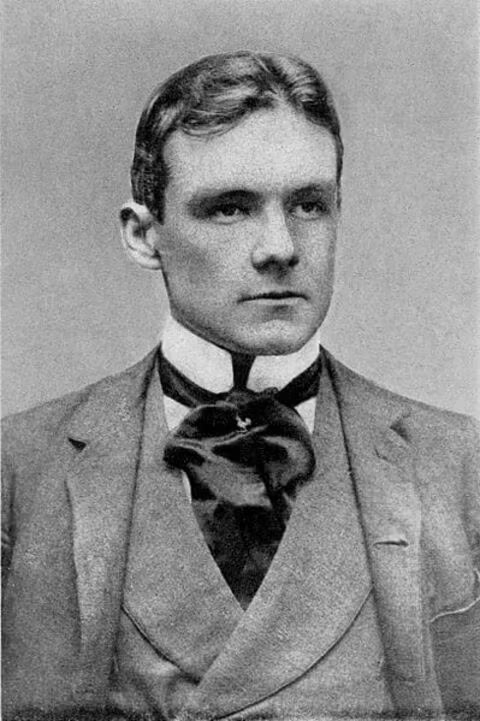
Quick Facts
Richard Harding Davis
Born: April 18, 1864
Died: April 11, 1916
Nationality: American
Genres: Adventure, Realism, Historical Fiction
Notable Works: Soldiers of Fortune, Gallegher and Other Stories, Van Bibber and Others, Ranson's Folly, The Bar Sinister
👶 Early Life and Family
Richard Harding Davis was born on April 18, 1864, in Philadelphia, Pennsylvania, into a distinguished literary family. His mother, Rebecca Harding Davis, was a celebrated novelist and pioneering realist, famous for her groundbreaking novella Life in the Iron-Mills (1861). His father, Lemuel Clarke Davis, was a journalist and editor of the Philadelphia Public Ledger. Growing up surrounded by writers and editors, young Richard was immersed in the world of letters from childhood.
📚 Education
Davis attended the Episcopal Academy in Philadelphia before enrolling at Swarthmore College in 1882. After an unhappy year at Swarthmore, he transferred to Lehigh University, where he published his first book, The Adventures of My Freshman (1884), a collection of short stories. He later transferred again to Johns Hopkins University in 1885, though he left without completing a degree, eager to pursue a career in journalism.
📰 Journalism Career and Rise to Fame
Davis began his journalism career at the Philadelphia Record, where his father helped him land his first position. After brief stints at the Philadelphia Press, he joined the New York Evening Sun, where his vivid, flamboyant writing style drew wide attention. He quickly rose to become managing editor of Harper's Weekly, one of the most influential publications of the era. His reporting ranged from politics to city life, and he became one of the most recognizable journalists in America.
Davis's fame as a war correspondent defined his career. He covered six major conflicts firsthand: the Greco-Turkish War (1897), the Spanish-American War (1898), the Second Boer War (1899-1900), the Russo-Japanese War (1904), and the early years of World War I (1914-1915). His vivid dispatches from the front lines, particularly his coverage of the German invasion of Belgium, set the standard for American war journalism and made him an international celebrity.
📖 Literary Career
While Davis is remembered today primarily as a journalist, he was equally famous in his time as a fiction writer. His breakthrough came with Gallegher and Other Stories (1891), featuring his beloved tale of a Philadelphia newsboy who helps solve a crime. The collection was an immediate sensation and established Davis as a major voice in American short fiction.
He went on to create one of the most popular characters of the 1890s: Courtlandt Van Bibber, a charming, wealthy New York socialite who appeared in dozens of stories collected in Van Bibber and Others (1892). Davis published over a dozen story collections containing roughly eighty tales, including The Exiles and Other Stories (1894), Ranson's Folly (1902), and Once Upon a Time (1910). His seven novels, particularly Soldiers of Fortune (1897)—a best-selling adventure set in a fictional Latin American republic—cemented his status as one of the most widely read American authors of the Gilded Age.
Davis also found success as a playwright, writing twenty-five plays. His dramatization of Ranson's Folly (1904), The Dictator (1904), and Miss Civilization (1906) were popular Broadway productions.
🌿 Writing Style
Davis wrote with the sharp eye of a journalist and the narrative flair of an adventure novelist. His prose was fast-paced, vivid, and often infused with dry humor. He excelled at depicting men of action—soldiers, reporters, diplomats, and adventurers—in exotic or dangerous settings. His fiction drew heavily on his own globe-trotting experiences, blending realism with romanticism. Critics noted his gift for creating memorable openings and for sketching character through dialogue and gesture rather than interior monologue.
✒️ Notable Works
Among Davis's most enduring works are:
- "Gallegher" (1891) — his most famous short story, about a scrappy newsboy who outsmarts the police
- Soldiers of Fortune (1897) — his best-selling adventure novel
- "The Reporter Who Made Himself King" (1894) — a classic tale of a journalist's adventure on a South Pacific island
- "The Bar Sinister" (1903) — a beloved story told from the perspective of a mixed-breed dog
- "A Charmed Life" (1910) — a powerful war story about love, duty, and luck
🕴️ The Gibson Man
Davis was famously handsome and impeccably dressed, and he became the real-life model for illustrator Charles Dana Gibson's "Gibson Man"—the dashing, square-jawed masculine ideal that paired with Gibson's iconic "Gibson Girl." Davis's influence extended beyond literature into fashion and popular culture; he was widely credited with popularizing the clean-shaven look among American men at the turn of the century.
❤️ Personal Life
Davis married Cecil Clark, an artist, in 1899. The couple divorced in 1912, and Davis married Bessie McCoy, a popular actress and vaudeville performer known for her signature "Yama Yama Man" routine. They had a daughter, Hope, born in 1915.
✨ Death and Legacy
Richard Harding Davis died of a heart attack on April 11, 1916, at his home in Mount Kisco, New York, just one week before his fifty-second birthday. He was buried in Philadelphia.
In his lifetime, Davis was one of the most famous Americans of his generation—a celebrity journalist, best-selling author, and cultural icon. Though his literary reputation faded in the decades after his death, his war correspondence remains a landmark of the genre, and stories like "Gallegher" continue to be read and anthologized. His adventurous life and prolific output embody the restless, ambitious spirit of Gilded Age America.
⭐ Interesting Facts
- Davis was said to be the highest-paid reporter in America during the 1890s.
- Theodore Roosevelt personally praised Davis's coverage of the Rough Riders during the Spanish-American War.
- His mother, Rebecca Harding Davis, is now considered more literary important than her son—her Life in the Iron-Mills is a cornerstone of American realism.
- He covered six wars on four continents in less than twenty years.
- The Van Bibber stories were so popular that "Van Bibber" became a slang term for a well-dressed gentleman about town.
Frequently Asked Questions about Richard Harding Davis
Where can I find study guides for Richard Harding Davis's stories?
We offer free interactive study guides for the following Richard Harding Davis stories:
- Gallegher — comprehension questions, vocabulary review, and discussion prompts
- The Reporter Who Made Himself King — comprehension questions, vocabulary review, and discussion prompts