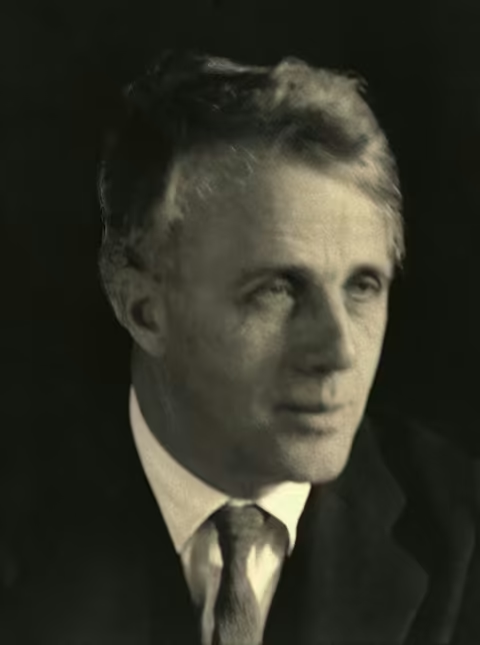
Photograph by Doris Ulmann, 1929. Platinum print. National Portrait Gallery, Smithsonian Institution.
Quick Facts
Robert Lee Frost
Pen Name: Robert Frost
Born: March 26, 1874
Died: January 29, 1963
Nationality: American
Genres: Poetry, Realism
Notable Works: The Road Not Taken, Stopping by Woods on a Snowy Evening, Mending Wall, Nothing Gold Can Stay, Fire and Ice
👶 Early Life and Education
Robert Lee Frost was born on March 26, 1874, in San Francisco, California — a surprising origin for a poet so closely identified with New England. His father, William Prescott Frost Jr., was a journalist and aspiring politician who named his son after the Confederate general Robert E. Lee. When his father died of tuberculosis in 1885, the eleven-year-old Frost and his mother, Isabelle Moodie Frost, moved to Lawrence, Massachusetts, to live with his paternal grandparents.
Frost discovered poetry early: he published his first poem in his high school magazine and graduated as co-valedictorian of Lawrence High School in 1892, alongside Elinor Miriam White, who would become his wife. He briefly attended Dartmouth College but left after less than a semester. He later enrolled at Harvard in 1897, studying classical literature, but departed after two years without completing his degree. His real education came from farming, teaching, and reading — he was particularly drawn to Ralph Waldo Emerson, William Shakespeare, and the English Romantic poets.
🌾 The Derry Farm Years
In December 1895, Frost married Elinor White, and the couple settled on a farm in Derry, New Hampshire, in 1900. The Derry years (1900–1909) were defined by hardship and heartbreak — their eldest son Elliott had died of cholera in 1900 at age three, and their daughter Elinor died shortly after birth in 1907 — but they also shaped the landscapes, voices, and rhythms that would infuse Frost's greatest poetry. He farmed by day and wrote by night, publishing his first significant poem, My Butterfly, in The Independent as early as 1894, but struggling to find an audience for his work.
Frost supplemented farming with teaching, first at Pinkerton Academy (1906–1911), then at the New Hampshire Normal School. But by 1912, with few publications and little recognition, the thirty-eight-year-old poet made a bold decision: he sold the farm and moved his family to England.
📖 England and the Breakthrough
The English years (1912–1915) transformed Frost's career. Within months of arriving, he published A Boy's Will (1913), his first poetry collection, with the London publisher David Nutt. The following year brought North of Boston (1914), containing poems that would become cornerstones of American literature: Mending Wall, The Death of the Hired Man, After Apple-Picking, and Home Burial.
In England, Frost formed a pivotal friendship with the poet Edward Thomas, whose walks through the English countryside with Frost inspired The Road Not Taken. Frost also met Ezra Pound, who championed his work in American literary magazines. By the time Frost returned to the United States in 1915, he was already famous.
🌿 Writing Style
Frost's genius lay in what he called "the sound of sense" — the idea that meaning lives not only in words but in the tones and rhythms of actual speech. His poems use the natural cadences of New England conversation within traditional verse forms — blank verse, sonnets, couplets — creating a deceptive simplicity that opens onto philosophical depth. Beneath the stone walls, birch trees, and snowy woods of his rural settings run darker currents: isolation, grief, the limits of knowledge, and the human confrontation with an indifferent natural world.
He once wrote that a poem "begins in delight and ends in wisdom," and his best work enacts exactly that movement — drawing readers in with vivid imagery and plain speech before arriving at moments of startling insight.
✒️ Notable Works
Frost published nine major collections over five decades. Mountain Interval (1916) gave the world The Road Not Taken, Birches, and “Out, Out—”. New Hampshire (1923) won his first Pulitzer Prize and included Stopping by Woods on a Snowy Evening, Fire and Ice, and Nothing Gold Can Stay — the last of which gained a second life through S.E. Hinton's novel The Outsiders.
Frost remains the only poet to receive four Pulitzer Prizes for Poetry: for New Hampshire (1924), Collected Poems (1931), A Further Range (1937), and A Witness Tree (1943). Other essential poems include The Wood-Pile, The Oven Bird, Acquainted with the Night, Design, and Dust of Snow.
🏡 Personal Life and Later Years
Frost's public persona — the avuncular New England farmer-poet — masked a life shadowed by loss. His son Carol committed suicide in 1940, his daughter Marjorie died of puerperal fever in 1934, and his daughter Irma was institutionalized with mental illness. His wife Elinor, his high school sweetheart and lifelong companion, died of heart failure in 1938. Frost himself suffered bouts of severe depression throughout his life.
Despite private grief, Frost's later career brought extraordinary public honors. He held teaching posts at Amherst College, the University of Michigan, Dartmouth, and Harvard. Congress awarded him a Congressional Gold Medal in 1960, and in 1961 he became the first poet invited to read at a presidential inauguration.
On January 20, 1961, the eighty-six-year-old Frost took the lectern at President John F. Kennedy's inauguration. He had labored to write a new poem, Dedication, for the occasion — but the brilliant winter sun reflecting off the snow made the page impossible to read. Vice President Lyndon Johnson held his hat up to shade the text, but Frost, with the poise of a man who had spent a lifetime trusting memory over the written word, set aside the new poem and recited The Gift Outright from memory instead.
✨ Death and Legacy
Robert Frost died on January 29, 1963, in Boston, Massachusetts, from complications following surgery. He was buried alongside Elinor and other family members in Old Bennington Cemetery in Vermont. His gravestone bears the inscription: "I had a lover's quarrel with the world."
Frost's poetry endures because it works on two levels simultaneously: accessible enough for schoolchildren, yet complex enough to sustain a lifetime of rereading. His poems are among the most memorized, quoted, and taught in the English language — and his influence extends far beyond literature into the broader American imagination. He remains a towering figure in American letters, a poet who captured both the beauty and the darkness of the rural New England landscape, and of human experience itself.
Frequently Asked Questions about Robert Frost
What are Robert Frost's most famous poems?
Robert Frost's most famous poems include The Road Not Taken, Stopping by Woods on a Snowy Evening, Mending Wall, Fire and Ice, and Nothing Gold Can Stay. Other widely taught poems include Birches, After Apple-Picking, and The Death of the Hired Man.
What is Robert Frost best known for?
Robert Frost is best known for his realistic depictions of rural New England life and his mastery of American colloquial speech within traditional verse forms. He is the only poet to have won four Pulitzer Prizes for Poetry (1924, 1931, 1937, 1943). His poems are among the most widely memorized and taught in the English language.
What was Robert Frost's writing style?
Frost's writing style combines the natural rhythms of New England speech with traditional poetic forms like blank verse and sonnets. He called this approach "the sound of sense" — the idea that meaning lives in the tones and cadences of spoken language. His poems use accessible imagery of rural life — stone walls, birch trees, snowy woods — to explore deeper philosophical themes of isolation, choice, mortality, and humanity's relationship with nature.
How many Pulitzer Prizes did Robert Frost win?
Robert Frost won four Pulitzer Prizes for Poetry, making him the only poet to achieve this distinction. He won for New Hampshire (1924), Collected Poems (1931), A Further Range (1937), and A Witness Tree (1943). He also received a Congressional Gold Medal in 1960.
Did Robert Frost read a poem at JFK's inauguration?
Yes. On January 20, 1961, the eighty-six-year-old Frost became the first poet to read at a presidential inauguration. He had written a new poem, Dedication, for the occasion, but brilliant sunlight reflecting off the snow made the manuscript impossible to read. He set the new poem aside and recited The Gift Outright from memory instead.
Where was Robert Frost born and raised?
Robert Frost was born on March 26, 1874, in San Francisco, California. After his father died of tuberculosis in 1885, the eleven-year-old Frost moved with his mother to Lawrence, Massachusetts. Though born on the West Coast, Frost became closely identified with New England — particularly New Hampshire and Vermont — where he lived, farmed, taught, and set most of his poetry.
When did Robert Frost die and what was his cause of death?
Robert Frost died on January 29, 1963, in Boston, Massachusetts, at age eighty-eight. He died from complications following surgery. He was buried alongside his wife Elinor in Old Bennington Cemetery in Vermont, with the epitaph: "I had a lover's quarrel with the world."
What is "The Road Not Taken" really about?
The Road Not Taken is often read as a celebration of individualism, but Frost intended it partly as a gentle joke about his friend, the poet Edward Thomas, who always regretted whichever path they chose on their walks together. The poem's famous final lines — "I took the one less traveled by, / And that has made all the difference" — carry an ironic edge: the speaker admits the two roads were "really about the same." The poem explores how we construct narratives about our choices after the fact.