The Road Not Taken
by Robert Frost
Some say this poem represents the quintessential American expression of free will, but many get its meaning wrong. Frost's oft-quoted poem was published in his poetry collection, Maintain Interval (1916). Both paths were actually equally worn, the author planned to recreate the scene for others later with a slight twist: He will claim that he took the less-traveled road. Read more.
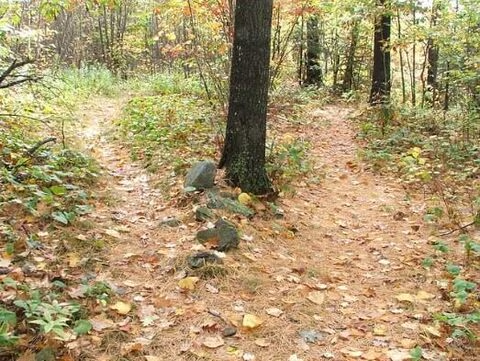
Two roads diverged in a yellow wood,
And sorry I could not travel both
And be one traveler, long I stood
And looked down one as far as I could
To where it bent in the undergrowth;

Then took the other, as just as fair,
And having perhaps the better claim
Because it was grassy and wanted wear,
Though as for that the passing there
Had worn them really about the same,

And both that morning equally lay
In leaves no step had trodden black.
Oh, I marked the first for another day!
Yet knowing how way leads on to way
I doubted if I should ever come back.

I shall be telling this with a sigh
Somewhere ages and ages hence:
Two roads diverged in a wood, and I,
I took the one less traveled by,
And that has made all the difference.
This poem is featured in our selection of Poetry for Students, 100 Great Poems, and Pulitzer Prize Poetry.
Frequently Asked Questions about The Road Not Taken
What is "The Road Not Taken" by Robert Frost about?
The Road Not Taken describes a traveler who encounters a fork in a yellow wood and must choose between two paths. After considering both, the speaker takes one, noting that it looked "grassy and wanted wear" -- though he admits both paths were actually worn "about the same." The poem ends with the speaker imagining that "ages and ages hence," he will claim his choice "made all the difference." On the surface it is about a woodland walk, but Frost uses the diverging roads as an extended metaphor for the life choices we all face and the stories we later tell ourselves about them.
What is the theme of "The Road Not Taken"?
The central theme is the nature of choice and its consequences. The speaker faces two nearly identical paths and must commit to one, knowing he can never go back. A secondary theme is self-deception and narrative construction -- the speaker admits the roads were "really about the same," yet imagines telling the story later as though one road was clearly different. Frost suggests that we assign meaning to our choices in retrospect, turning ordinary decisions into defining moments. Related themes include regret, the passage of time, and the impossibility of knowing what the unchosen path would have brought.
Is "The Road Not Taken" really about individualism?
Not exactly. The poem is widely quoted as a celebration of nonconformity -- "I took the one less traveled by, / And that has made all the difference" -- but this is arguably the most famous misreading in American poetry. The speaker explicitly states that both roads "equally lay / In leaves no step had trodden black" and were worn "really about the same." The supposedly less-traveled road is not less traveled at all. Frost originally wrote the poem as a gentle joke about his friend, the English poet Edward Thomas, who on their walks together was perpetually indecisive and always lamented not taking the other path. The deeper meaning is about how we retroactively construct narratives of individuality around choices that were, at the time, essentially arbitrary.
What literary devices are used in "The Road Not Taken"?
Frost employs several key literary devices. The entire poem is an extended metaphor, with the diverging roads representing life choices. Imagery is vivid throughout -- "yellow wood," "grassy and wanted wear," "leaves no step had trodden black" -- appealing to sight and touch to place the reader on the forest path. Irony is central: the title refers to the road not taken, yet the speaker fixates on justifying the road he chose, and his claim that one was "less traveled" contradicts his own earlier observation. The poem also uses anaphora ("And" repeated at the start of consecutive lines), enjambment to mimic the flow of walking, and a steady iambic tetrameter rhythm with an ABAAB rhyme scheme that gives it a conversational, contemplative pace.
What do the two roads symbolize in "The Road Not Taken"?
The two roads symbolize the choices and crossroads we encounter in life -- career paths, relationships, beliefs, or any decision where choosing one option means foreclosing another. The fact that the roads are described as nearly identical is itself symbolic: many of life's pivotal decisions feel ambiguous in the moment, with no clear "right" answer. The yellow wood symbolizes autumn and a time of transition or maturity, suggesting the speaker is at a turning point. The undergrowth that hides where each path leads represents the uncertainty of the future. Together, these symbols reinforce Frost's theme that the significance we assign to our choices often comes after the fact, not during the decision itself.
When was "The Road Not Taken" published?
The Road Not Taken was first published in the August 1915 issue of The Atlantic Monthly. It was then collected as the opening poem of Frost's third poetry collection, Mountain Interval, in 1916. Frost wrote it while living in England (1912--1915), inspired by walks with his friend Edward Thomas, whose habitual indecisiveness at forks in the road amused Frost. The poem quickly became one of the most quoted and anthologized poems in the English language.
Why is "The Road Not Taken" so famous?
The Road Not Taken is one of the most widely quoted poems in the English language, and its fame rests on a productive ambiguity. On a first reading, the final stanza sounds like an inspirational endorsement of individuality, which is why it appears in graduation speeches, self-help books, and motivational posters. But on closer reading, the poem's irony becomes apparent -- the speaker's claim of taking "the one less traveled" contradicts his own admission that both paths were equally worn. This double nature allows the poem to speak to casual readers and literary scholars alike. Its cultural footprint is enormous: the phrase "the road not taken" has appeared in over 400 book titles and subtitles, and lines from the poem have been referenced in songs, television episodes, and thousands of news articles.
What does the ending of "The Road Not Taken" mean?
In the final stanza, the speaker projects himself into the distant future: "I shall be telling this with a sigh / Somewhere ages and ages hence." He imagines claiming that choosing the less-traveled road "has made all the difference." The key word is "shall" -- he is not reflecting on the past but predicting how he will retell the story. The "sigh" is ambiguous: it could be wistful satisfaction or lingering regret. Frost is showing how people construct meaning from their choices in hindsight, turning a moment of indecision into a narrative of destiny. The ending invites readers to question whether our life stories are truthful recollections or comforting fictions we craft long after the fact.
Who was Edward Thomas and how did he inspire "The Road Not Taken"?
Edward Thomas was a Welsh-born English writer, poet, and literary critic who became one of Frost's closest friends during Frost's time in England (1912--1915). The two took frequent walks through the English countryside, and Thomas was notoriously indecisive at every fork in the path, invariably regretting afterward that they had not taken the other route. Frost wrote The Road Not Taken as a gently teasing portrait of this habit. Ironically, Thomas took the poem at face value as a sincere reflection on choices, which disappointed Frost. Thomas himself went on to become one of the finest English poets of the early twentieth century before he was killed at the Battle of Arras in 1917.
What is the rhyme scheme and structure of "The Road Not Taken"?
The Road Not Taken consists of four stanzas of five lines each (quintains). The rhyme scheme is ABAAB -- the first, third, and fourth lines rhyme, and the second and fifth lines rhyme. The poem is written primarily in iambic tetrameter (four stressed beats per line), which gives it a steady, walking rhythm that mirrors the speaker's journey through the woods. Frost uses enjambment between lines to create a flowing, conversational tone, and the regular but not rigid meter reflects his characteristic blend of formal craft and natural speech -- what Frost called "the sound of sense."
Save stories, build your reading list, and access all study tools — completely free.
Save The Road Not Taken to your library — it's free!Need help with The Road Not Taken?
Study tools to help with homework, prepare for quizzes, and deepen your understanding.
Flashcards → | Vocabulary → | Study Guide →