Little Snow-White
by The Brothers Grimm
The Brothers Grimm wrote Little Snow-White, an original German fairytale published in their collection, "Kinder- und Hausmärchen," translated as Children's and Household Tales (1812). Note: for younger children, we recommend this version instead: Snow White, one of our Favorite Fairy Tales.
Once upon a time in the middle of winter, when the flakes of snow were falling like feathers from the sky, a queen sat at a window sewing, and the frame of the window was made of black ebony. And whilst she was sewing and looking out of the window at the snow, she pricked her finger with the needle, and three drops of blood fell upon the snow. And the red looked pretty upon the white snow, and she thought to herself, "Would that I had a child as white as snow, as red as blood, and as black as the wood of the window-frame."
Soon after that she had a little daughter, who was as white as snow, and as red as blood, and her hair was as black as ebony; and she was therefore called Little Snow-white. And when the child was born, the Queen died.
After a year had passed the King took to himself another wife. She was a beautiful woman, but proud and haughty, and she could not bear that anyone else should surpass her in beauty. She had a wonderful looking-glass, and when she stood in front of it and looked at herself in it, and said—-
"Looking-glass, Looking-glass, on the wall,
Who in this land is the fairest of all?"
the looking-glass answered—-
"Thou, O Queen, art the fairest of all!"
Then she was satisfied, for she knew that the looking-glass spoke the truth.
But Snow-white was growing up, and grew more and more beautiful; and when she was seven years old she was as beautiful as the day, and more beautiful than the Queen herself. And once when the Queen asked her looking-glass —
"Looking-glass, Looking-glass, on the wall, Who in this land is the fairest of all?"
it answered—-
"Thou art fairer than all who are here, Lady Queen."
But more beautiful still is Snow-white, as I ween."
Then the Queen was shocked, and turned yellow and green with envy. From that hour, whenever she looked at Snow-white, her heart heaved in her breast, she hated the girl so much.
And envy and pride grew higher and higher in her heart like a weed, so that she had no peace day or night. She called a huntsman, and said, "Take the child away into the forest; I will no longer have her in my sight. Kill her, and bring me back her heart as a token." The huntsman obeyed, and took her away; but when he had drawn his knife, and was about to pierce Snow-white's innocent heart, she began to weep, and said, "Ah dear huntsman, leave me my life! I will run away into the wild forest, and never come home again."
And as she was so beautiful the huntsman had pity on her and said, "Run away, then, you poor child." "The wild beasts will soon have devoured you," thought he, and yet it seemed as if a stone had been rolled from his heart since it was no longer needful for him to kill her. And as a young boar just then came running by he stabbed it, and cut out its heart and took it to the Queen as proof that the child was dead. The cook had to salt this, and the wicked Queen ate it, and thought she had eaten the heart of Snow-white.
But now the poor child was all alone in the great forest, and so terrified that she looked at every leaf of every tree, and did not know what to do. Then she began to run, and ran over sharp stones and through thorns, and the wild beasts ran past her, but did her no harm.
She ran as long as her feet would go until it was almost evening; then she saw a little cottage and went into it to rest herself. Everything in the cottage was small, but neater and cleaner than can be told. There was a table on which was a white cover, and seven little plates, and on each plate a little spoon; moreover, there were seven little knives and forks, and seven little mugs. Against the wall stood seven little beds side by side, and covered with snow-white counterpanes.
Little Snow-white was so hungry and thirsty that she ate some vegetables and bread from each plate and drank a drop of wine out of each mug, for she did not wish to take all from one only. Then, as she was so tired, she laid herself down on one of the little beds, but none of them suited her; one was too long, another too short, but at last she found that the seventh one was right, and so she remained in it, said a prayer and went to sleep.
When it was quite dark the owners of the cottage came back; they were seven dwarfs who dug and delved in the mountains for ore. They lit their seven candles, and as it was now light within the cottage they saw that someone had been there, for everything was not in the same order in which they had left it.
The first said, "Who has been sitting on my chair?"
The second, "Who has been eating off my plate?"
The third, "Who has been taking some of my bread?"
The fourth, "Who has been eating my vegetables?"
The fifth, "Who has been using my fork?"
The sixth, "Who has been cutting with my knife?"
The seventh, "Who has been drinking out of my mug?"
Then the first looked round and saw that there was a little hole on his bed, and he said, "Who has been getting into my bed?" The others came up and each called out, "Somebody has been lying in my bed too." But the seventh when he looked at his bed saw little Snow-white, who was lying asleep therein. And he called the others, who came running up, and they cried out with astonishment, and brought their seven little candles and let the light fall on little Snow-white. "Oh, heavens! oh, heavens!" cried they, "what a lovely child!" and they were so glad that they did not wake her up, but let her sleep on in the bed. And the seventh dwarf slept with his companions, one hour with each, and so got through the night.
When it was morning little Snow-white awoke, and was frightened when she saw the seven dwarfs. But they were friendly and asked her what her name was. "My name is Snow-white," she answered. "How have you come to our house?" said the dwarfs. Then she told them that her step-mother had wished to have her killed, but that the huntsman had spared her life, and that she had run for the whole day, until at last she had found their dwelling. The dwarfs said, "If you will take care of our house, cook, make the beds, wash, sew, and knit, and if you will keep everything neat and clean, you can stay with us and you shall want for nothing." "Yes," said Snow-white, "with all my heart," and she stayed with them. She kept the house in order for them; in the mornings they went to the mountains and looked for copper and gold, in the evenings they came back, and then their supper had to be ready. The girl was alone the whole day, so the good dwarfs warned her and said, "Beware of your step-mother, she will soon know that you are here; be sure to let no one come in."
But the Queen, believing that she had eaten Snow-white's heart, could not but think that she was again the first and most beautiful of all; and she went to her looking-glass and said—-
"Looking-glass, Looking-glass, on the wall,
Who in this land is the fairest of all?"
and the glass answered —
"Oh, Queen, thou art fairest of all I see,
But over the hills, where the seven dwarfs dwell,
Snow-white is still alive and well,
And none is so fair as she."
Then she was astounded, for she knew that the looking-glass never spoke falsely, and she knew that the huntsman had betrayed her, and that little Snow-white was still alive.
And so she thought and thought again how she might kill her, for so long as she was not the fairest in the whole land, envy let her have no rest. And when she had at last thought of something to do, she painted her face, and dressed herself like an old pedler-woman, and no one could have known her. In this disguise she went over the seven mountains to the seven dwarfs, and knocked at the door and cried, "Pretty things to sell, very cheap, very cheap." Little Snow-white looked out of the window and called out, "Good-day my good woman, what have you to sell?" "Good things, pretty things," she answered; "stay-laces of all colours," and she pulled out one which was woven of bright-coloured silk. "I may let the worthy old woman in," thought Snow-white, and she unbolted the door and bought the pretty laces. "Child," said the old woman, "what a fright you look; come, I will lace you properly for once." Snow-white had no suspicion, but stood before her, and let herself be laced with the new laces. But the old woman laced so quickly and so tightly that Snow-white lost her breath and fell down as if dead. "Now I am the most beautiful," said the Queen to herself, and ran away.
Not long afterwards, in the evening, the seven dwarfs came home, but how shocked they were when they saw their dear little Snow-white lying on the ground, and that she neither stirred nor moved, and seemed to be dead. They lifted her up, and, as they saw that she was laced too tightly, they cut the laces; then she began to breathe a little, and after a while came to life again. When the dwarfs heard what had happened they said, "The old pedler-woman was no one else than the wicked Queen; take care and let no one come in when we are not with you."
But the wicked woman when she had reached home went in front of the glass and asked—-
"Looking-glass, Looking-glass, on the wall,
Who in this land is the fairest of all?"
and it answered as before—-
"Oh, Queen, thou art fairest of all I see,
But over the hills, where the seven dwarfs dwell,
Snow-white is still alive and well,
And none is so fair as she."
When she heard that, all her blood rushed to her heart with fear, for she saw plainly that little Snow-white was again alive. "But now," she said, "I will think of something that shall put an end to you," and by the help of witchcraft, which she understood, she made a poisonous comb. Then she disguised herself and took the shape of another old woman. So she went over the seven mountains to the seven dwarfs, knocked at the door, and cried, "Good things to sell, cheap, cheap!" Little Snow-white looked out and said, "Go away; I cannot let any one come in." "I suppose you can look," said the old woman, and pulled the poisonous comb out and held it up. It pleased the girl so well that she let herself be beguiled, and opened the door. When they had made a bargain the old woman said, "Now I will comb you properly for once." Poor little Snow-white had no suspicion, and let the old woman do as she pleased, but hardly had she put the comb in her hair than the poison in it took effect, and the girl fell down senseless. "You paragon of beauty," said the wicked woman, "you are done for now," and she went away.
But fortunately it was almost evening, when the seven dwarfs came home. When they saw Snow-white lying as if dead upon the ground they at once suspected the step-mother, and they looked and found the poisoned comb. Scarcely had they taken it out when Snow-white came to herself, and told them what had happened. Then they warned her once more to be upon her guard and to open the door to no one.
The Queen, at home, went in front of the glass and said—-
"Looking-glass, Looking-glass, on the wall,
Who in this land is the fairest of all?"
then it answered as before—-
"Oh, Queen, thou art fairest of all I see,
But over the hills, where the seven dwarfs dwell,
Snow-white is still alive and well,
And none is so fair as she."
When she heard the glass speak thus she trembled and shook with rage.
"Snow-white shall die," she cried, "even if it costs me my life!"
Thereupon she went into a quite secret, lonely room, where no one ever came, and there she made a very poisonous apple. Outside it looked pretty, white with a red cheek, so that everyone who saw it longed for it; but whoever ate a piece of it must surely die.
When the apple was ready she painted her face, and dressed herself up as a country-woman, and so she went over the seven mountains to the seven dwarfs. She knocked at the door. Snow-white put her head out of the window and said, "I cannot let any one in; the seven dwarfs have forbidden me." "It is all the same to me," answered the woman, "I shall soon get rid of my apples. There, I will give you one."
"No," said Snow-white, "I dare not take anything." "Are you afraid of poison?" said the old woman; "look, I will cut the apple in two pieces; you eat the red cheek, and I will eat the white." The apple was so cunningly made that only the red cheek was poisoned. Snow-white longed for the fine apple, and when she saw that the woman ate part of it she could resist no longer, and stretched out her hand and took the poisonous half. But hardly had she a bit of it in her mouth than she fell down dead. Then the Queen looked at her with a dreadful look, and laughed aloud and said, "White as snow, red as blood, black as ebony-wood! this time the dwarfs cannot wake you up again."
And when she asked of the Looking-glass at home—-
"Looking-glass, Looking-glass, on the wall,
Who in this land is the fairest of all?"
it answered at last —
"Oh, Queen, in this land thou art fairest of all."
Then her envious heart had rest, so far as an envious heart can have rest.
The dwarfs, when they came home in the evening, found Snow-white lying upon the ground; she breathed no longer and was dead. They lifted her up, looked to see whether they could find anything poisonous, unlaced her, combed her hair, washed her with water and wine, but it was all of no use; the poor child was dead, and remained dead. They laid her upon a bier, and all seven of them sat round it and wept for her, and wept three days long.
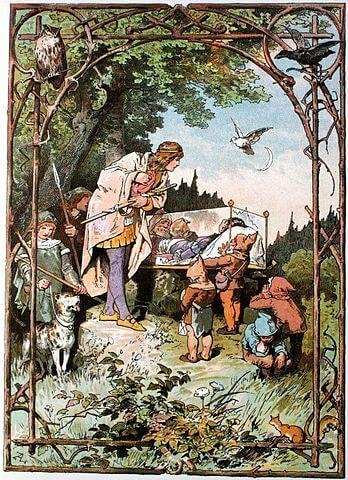
Then they were going to bury her, but she still looked as if she were living, and still had her pretty red cheeks. They said, "We could not bury her in the dark ground," and they had a transparent coffin of glass made, so that she could be seen from all sides, and they laid her in it, and wrote her name upon it in golden letters, and that she was a king's daughter. Then they put the coffin out upon the mountain, and one of them always stayed by it and watched it. And birds came too, and wept for Snow-white; first an owl, then a raven, and last a dove.
And now Snow-white lay a long, long time in the coffin, and she did not change, but looked as if she were asleep; for she was as white as snow, as red as blood, and her hair was as black as ebony.
It happened, however, that a king's son came into the forest, and went to the dwarfs' house to spend the night. He saw the coffin on the mountain, and the beautiful Snow-white within it, and read what was written upon it in golden letters. Then he said to the dwarfs, "Let me have the coffin, I will give you whatever you want for it." But the dwarfs answered, "We will not part with it for all the gold in the world." Then he said, "Let me have it as a gift, for I cannot live without seeing Snow-white. I will honour and prize her as my dearest possession." As he spoke in this way the good dwarfs took pity upon him, and gave him the coffin.
And now the King's son had it carried away by his servants on their shoulders. And it happened that they stumbled over a tree-stump, and with the shock the poisonous piece of apple which Snow-white had bitten off came out of her throat. And before long she opened her eyes, lifted up the lid of the coffin, sat up, and was once more alive. "Oh, heavens, where am I?" she cried. The King's son, full of joy, said, "You are with me," and told her what had happened, and said, "I love you more than everything in the world; come with me to my father's palace, you shall be my wife."
And Snow-white was willing, and went with him, and their wedding was held with great show and splendour. But Snow-white's wicked step-mother was also bidden to the feast. When she had arrayed herself in beautiful clothes she went before the Looking-glass, and said—-
"Looking-glass, Looking-glass, on the wall,
Who in this land is the fairest of all?"
the glass answered—-
"Oh, Queen, of all here the fairest art thou,
But the young Queen is fairer by far as I trow."
Then the wicked woman uttered a curse, and was so wretched, so utterly wretched, that she knew not what to do. At first she would not go to the wedding at all, but she had no peace, and must go to see the young Queen. And when she went in she knew Snow-white; and she stood still with rage and fear, and could not stir. But iron slippers had already been put upon the fire, and they were brought in with tongs, and set before her. Then she was forced to put on the red-hot shoes, and dance until she dropped down dead.
We offer an alternate version that may be more appropriate for younger children in our Short Stories for Children, Snow White
Frequently Asked Questions about Little Snow-White
What is "Little Snow-White" about?
Little Snow-White is a fairy tale by about a princess whose extraordinary beauty provokes her vain stepmother, the Evil Queen, into murderous jealousy. After a huntsman spares Snow-White's life, she finds refuge with seven dwarfs in the forest. The Queen discovers Snow-White is alive through her magic looking-glass and attempts to kill her three times—first with tight laces, then a poisoned comb, and finally a poisoned apple. The apple succeeds, and the dwarfs place Snow-White in a glass coffin. A prince discovers her, and when his servants stumble while carrying the coffin, the poisoned apple piece dislodges from her throat, reviving her. Snow-White marries the prince, and at the wedding feast, the Queen is forced to dance in red-hot iron shoes until she drops dead.
What are the main themes of "Little Snow-White" by the Brothers Grimm?
The central themes of Little Snow-White include vanity and its destructive consequences, jealousy, the conflict between good and evil, and the deceptive nature of appearances. The Queen’s obsessive need to be "the fairest of all" drives every act of violence in the story, illustrating how vanity can corrupt even a powerful ruler. Jealousy is closely intertwined—the Queen cannot tolerate anyone surpassing her beauty, and this envy "grew higher and higher in her heart like a weed." The theme of deceptive appearances runs throughout: the Queen disguises herself as harmless old women, the poisoned apple looks beautiful on the outside, and Snow-White herself appears dead when she is merely enchanted. The tale ultimately suggests that inner goodness triumphs over outward beauty pursued through wickedness.
What does the magic mirror symbolize in "Little Snow-White"?
The magic looking-glass in Little Snow-White symbolizes truth and self-knowledge that cannot be escaped. The Queen relies on it for validation of her beauty, and the mirror always "spoke the truth"—it cannot be bribed, flattered, or deceived. When it reveals that Snow-White has surpassed her, the Queen is forced to confront a reality she cannot accept. The mirror also represents the Queen’s narcissistic ego: her entire sense of self-worth depends on its confirmation. In a broader sense, the mirror serves as the story’s moral arbiter, objectively reflecting the truth regardless of what the Queen wants to hear. Its final answer—confirming Snow-White as "the young Queen" who is "fairer by far"—seals the wicked Queen’s downfall.
What does the poisoned apple represent in "Little Snow-White"?
The poisoned apple in Little Snow-White represents temptation, deception, and the danger of trusting appearances. The apple is deliberately crafted to look irresistible—"pretty, white with a red cheek, so that everyone who saw it longed for it"—but its beauty conceals a deadly poison. The Queen even eats the unpoisoned white half to prove it is safe, exploiting Snow-White’s trust and appetite. The apple also carries strong echoes of the biblical forbidden fruit, linking Snow-White’s act of eating it to a fall from innocence. Unlike the Queen’s two previous attempts with laces and a comb, which the dwarfs could reverse, the apple lodges in Snow-White’s throat and appears to kill her permanently—making it the most potent symbol of how the most dangerous deceptions are those that look most wholesome.
What is the moral of "Little Snow-White"?
The moral of Little Snow-White is that vanity and jealousy lead to self-destruction, while innocence and goodness are ultimately rewarded. The Queen’s relentless pursuit of being "the fairest of all" drives her to increasingly desperate and wicked acts—ordering a child’s murder, practicing witchcraft, and personally attempting assassination three times. Yet each scheme either fails or is undone, and the Queen’s final punishment—dancing in red-hot iron shoes at Snow-White’s wedding—is a direct consequence of her own obsessive curiosity drawing her to the feast. The tale also cautions against naïveté: Snow-White is warned repeatedly by the dwarfs not to open the door to strangers, yet she is deceived three times, suggesting that pure-heartedness must be tempered with wisdom.
What literary devices are used in "Little Snow-White"?
Little Snow-White employs several key literary devices. Repetition is central to the tale’s structure: the Queen consults her mirror using the same rhyming formula five times, and she attempts to kill Snow-White three times with escalating methods. This rule of three is a hallmark of fairy tale storytelling, building suspense with each failed attempt. Symbolism pervades the narrative—the mirror represents truth, the apple represents temptation, and the colors white, red, and black (snow, blood, ebony) recur as a motif representing Snow-White’s identity. Foreshadowing appears in the Queen’s eating of what she believes is Snow-White’s heart, presaging her own monstrous end. The tale also uses dramatic irony, as readers know the disguised old women are the Queen, while Snow-White does not.
How is the Brothers Grimm version of Snow White different from the Disney movie?
The Brothers Grimm’s Little Snow-White differs from Disney’s 1937 film in several significant ways. In the original tale, the Queen orders the huntsman to bring back Snow-White’s heart, which she then eats, believing it to be the child’s—a detail Disney omitted entirely. The Queen attempts to kill Snow-White three separate times (with tight laces, a poisoned comb, and the apple), whereas Disney uses only the poisoned apple. Snow-White is revived not by a kiss but when servants stumble carrying her glass coffin, dislodging the apple from her throat. Perhaps most strikingly, the Grimm ending has the Queen forced to dance in red-hot iron shoes until she drops dead at Snow-White’s wedding—a far more brutal punishment than Disney’s cliff fall. The dwarfs are also unnamed in the Grimm version, and Snow-White is only seven years old when the story begins.
What role do the seven dwarfs play in "Little Snow-White"?
The seven dwarfs in Little Snow-White serve as Snow-White’s protectors and surrogate family after she flees the Queen’s murderous plot. They are miners who "dug and delved in the mountains for ore," and they offer Snow-White shelter in exchange for housekeeping—cooking, cleaning, sewing, and knitting. The dwarfs repeatedly warn Snow-White to let no one in while they are away, and each time the Queen attacks, they are the ones who discover and revive her, cutting the tight laces and removing the poisoned comb. When the apple finally defeats them, they mourn for three days and craft a transparent glass coffin so she can still be seen, with one dwarf always standing watch. The dwarfs represent loyalty, community, and domestic protection, contrasting sharply with the isolated, power-obsessed Queen.
When was "Little Snow-White" written and who are the Brothers Grimm?
Little Snow-White was first published in 1812 in Kinder- und Hausmärchen (Children’s and Household Tales), the landmark fairy tale collection compiled by . The Brothers Grimm were German scholars, linguists, and folklorists who gathered stories from oral tradition—tales that had been passed down through generations of storytelling. They did not invent these stories but collected, edited, and published them, preserving a rich tradition of European folklore. Their collection, which also includes Hansel and Gretel, Cinderella, Rapunzel, and Rumpelstiltskin, became one of the most influential works of Western literature. The tale of Snow White, classified as Aarne–Thompson type 709, has roots in folklore traditions across Europe.
What happens at the end of "Little Snow-White"?
The ending of Little Snow-White is both triumphant and brutally punitive. After Snow-White lies in her glass coffin for "a long, long time," a prince discovers her and begs the dwarfs to let him take the coffin. As his servants carry it away, they stumble over a tree-stump, and the jolt dislodges the piece of poisoned apple from Snow-White’s throat, bringing her back to life. The prince declares his love and they plan a grand wedding. The wicked Queen, unable to resist her curiosity, consults her mirror one final time and learns that "the young Queen is fairer by far." Driven by compulsion, she attends the wedding, where she recognizes Snow-White and is frozen with "rage and fear." As punishment, iron slippers heated in the fire are placed before her, and she is forced to dance in them until she collapses and dies—a fitting end for a villain destroyed by the very vanity that drove her crimes.
Save stories, build your reading list, and access all study tools — completely free.
Save Little Snow-White to your library — it's free!Need help with Little Snow-White?
Study tools to help with homework, prepare for quizzes, and deepen your understanding.
Flashcards → | Vocabulary → | Study Guide →