👶 Early Life and Education
Jacob Ludwig Carl Grimm was born on January 4, 1785, and Wilhelm Carl Grimm on February 24, 1786, in Hanau, in the Landgraviate of Hesse-Kassel within the Holy Roman Empire. They were the eldest surviving sons of Philipp Wilhelm Grimm, a prosperous town clerk, and Dorothea Grimm (née Zimmer). The family enjoyed a comfortable, middle-class life until their father died unexpectedly in 1796, plunging them into financial hardship. Despite their reduced circumstances, the brothers were admitted to the prestigious Friedrichsgymnasium in Kassel through their aunt's connections, and both later studied law at the University of Marburg. There, the eminent legal scholar Friedrich Carl von Savigny introduced them to the study of medieval history and folklore, setting the course for their life's work.
📖 Collecting the Tales
Inspired by the German Romantic movement and the conviction that an authentic national literature lay hidden in the oral traditions of the common people, Jacob and Wilhelm began systematically gathering folk stories in 1806. Contrary to popular belief, the brothers did not simply wander through forests interviewing peasants. Many of their most important sources were educated, middle-class women like Dorothea Viehmann, a tailor's wife with a gift for storytelling, and the Wild family of Kassel (Wilhelm would eventually marry Dorothea Wild in 1825). The brothers recorded stories told to them in person, solicited tales by letter, and drew from earlier printed sources including Charles Perrault's 17th-century French collections.
📚 Publication and Editions
The first volume of Kinder- und Hausmärchen (Children's and Household Tales) was published on December 20, 1812, containing 86 stories. A second volume followed in 1815 with 70 more. Jacob handled most of the scholarly apparatus while Wilhelm, the more literary of the two, progressively softened the tales across seven editions (the final, "definitive" edition appeared in 1857). By that last edition, the collection contained 200 tales and 10 "Children's Legends" — numbered KHM 1 through KHM 210 (plus KHM 151a). Early editions were rougher, more violent, and more clearly aimed at adult folklorists; later editions trimmed sexual content while often intensifying moral lessons and punishments, shaping the stories into the form most readers know today.
✒️ Most Famous Fairy Tales
The Brothers Grimm collected and published some of the most recognizable stories in Western literature. Among the most celebrated:
- Rapunzel — a young woman imprisoned in a tower, rescued by her own resourcefulness and a prince's devotion
- Cinderella — the rags-to-riches tale of a mistreated stepdaughter, complete with the famous glass (or in Grimm's version, golden) slipper
- Little Snow-White — the story of a princess, a jealous queen, a poisoned apple, and seven dwarfs
- Hansel and Gretel — two children lost in the forest who outsmart a cannibalistic witch
- Rumpelstiltskin — a mysterious imp who spins straw into gold, demanding a terrible price
- Little Red-Cap (Little Red Riding Hood) — a girl's dangerous encounter with a wolf on the way to grandmother's house
- Briar-Rose (Sleeping Beauty) — a princess cursed to sleep for a hundred years
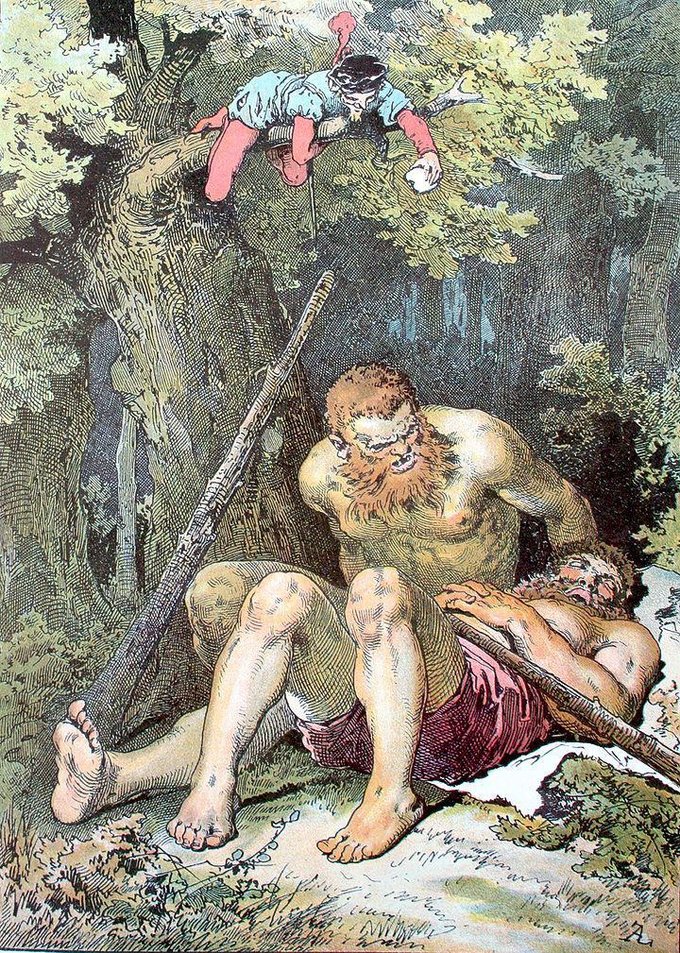
- The Brave Little Tailor — a clever tailor who defeats giants through wit rather than strength
- The Bremen Town Musicians — four aging animals who find a new purpose by banding together
- The Frog Prince — the very first tale in the collection, about a princess and a transformed prince
🌿 Themes and Dark Origins
Grimm fairy tales explore universal themes of good versus evil, cleverness triumphing over brute force, justice for the downtrodden, and the dangers of greed and vanity. But these are not sanitized bedtime stories. The original tales feature dismemberment (The Girl Without Hands), cannibalism (The Juniper-Tree), and gruesome punishments for villains — the evil queen in Little Snow-White is forced to dance in red-hot iron shoes until she drops dead. Modern readers sometimes ask, "What is the scariest Grimm fairy tale?" — strong contenders include The Juniper-Tree, The Robber Bridegroom, and The Girl Without Hands. We recommend parents pre-read Grimm stories before sharing with young children — our Fairy Tales Guide offers age-appropriate recommendations.
🔬 Scholarly Legacy
The Brothers Grimm were far more than storytellers. Jacob, in particular, was one of the foremost linguists of the 19th century. His Deutsche Grammatik (1819–1837) formulated what is now known as Grimm's Law, a foundational discovery in historical linguistics describing systematic sound shifts between Proto-Indo-European and Germanic languages. The brothers also began the monumental Deutsches Wörterbuch (German Dictionary), a comprehensive historical dictionary of the German language that was not completed until 1961 — nearly a century after their deaths. Both brothers held professorships, first at the University of Göttingen and later at the University of Berlin, and were founding members of the Berlin Academy of Sciences.
❤️ Personal Life
Jacob never married, dedicating himself entirely to scholarship. Wilhelm married Dorothea Wild in 1825, and the couple had four children. Remarkably, Jacob lived in the same household as Wilhelm and Dorothea for their entire married life — the brothers were virtually inseparable. In 1837, both were among the "Göttingen Seven," a group of professors who publicly protested the King of Hanover's revocation of the liberal constitution, an act that cost them their university positions but earned them lasting respect as defenders of constitutional rights. Wilhelm died on December 16, 1859, in Berlin. Jacob followed on September 20, 1863, at the age of 78.
🌍 Real-Life Inspirations
Readers often wonder whether Grimm fairy tales are based on true stories. While the tales are not biographical, many draw on real places, customs, and historical events. The forest settings reflect the vast woodlands of Hesse where the brothers grew up. Scholars have traced Little Snow-White to possible real figures, including Margaretha von Waldeck, a 16th-century German countess who was reportedly poisoned. The abandoned-children motif in Hansel and Gretel likely echoes the Great Famine of 1315–1317, when desperate families did abandon children they could not feed.
✨ Legacy and Cultural Impact
The Kinder- und Hausmärchen is the most translated and best-known work of German literature worldwide. It has been translated into more than 160 languages and has never gone out of print. The tales became the foundation for Disney animated films, countless stage adaptations, and modern retellings across every medium. Beyond entertainment, the Grimms pioneered the academic disciplines of folklore studies and comparative mythology. Their work influenced writers from Hans Christian Andersen to J.R.R. Tolkien and Angela Carter. In 2005, UNESCO added the brothers' personal annotated copy of the Kinder- und Hausmärchen to the Memory of the World Register.
📖 About Our Collection
The fairy tales presented here are drawn from the 1884 English translation of Household Tales by Margaret Hunt, and the 1912 edition translated by Marian Edwardes — both faithful renderings of the brothers' final (seventh) edition. Our collection of 216 tales represents the most comprehensive freely available English-language Grimm library online. For gentler tales suitable for very young readers, visit our Children's Library. You may also enjoy the satirical poems of Guy Wetmore Carryl, including How Cinderella Disposed of Her Shoe, inspired by Grimm's tales.