Rapunzel
by The Brothers Grimm
"Rapunzel, Rapunzel, let down your hair!" Originally published in the Brothers Grimm's fairytale collection, "Kinder- und Hausmärchen," translated as Children's and Household Tales in 1812, Rapunzel has been adapted broadly over countless generations in book, movie, and musical forms.
There were once a man and a woman who had long in vain wished for a child. At length the woman hoped that God was about to grant her desire. These people had a little window at the back of their house from which a splendid garden could be seen, which was full of the most beautiful flowers and herbs. It was, however, surrounded by a high wall, and no one dared to go into it because it belonged to an enchantress, who had great power and was dreaded by all the world. One day the woman was standing by this window and looking down into the garden, when she saw a bed which was planted with the most beautiful rampion (rapunzel), and it looked so fresh and green that she longed for it, and had the greatest desire to eat some. This desire increased every day, and as she knew that she could not get any of it, she quite pined away, and looked pale and miserable. Then her husband was alarmed, and asked, "What aileth thee, dear wife?" "Ah," she replied, "if I can't get some of the rampion, which is in the garden behind our house, to eat, I shall die." The man, who loved her, thought, "Sooner than let thy wife die, bring her some of the rampion thyself, let it cost thee what it will." In the twilight of the evening, he clambered down over the wall into the garden of the enchantress, hastily clutched a handful of rampion, and took it to his wife. She at once made herself a salad of it, and ate it with much relish. She, however, liked it so much—-so very much, that the next day she longed for it three times as much as before. If he was to have any rest, her husband must once more descend into the garden. In the gloom of evening, therefore, he let himself down again; but when he had clambered down the wall he was terribly afraid, for he saw the enchantress standing before him. "How canst thou dare," said she with angry look, "to descend into my garden and steal my rampion like a thief? Thou shalt suffer for it!" "Ah," answered he, "let mercy take the place of justice, I only made up my mind to do it out of necessity. My wife saw your rampion from the window, and felt such a longing for it that she would have died if she had not got some to eat." Then the enchantress allowed her anger to be softened, and said to him, "If the case be as thou sayest, I will allow thee to take away with thee as much rampion as thou wilt, only I make one condition, thou must give me the child which thy wife will bring into the world; it shall be well treated, and I will care for it like a mother." The man in his terror consented to everything, and when the woman was brought to bed, the enchantress appeared at once, gave the child the name of Rapunzel, and took it away with her.
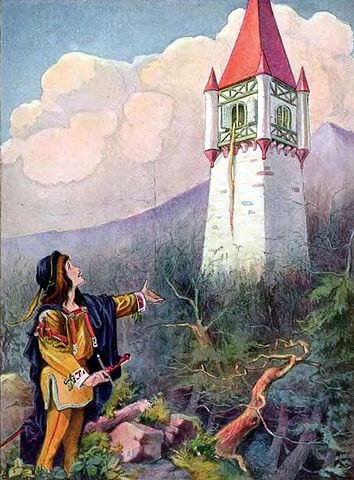
Rapunzel grew into the most beautiful child beneath the sun. When she was twelve years old, the enchantress shut her into a tower, which lay in a forest, and had neither stairs nor door, but quite at the top was a little window. When the enchantress wanted to go in, she placed herself beneath it and cried,
"Rapunzel, Rapunzel,
Let down your hair to me."
Rapunzel had magnificent long hair, fine as spun gold, and when she heard the voice of the enchantress she unfastened her braided tresses, wound them round one of the hooks of the window above, and then the hair fell twenty ells down, and the enchantress climbed up by it.
After a year or two, it came to pass that the King's son rode through the forest and went by the tower. Then he heard a song, which was so charming that he stood still and listened. This was Rapunzel, who in her solitude passed her time in letting her sweet voice resound. The King's son wanted to climb up to her, and looked for the door of the tower, but none was to be found. He rode home, but the singing had so deeply touched his heart, that every day he went out into the forest and listened to it. Once when he was thus standing behind a tree, he saw that an enchantress came there, and he heard how she cried,
"Rapunzel, Rapunzel,
Let down your hair."
Then Rapunzel let down the braids of her hair, and the enchantress climbed up to her. "If that is the ladder by which one mounts, I will for once try my fortune," said he, and the next day when it began to grow dark, he went to the tower and cried,
"Rapunzel, Rapunzel,
Let down your hair."
Immediately the hair fell down and the King's son climbed up.
At first Rapunzel was terribly frightened when a man such as her eyes had never yet beheld, came to her; but the King's son began to talk to her quite like a friend, and told her that his heart had been so stirred that it had let him have no rest, and he had been forced to see her. Then Rapunzel lost her fear, and when he asked her if she would take him for her husband, and she saw that he was young and handsome, she thought, "He will love me more than old Dame Gothel does;" and she said yes, and laid her hand in his. She said, "I will willingly go away with thee, but I do not know how to get down. Bring with thee a skein of silk every time that thou comest, and I will weave a ladder with it, and when that is ready I will descend, and thou wilt take me on thy horse." They agreed that until that time he should come to her every evening, for the old woman came by day. The enchantress remarked nothing of this, until once Rapunzel said to her, "Tell me, Dame Gothel, how it happens that you are so much heavier for me to draw up than the young King's son—-he is with me in a moment." "Ah! thou wicked child," cried the enchantress "What do I hear thee say! I thought I had separated thee from all the world, and yet thou hast deceived me." In her anger she clutched Rapunzel's beautiful tresses, wrapped them twice round her left hand, seized a pair of scissors with the right, and snip, snap, they were cut off, and the lovely braids lay on the ground. And she was so pitiless that she took poor Rapunzel into a desert where she had to live in great grief and misery.
On the same day, however, that she cast out Rapunzel, the enchantress in the evening fastened the braids of hair which she had cut off, to the hook of the window, and when the King's son came and cried,
"Rapunzel, Rapunzel,
Let down your hair,"
she let the hair down. The King's son ascended, but he did not find his dearest Rapunzel above, but the enchantress, who gazed at him with wicked and venomous looks. "Aha!" she cried mockingly, "Thou wouldst fetch thy dearest, but the beautiful bird sits no longer singing in the nest; the cat has got it, and will scratch out thy eyes as well. Rapunzel is lost to thee; thou wilt never see her more." The King's son was beside himself with pain, and in his despair he leapt down from the tower. He escaped with his life, but the thorns into which he fell, pierced his eyes. Then he wandered quite blind about the forest, ate nothing but roots and berries, and did nothing but lament and weep over the loss of his dearest wife. Thus he roamed about in misery for some years, and at length came to the desert where Rapunzel, with the twins to which she had given birth, a boy and a girl, lived in wretchedness. He heard a voice, and it seemed so familiar to him that he went towards it, and when he approached, Rapunzel knew him and fell on his neck and wept. Two of her tears wetted his eyes and they grew clear again, and he could see with them as before. He led her to his kingdom where he was joyfully received, and they lived for a long time afterwards, happy and contented.
Frequently Asked Questions about Rapunzel
What is "Rapunzel" by the Brothers Grimm about?
Rapunzel tells the story of a young girl who is given to an enchantress named Dame Gothel as payment for her father stealing rampion from the enchantress's garden. When Rapunzel turns twelve, Dame Gothel locks her in a doorless tower deep in the forest, accessible only by climbing Rapunzel's extraordinarily long golden hair. A prince discovers her by following the sound of her singing, and the two fall in love and secretly plan her escape. When Dame Gothel discovers their meetings, she cuts off Rapunzel's hair, banishes her to a desert wilderness, and tricks the prince into leaping from the tower, blinding him on the thorns below. After years of wandering, the prince finds Rapunzel and their twin children, and her tears restore his sight.
What is the moral of "Rapunzel"?
The moral of Rapunzel operates on multiple levels. On the surface, it warns against the consequences of unchecked desire — Rapunzel's mother's desperate craving for rampion leads to the loss of her child, and Dame Gothel's possessive desire to keep Rapunzel isolated ultimately fails. More broadly, the tale affirms that love and perseverance triumph over tyranny. Despite years of separation, blindness, and suffering, Rapunzel and the prince are reunited through their devotion. The story also cautions against overprotective guardianship — Dame Gothel's attempt to shield Rapunzel from the outside world only delays the inevitable rather than preventing it.
What are the main themes of "Rapunzel"?
The central themes of Rapunzel include freedom versus imprisonment, as the tower represents both physical confinement and the broader suppression of a young woman's autonomy. The power of love drives the narrative — it compels the prince to risk his life climbing the tower and sustains both characters through years of suffering. The tale also explores the tension between protection and control, with Dame Gothel embodying the archetype of the "devouring mother" who hoards rather than nurtures. Finally, desire and its consequences thread through the entire story, from the mother's craving for rampion to the enchantress's possessive claim on Rapunzel herself.
What does Rapunzel's hair symbolize?
Rapunzel's long golden hair functions as the tale's most potent symbol, representing her beauty, vitality, and connection to the outside world. It is literally the only means of accessing the tower, making it a bridge between Rapunzel's imprisoned life and the freedom beyond. When Dame Gothel cuts it off, the act symbolizes a severing of Rapunzel's power and identity — yet the loss of her hair also marks the beginning of her independence, as she must survive on her own in the wilderness. The hair also carries sexual symbolism common in fairy tales, representing Rapunzel's emerging womanhood that Dame Gothel tries to suppress but cannot ultimately control.
What does the tower represent in "Rapunzel"?
The tower is a multifaceted symbol in the story. Most directly, it represents isolation and overprotective confinement — Dame Gothel uses it to keep Rapunzel separated from the world and from any potential suitors. Many scholars interpret the tower as a metaphor for the way patriarchal societies historically sequestered young women to preserve their "purity" before marriage. The tower has no door or stairs, emphasizing that Rapunzel's imprisonment is absolute and unnatural. It also functions as a test of worthiness: just as Dame Gothel climbs the hair to visit, the prince must prove his devotion by doing the same. The tower's setting deep in an impenetrable forest further reinforces its role as a place of extreme seclusion.
Who is Dame Gothel in "Rapunzel"?
Dame Gothel is the enchantress (sometimes translated as "witch" or "sorceress") who serves as the story's antagonist. She is a figure of great power feared by everyone in the community, who maintains a beautiful walled garden. When Rapunzel's father is caught stealing rampion from her garden, Dame Gothel demands the couple's unborn child as payment. She raises Rapunzel and, at age twelve, locks her in a tower. Scholars often interpret Dame Gothel as the "devouring mother" archetype — a guardian who claims to protect but actually imprisons, driven by possessiveness rather than genuine love. Her name is linked to the German word for "godmother," adding an ironic dimension to her role as a caretaker who ultimately causes great suffering.
How does the prince go blind in "Rapunzel"?
After Dame Gothel discovers Rapunzel's secret meetings with the prince, she cuts off Rapunzel's hair and banishes her to a desert. That same evening, she fastens the severed braids to the tower window and waits. When the prince climbs up expecting to find Rapunzel, he instead finds Dame Gothel, who tells him mockingly that he will never see Rapunzel again. In his despair, the prince leaps from the tower, and though he survives the fall, the thorns below pierce his eyes and blind him. His blindness has been interpreted symbolically as punishment for his lustful gazing — his eyes desired Rapunzel, and so he loses them — as well as a trial he must endure before earning his reunion with her.
How do Rapunzel's tears heal the prince?
After wandering blind through the forest for years, eating only roots and berries, the prince hears a familiar voice singing in the desert. He follows it and finds Rapunzel living in wretchedness with the twins she has borne. When Rapunzel recognizes him, she falls on his neck and weeps, and two of her tears fall on his eyes, restoring his sight. This moment carries strong symbolic weight — many scholars note its parallel to biblical healing miracles, with Rapunzel's tears functioning as an act of redemptive love. The tears represent the idea that genuine love has the power to heal even the deepest wounds, and that suffering endured faithfully leads to restoration.
When was "Rapunzel" first published?
Rapunzel was first published in 1812 as part of the 's landmark collection Kinder- und Hausmärchen (Children's and Household Tales). The Grimms adapted their version from an earlier literary fairy tale by Friedrich Schulz, published in 1790, which was itself based on Charlotte-Rose de Caumont de La Force's French tale Persinette (1698). The Grimms revised the story across multiple editions, notably removing sexual elements — in earlier versions, Rapunzel's pregnancy is what reveals the prince's visits to Dame Gothel, but later editions changed this to Rapunzel's careless remark about the prince being lighter to pull up.
What is rampion (rapunzel) and why is it important to the story?
Rampion (Campanula rapunculus) is a European plant with edible leaves and roots that was commonly used in salads during the medieval and early modern period. In the story, the plant is the catalyst for the entire plot — Rapunzel's mother develops an overwhelming craving for the rampion growing in Dame Gothel's garden, and her husband's attempts to steal it lead to their daughter being surrendered to the enchantress. The child is even named after the plant. The rampion symbolizes forbidden desire and its consequences, echoing the biblical story of Eve and the forbidden fruit. The mother's craving is described in terms of life and death — she claims she will die without it — establishing from the outset that unchecked desire carries a devastating price.
Save stories, build your reading list, and access all study tools — completely free.
Save Rapunzel to your library — it's free!Need help with Rapunzel?
Study tools to help with homework, prepare for quizzes, and deepen your understanding.
Flashcards → | Vocabulary → | Study Guide →