ACT V - Scene II Hamlet
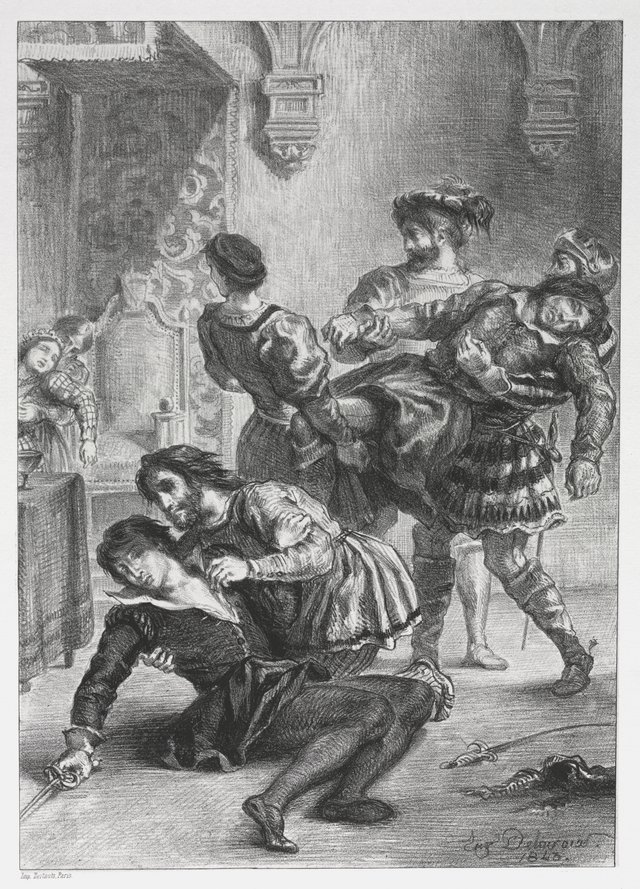
Elsinore. A hall in the Castle.
Enter Hamlet and Horatio.
So much for this, sir; now shall you see the other.
You do remember all the circumstance?
Remember it, my lord!
Sir, in my heart there was a kind of fighting
That would not let me sleep. Methought I lay
Worse than the mutinies in the bilboes. Rashly-
And prais'd be rashness for it; let us know,
Our indiscretion sometime serves us well
When our deep plots do pall; and that should learn us
There's a divinity that shapes our ends,
Rough-hew them how we will-
That is most certain.
Up from my cabin,
My sea-gown scarf'd about me, in the dark
Grop'd I to find out them; had my desire,
Finger'd their packet, and in fine withdrew
To mine own room again; making so bold
(My fears forgetting manners) to unseal
Their grand commission; where I found, Horatio
(O royal knavery!), an exact command,
Larded with many several sorts of reasons,
Importing Denmark's health, and England's too,
With, hoo! such bugs and goblins in my life-
That, on the supervise, no leisure bated,
No, not to stay the finding of the axe,
My head should be struck off.
Is't possible?
Here's the commission; read it at more leisure.
But wilt thou bear me how I did proceed?
I beseech you.
Being thus benetted round with villanies,
Or I could make a prologue to my brains,
They had begun the play. I sat me down;
Devis'd a new commission; wrote it fair.
I once did hold it, as our statists do,
A baseness to write fair, and labour'd much
How to forget that learning; but, sir, now
It did me yeoman's service. Wilt thou know
Th' effect of what I wrote?
Ay, good my lord.
An earnest conjuration from the King,
As England was his faithful tributary,
As love between them like the palm might flourish,
As peace should still her wheaten garland wear
And stand a comma 'tween their amities,
And many such-like as's of great charge,
That, on the view and knowing of these contents,
Without debatement further, more or less,
He should the bearers put to sudden death,
Not shriving time allow'd.
How was this seal'd?
Why, even in that was heaven ordinant.
I had my father's signet in my purse,
Which was the model of that Danish seal;
Folded the writ up in the form of th' other,
Subscrib'd it, gave't th' impression, plac'd it safely,
The changeling never known. Now, the next day
Was our sea-fight; and what to this was sequent
Thou know'st already.
So Guildenstern and Rosencrantz go to't.
Why, man, they did make love to this employment!
They are not near my conscience; their defeat
Does by their own insinuation grow.
'Tis dangerous when the baser nature comes
Between the pass and fell incensed points
Of mighty opposites.
Why, what a king is this!
Does it not, thinks't thee, stand me now upon-
He that hath kill'd my king, and whor'd my mother;
Popp'd in between th' election and my hopes;
Thrown out his angle for my proper life,
And with such coz'nage- is't not perfect conscience
To quit him with this arm? And is't not to be damn'd
To let this canker of our nature come
In further evil?
It must be shortly known to him from England
What is the issue of the business there.
It will be short; the interim is mine,
And a man's life is no more than to say 'one.'
But I am very sorry, good Horatio,
That to Laertes I forgot myself,
For by the image of my cause I see
The portraiture of his. I'll court his favours.
But sure the bravery of his grief did put me
Into a tow'ring passion.
Peace! Who comes here?Enter young Osric, a courtier.
Your lordship is right welcome back to Denmark.
I humbly thank you, sir. [Aside to Horatio] Dost know this
waterfly?
[aside to Hamlet] No, my good lord.
[aside to Horatio] Thy state is the more gracious; for 'tis a
vice to know him. He hath much land, and fertile. Let a beast be
lord of beasts, and his crib shall stand at the king's mess. 'Tis
a chough; but, as I say, spacious in the possession of dirt.
Sweet lord, if your lordship were at leisure, I should impart
a thing to you from his Majesty.
I will receive it, sir, with all diligence of spirit. Put your
bonnet to his right use. 'Tis for the head.
I thank your lordship, it is very hot.
No, believe me, 'tis very cold; the wind is northerly.
It is indifferent cold, my lord, indeed.
But yet methinks it is very sultry and hot for my complexion.
Exceedingly, my lord; it is very sultry, as 'twere- I cannot
tell how. But, my lord, his Majesty bade me signify to you that
he has laid a great wager on your head. Sir, this is the matter-
I beseech you remember.[Hamlet moves him to put on his hat.]
Nay, good my lord; for mine ease, in good faith. Sir, here is
newly come to court Laertes; believe me, an absolute gentleman,
full of most excellent differences, of very soft society and
great showing. Indeed, to speak feelingly of him, he is the card
or calendar of gentry; for you shall find in him the continent of
what part a gentleman would see.
Sir, his definement suffers no perdition in you; though, I
know, to divide him inventorially would dozy th' arithmetic of
memory, and yet but yaw neither in respect of his quick sail.
But, in the verity of extolment, I take him to be a soul of great
article, and his infusion of such dearth and rareness as, to make
true diction of him, his semblable is his mirror, and who else
would trace him, his umbrage, nothing more.
Your lordship speaks most infallibly of him.
The concernancy, sir? Why do we wrap the gentleman in our more
rawer breath?
Sir?
[aside to Hamlet] Is't not possible to understand in another
tongue? You will do't, sir, really.
What imports the nomination of this gentleman?
Of Laertes?
[aside] His purse is empty already. All's golden words are
spent.
Of him, sir.
I know you are not ignorant-
I would you did, sir; yet, in faith, if you did, it would not
much approve me. Well, sir?
You are not ignorant of what excellence Laertes is-
I dare not confess that, lest I should compare with him in
excellence; but to know a man well were to know himself.
I mean, sir, for his weapon; but in the imputation laid on him
by them, in his meed he's unfellowed.
What's his weapon?
Rapier and dagger.
That's two of his weapons- but well.
The King, sir, hath wager'd with him six Barbary horses;
against the which he has impon'd, as I take it, six French
rapiers and poniards, with their assigns, as girdle, hangers, and
so. Three of the carriages, in faith, are very dear to fancy,
very responsive to the hilts, most delicate carriages, and of
very liberal conceit.
What call you the carriages?
[aside to Hamlet] I knew you must be edified by the margent
ere you had done.
The carriages, sir, are the hangers.
The phrase would be more germane to the matter if we could
carry cannon by our sides. I would it might be hangers till then.
But on! Six Barbary horses against six French swords, their
assigns, and three liberal-conceited carriages: that's the French
bet against the Danish. Why is this all impon'd, as you call it?
The King, sir, hath laid that, in a dozen passes between
yourself and him, he shall not exceed you three hits; he hath
laid on twelve for nine, and it would come to immediate trial
if your lordship would vouchsafe the answer.
How if I answer no?
I mean, my lord, the opposition of your person in trial.
Sir, I will walk here in the hall. If it please his Majesty,
it is the breathing time of day with me. Let the foils be
brought, the gentleman willing, and the King hold his purpose,
I will win for him if I can; if not, I will gain nothing but my
shame and the odd hits.
Shall I redeliver you e'en so?
To this effect, sir, after what flourish your nature will.
I commend my duty to your lordship.
Yours, yours. [Exit Osric.] He does well to commend it
himself; there are no tongues else for's turn.
This lapwing runs away with the shell on his head.
He did comply with his dug before he suck'd it. Thus has he,
and many more of the same bevy that I know the drossy age dotes
on, only got the tune of the time and outward habit of encounter-
a kind of yesty collection, which carries them through and
through the most fann'd and winnowed opinions; and do but blow
them to their trial-the bubbles are out,Enter a Lord.
My lord, his Majesty commended him to you by young Osric, who
brings back to him, that you attend him in the hall. He sends to
know if your pleasure hold to play with Laertes, or that you will
take longer time.
I am constant to my purposes; they follow the King's pleasure.
If his fitness speaks, mine is ready; now or whensoever, provided
I be so able as now.
The King and Queen and all are coming down.
In happy time.
The Queen desires you to use some gentle entertainment to
Laertes before you fall to play.
She well instructs me.[Exit Lord.]
You will lose this wager, my lord.
I do not think so. Since he went into France I have been in
continual practice. I shall win at the odds. But thou wouldst not
think how ill all's here about my heart. But it is no matter.
Nay, good my lord -
It is but foolery; but it is such a kind of gaingiving as
would perhaps trouble a woman.
If your mind dislike anything, obey it. I will forestall their
repair hither and say you are not fit.
Not a whit, we defy augury; there's a special providence in
the fall of a sparrow. If it be now, 'tis not to come; if it be
not to come, it will be now; if it be not now, yet it will come:
the readiness is all. Since no man knows aught of what he leaves,
what is't to leave betimes? Let be.Enter King, Queen, Laertes, Osric, and Lords, with other Attendants with foils and gauntlets. A table and flagons of wine on it.
Come, Hamlet, come, and take this hand from me.[The King puts Laertes' hand into Hamlet's.]
Give me your pardon, sir. I have done you wrong;
But pardon't, as you are a gentleman.
This presence knows,
And you must needs have heard, how I am punish'd
With sore distraction. What I have done
That might your nature, honour, and exception
Roughly awake, I here proclaim was madness.
Was't Hamlet wrong'd Laertes? Never Hamlet.
If Hamlet from himself be taken away,
And when he's not himself does wrong Laertes,
Then Hamlet does it not, Hamlet denies it.
Who does it, then? His madness. If't be so,
Hamlet is of the faction that is wrong'd;
His madness is poor Hamlet's enemy.
Sir, in this audience,
Let my disclaiming from a purpos'd evil
Free me so far in your most generous thoughts
That I have shot my arrow o'er the house
And hurt my brother.
I am satisfied in nature,
Whose motive in this case should stir me most
To my revenge. But in my terms of honour
I stand aloof, and will no reconcilement
Till by some elder masters of known honour
I have a voice and precedent of peace
To keep my name ungor'd. But till that time
I do receive your offer'd love like love,
And will not wrong it.
I embrace it freely,
And will this brother's wager frankly play.
Give us the foils. Come on.
Come, one for me.
I'll be your foil, Laertes. In mine ignorance
Your skill shall, like a star i' th' darkest night,
Stick fiery off indeed.
You mock me, sir.
No, by this hand.
Give them the foils, young Osric. Cousin Hamlet,
You know the wager?
Very well, my lord.
Your Grace has laid the odds o' th' weaker side.
I do not fear it, I have seen you both;
But since he is better'd, we have therefore odds.
This is too heavy; let me see another.
This likes me well. These foils have all a length?Prepare to play.
Ay, my good lord.
Set me the stoups of wine upon that table.
If Hamlet give the first or second hit,
Or quit in answer of the third exchange,
Let all the battlements their ordnance fire;
The King shall drink to Hamlet's better breath,
And in the cup an union shall he throw
Richer than that which four successive kings
In Denmark's crown have worn. Give me the cups;
And let the kettle to the trumpet speak,
The trumpet to the cannoneer without,
The cannons to the heavens, the heaven to earth,
'Now the King drinks to Hamlet.' Come, begin.
And you the judges, bear a wary eye.
Come on, sir.
Come, my lord.They play.
One.
No.
Judgment!
A hit, a very palpable hit.
Well, again!
Stay, give me drink. Hamlet, this pearl is thine;
Here's to thy health.[Drum; trumpets sound; a piece goes off [within].
Give him the cup.
I'll play this bout first; set it by awhile.
Come. (They play.) Another hit. What say you?
A touch, a touch; I do confess't.
Our son shall win.
He's fat, and scant of breath.
Here, Hamlet, take my napkin, rub thy brows.
The Queen carouses to thy fortune, Hamlet.
Good madam!
Gertrude, do not drink.
I will, my lord; I pray you pardon me.Drinks.
[aside] It is the poison'd cup; it is too late.
I dare not drink yet, madam; by-and-by.
Come, let me wipe thy face.
My lord, I'll hit him now.
I do not think't.
[aside] And yet it is almost against my conscience.
Come for the third, Laertes! You but dally.
Pray you pass with your best violence;
I am afeard you make a wanton of me.
Say you so? Come on.Play.
Nothing neither way.
Have at you now![Laertes wounds Hamlet; then] in scuffling, they change rapiers, [and Hamlet wounds Laertes].
Part them! They are incens'd.
Nay come! again!The Queen falls.
Look to the Queen there, ho!
They bleed on both sides. How is it, my lord?
How is't, Laertes?
Why, as a woodcock to mine own springe, Osric.
I am justly kill'd with mine own treachery.
How does the Queen?
She sounds to see them bleed.
No, no! the drink, the drink! O my dear Hamlet!
The drink, the drink! I am poison'd.[Dies.]
O villany! Ho! let the door be lock'd.
Treachery! Seek it out.[Laertes falls.]
It is here, Hamlet. Hamlet, thou art slain;
No medicine in the world can do thee good.
In thee there is not half an hour of life.
The treacherous instrument is in thy hand,
Unbated and envenom'd. The foul practice
Hath turn'd itself on me. Lo, here I lie,
Never to rise again. Thy mother's poison'd.
I can no more. The King, the King's to blame.
The point envenom'd too?
Then, venom, to thy work.Hurts the King.
Treason! treason!
O, yet defend me, friends! I am but hurt.
Here, thou incestuous, murd'rous, damned Dane,
Drink off this potion! Is thy union here?
Follow my mother.King dies.
He is justly serv'd.
It is a poison temper'd by himself.
Exchange forgiveness with me, noble Hamlet.
Mine and my father's death come not upon thee,
Nor thine on me!Dies.
Heaven make thee free of it! I follow thee.
I am dead, Horatio. Wretched queen, adieu!
You that look pale and tremble at this chance,
That are but mutes or audience to this act,
Had I but time (as this fell sergeant, Death,
Is strict in his arrest) O, I could tell you-
But let it be. Horatio, I am dead;
Thou liv'st; report me and my cause aright
To the unsatisfied.
Never believe it.
I am more an antique Roman than a Dane.
Here's yet some liquor left.
As th'art a man,
Give me the cup. Let go! By heaven, I'll ha't.
O good Horatio, what a wounded name
(Things standing thus unknown) shall live behind me!
If thou didst ever hold me in thy heart,
Absent thee from felicity awhile,
And in this harsh world draw thy breath in pain,
To tell my story.[March afar off, and shot within.]
What warlike noise is this?
Young Fortinbras, with conquest come from Poland,
To the ambassadors of England gives
This warlike volley.
O, I die, Horatio!
The potent poison quite o'ercrows my spirit.
I cannot live to hear the news from England,
But I do prophesy th' election lights
On Fortinbras. He has my dying voice.
So tell him, with th' occurrents, more and less,
Which have solicited- the rest is silence.Dies.
Now cracks a noble heart. Good night, sweet prince,
And flights of angels sing thee to thy rest![March within.]
Why does the drum come hither?
Enter Fortinbras and English Ambassadors, with Drum, Colours, and Attendants.
Where is this sight?
What is it you will see?
If aught of woe or wonder, cease your search.
This quarry cries on havoc. O proud Death,
What feast is toward in thine eternal cell
That thou so many princes at a shot
So bloodily hast struck.
The sight is dismal;
And our affairs from England come too late.
The ears are senseless that should give us hearing
To tell him his commandment is fulfill'd
That Rosencrantz and Guildenstern are dead.
Where should we have our thanks?
Not from his mouth,
Had it th' ability of life to thank you.
He never gave commandment for their death.
But since, so jump upon this bloody question,
You from the Polack wars, and you from England,
Are here arriv'd, give order that these bodies
High on a stage be placed to the view;
And let me speak to the yet unknowing world
How these things came about. So shall you hear
Of carnal, bloody and unnatural acts;
Of accidental judgments, casual slaughters;
Of deaths put on by cunning and forc'd cause;
And, in this upshot, purposes mistook
Fall'n on th' inventors' heads. All this can I
Truly deliver.
Let us haste to hear it,
And call the noblest to the audience.
For me, with sorrow I embrace my fortune.
I have some rights of memory in this kingdom
Which now, to claim my vantage doth invite me.
Of that I shall have also cause to speak,
And from his mouth whose voice will draw on more.
But let this same be presently perform'd,
Even while men's minds are wild, lest more mischance
On plots and errors happen.
Let four captains
Bear Hamlet like a soldier to the stage;
For he was likely, had he been put on,
To have prov'd most royally; and for his passage
The soldiers' music and the rites of war
Speak loudly for him.
Take up the bodies. Such a sight as this
Becomes the field but here shows much amiss.
Go, bid the soldiers shoot.Exeunt marching; after the which a peal of ordnance are shot off.
THE END