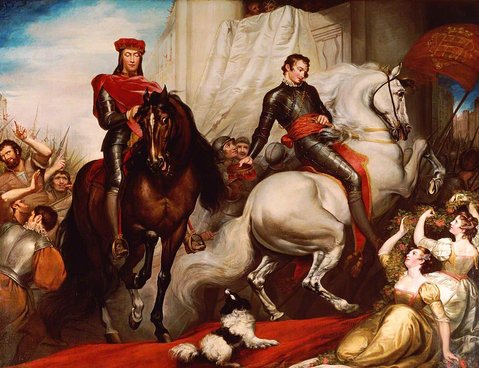
Richard II

Richard II, written around 1595, is the first play in Shakespeare's second tetralogy of English history plays, covering the events that led to the Wars of the Roses. The play depicts the fall of King Richard II, a monarch of exquisite poetic sensibility but catastrophic political judgment. When Richard arbitrarily seizes the lands of his exiled cousin Henry Bolingbroke, he provokes an invasion that rapidly strips him of his supporters, his crown, and ultimately his life.
The play is remarkable for being written entirely in verse, with no prose scenes, giving it an elevated, lyrical quality unique among Shakespeare's histories. Richard's great speeches, particularly the "hollow crown" meditation on the mortality of kings and the deposition scene in which he shatters a mirror, are among the most beautiful and haunting passages in the canon. Bolingbroke, by contrast, is a man of action and few words whose pragmatic efficiency makes him an effective usurper but a burdened king.
Richard II is a profound exploration of kingship, legitimacy, and the relationship between political power and personal identity. Richard's tragedy is that he understands the poetry of monarchy far better than its practice, while Bolingbroke grasps its practice but never its mystique. The play's central question, whether a divinely anointed king can ever be lawfully deposed, had explosive political implications in Shakespeare's own time and continues to resonate in any era where the sources of political authority are in dispute.