ACT I - Scene IV Romeo and Juliet

Previous Chapter Next Chapter

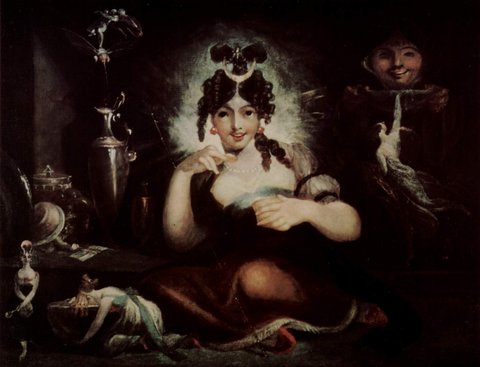
Queen Mab, the fairy queen of dreams
Queen Mab by Henry Fuseli (1815)

A street.

Enter Romeo, Mercutio, Benvolio, with five or six other Maskers;
Torchbearers.

ROMEO
What, shall this speech be spoke for our excuse?
Or shall we on without apology?

BENVOLIO
The date is out of such prolixity.
We'll have no Cupid hoodwink'd with a scarf,
Bearing a Tartar's painted bow of lath,
Scaring the ladies like a crowkeeper;

Nor no without-book prologue, faintly spoke
After the prompter, for our entrance;

But, let them measure us by what they will,
We'll measure them a measure, and be gone.

ROMEO
Give me a torch. I am not for this ambling.
Being but heavy, I will bear the light.

MERCUTIO
Nay, gentle Romeo, we must have you dance.

ROMEO
Not I, believe me. You have dancing shoes
With nimble soles;
I have a soul of lead
So stakes me to the ground I cannot move.

MERCUTIO
You are a lover. Borrow Cupid's wings
And soar with them above a common bound.

ROMEO
I am too sore enpierced with his shaft
To soar with his light feathers;
and so bound
I cannot bound a pitch above dull woe.
Under love's heavy burthen do I sink.

MERCUTIO
And, to sink in it, should you burthen love-
Too great oppression for a tender thing.

ROMEO
Is love a tender thing? It is too rough,
Too rude, too boist'rous, and it pricks like thorn.

MERCUTIO
If love be rough with you, be rough with love.
Prick love for pricking, and you beat love down.
Give me a case to put my visage in.
A visor for a visor! What care I
What curious eye doth quote deformities?
Here are the beetle brows shall blush for me.

BENVOLIO
Come, knock and enter;
and no sooner in
But every man betake him to his legs.

ROMEO
A torch for me! Let wantons light of heart
Tickle the senseless rushes with their heels;

For I am proverb'd with a grandsire phrase,
I'll be a candle-holder and look on;

The game was ne'er so fair, and I am done.

MERCUTIO
Tut! dun's the mouse, the constable's own word!
If thou art Dun, we'll draw thee from the mire
Of this sir-reverence love, wherein thou stick'st
Up to the ears. Come, we burn daylight, ho!

ROMEO
Nay, that's not so.

MERCUTIO
I mean, sir, in delay
We waste our lights in vain, like lamps by day.
Take our good meaning, for our judgment sits
Five times in that ere once in our five wits.

ROMEO
And we mean well, in going to this masque;

But 'tis no wit to go.

MERCUTIO
Why, may one ask?

ROMEO
I dreamt a dream to-night.

MERCUTIO
And so did I.

ROMEO
Well, what was yours?

MERCUTIO
That dreamers often lie.

ROMEO
In bed asleep, while they do dream things true.

MERCUTIO
O, then I see Queen Mab hath been with you.
She is the fairies' midwife, and she comes
In shape no bigger than an agate stone
On the forefinger of an alderman,
Drawn with a team of little atomies
Athwart men's noses as they lie asleep;

Her wagon spokes made of long spinners' legs,
The cover, of the wings of grasshoppers;

Her traces, of the smallest spider's web;

Her collars, of the moonshine's wat'ry beams;

Her whip, of cricket's bone;
the lash, of film;

Her wagoner, a small grey-coated gnat,
Not half so big as a round little worm
Prick'd from the lazy finger of a maid;

Her chariot is an empty hazelnut,
Made by the joiner squirrel or old grub,
Time out o' mind the fairies' coachmakers.
And in this state she gallops night by night
Through lovers' brains, and then they dream of love;

O'er courtiers' knees, that dream on cursies straight;

O'er lawyers' fingers, who straight dream on fees;

O'er ladies' lips, who straight on kisses dream,
Which oft the angry Mab with blisters plagues,
Because their breaths with sweetmeats tainted are.
Sometime she gallops o'er a courtier's nose,
And then dreams he of smelling out a suit;

And sometime comes she with a tithe-pig's tail
Tickling a parson's nose as 'a lies asleep,
Then dreams he of another benefice.
Sometimes she driveth o'er a soldier's neck,
And then dreams he of cutting foreign throats,
Of breaches, ambuscadoes, Spanish blades,
Of healths five fadom deep;
and then anon
Drums in his ear, at which he starts and wakes,
And being thus frighted, swears a prayer or two
And sleeps again. This is that very Mab
That plats the manes of horses in the night
And bakes the elflocks in foul sluttish, hairs,
Which once untangled much misfortune bodes
This is the hag, when maids lie on their backs,
That presses them and learns them first to bear,
Making them women of good carriage.
This is she-

ROMEO
Peace, peace, Mercutio, peace!
Thou talk'st of nothing.

MERCUTIO
True, I talk of dreams;

Which are the children of an idle brain,
Begot of nothing but vain fantasy;

Which is as thin of substance as the air,
And more inconstant than the wind, who wooes
Even now the frozen bosom of the North
And, being anger'd, puffs away from thence,
Turning his face to the dew-dropping South.

BENVOLIO
This wind you talk of blows us from ourselves.
Supper is done, and we shall come too late.

ROMEO
I fear, too early;
for my mind misgives
Some consequence, yet hanging in the stars,
Shall bitterly begin his fearful date
With this night's revels and expire the term
Of a despised life, clos'd in my breast,
By some vile forfeit of untimely death.
But he that hath the steerage of my course
Direct my sail! On, lusty gentlemen!

BENVOLIO
Strike, drum.

They march about the stage. [Exeunt.]

Frequently Asked Questions about ACT I - Scene IV from Romeo and Juliet

What happens in Act 1, Scene 4 of Romeo and Juliet?

In Act 1, Scene 4, Romeo, Mercutio, and Benvolio make their way to the Capulet feast disguised as maskers. Romeo is reluctant to join the revelry because he is lovesick and heavy-hearted, asking instead to carry a torch. After Romeo mentions a troubling dream he had the night before, Mercutio launches into his famous Queen Mab speech, an elaborate and increasingly dark fantasy about the fairy queen who delivers dreams to sleepers. The scene ends with Romeo voicing a powerful premonition that the night's events will lead to his early death, yet he resolves to go forward, surrendering his fate to providence.

What is the Queen Mab speech in Romeo and Juliet about?

The Queen Mab speech, delivered by Mercutio in Act 1, Scene 4, is an imaginative monologue about a tiny fairy queen who rides through the night in a chariot made from a hazelnut shell, bringing dreams to sleepers. She visits lovers who dream of love, lawyers who dream of fees, and soldiers who dream of battle. As the speech progresses, it grows darker — Queen Mab becomes a "hag" who corrupts maids and tangles horses' manes. The speech serves multiple purposes: it showcases Mercutio's brilliant, restless imagination, it comments on how dreams and desires often reveal human weakness and vice rather than noble aspirations, and it contrasts Mercutio's cynicism about fantasy with Romeo's earnest belief in the significance of his own dream.

What does Romeo's premonition in Act 1, Scene 4 foreshadow?

At the end of Act 1, Scene 4, Romeo declares that he fears "some consequence, yet hanging in the stars, shall bitterly begin his fearful date with this night's revels and expire the term of a despised life... by some vile forfeit of untimely death." This speech directly foreshadows the tragic ending of the play — Romeo's attendance at the Capulet feast will lead to his meeting Juliet, which ultimately results in both their deaths. The passage also reinforces the play's central theme of fate versus free will: Romeo senses the danger but chooses to go anyway, placing himself in the hands of "he that hath the steerage of my course." Shakespeare uses this moment to create dramatic irony, since the audience already knows from the Prologue that the lovers are "star-cross'd" and doomed.

How is Mercutio characterized in Act 1, Scene 4?

Act 1, Scene 4 serves as Mercutio's true introduction as a character, and Shakespeare immediately establishes him as witty, imaginative, and irreverent. He teases Romeo about his lovesickness with rapid-fire puns, urging him to "prick love for pricking" and to borrow Cupid's wings. His Queen Mab speech reveals a mind capable of extraordinary poetic flights that shift quickly from whimsy to darkness, from beautiful miniature imagery to biting social satire. Unlike Romeo, who takes dreams and love seriously, Mercutio is a skeptic who dismisses dreams as "the children of an idle brain, begot of nothing but vain fantasy." This contrast between Mercutio's cynical realism and Romeo's romantic idealism defines their friendship throughout the play.

What literary devices does Shakespeare use in Act 1, Scene 4 of Romeo and Juliet?

Shakespeare employs a rich variety of literary devices in this scene. Puns and wordplay dominate the early dialogue — Romeo plays on "soul" and "sole," "heavy" and "light," and "sore" and "soar," reflecting both his wit and his emotional turmoil. The Queen Mab speech is built on extended imagery and personification, constructing a vivid fairy world from spider webs, grasshopper wings, cricket bones, and moonbeams. Romeo's closing speech is a striking example of foreshadowing, predicting his own death in language that echoes the Prologue's "star-cross'd lovers." The scene also relies on contrast — Mercutio's frenetic energy against Romeo's brooding stillness, and the lightness of fairy fantasy against the gravity of fate. Additionally, the motif of light and darkness runs through Romeo's torch imagery, prefiguring the play's larger symbolic framework.

What is the role of fate and dreams in Act 1, Scene 4 of Romeo and Juliet?

Fate and dreams are the scene's central thematic concerns, presented through two opposing perspectives. Romeo takes his dream seriously as a genuine warning, sensing that "some consequence, yet hanging in the stars" will begin that night and lead to his death. He sees dreams as meaningful messages connected to destiny. Mercutio, by contrast, dismisses dreams entirely through his Queen Mab speech, arguing that dreams are merely reflections of individual desires and anxieties — "the children of an idle brain, begot of nothing but vain fantasy." Shakespeare leaves the tension deliberately unresolved: the play ultimately validates Romeo's intuition, since attending the feast does set the tragedy in motion, but Mercutio's insight that dreams reveal human weakness also proves prophetic, as the lovers' passionate desires contribute to their downfall as much as fate does.


Previous Chapter Next Chapter
Return to the Romeo and Juliet Summary Return to the William Shakespeare Library