ACT II - Scene VI Romeo and Juliet

Previous Chapter Next Chapter

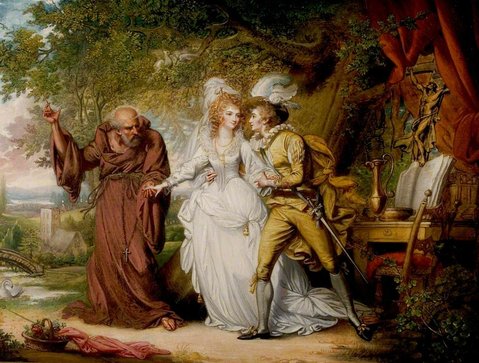
Romeo and Juliet before Friar Lawrence for their secret marriage
Romeo and Juliet with Friar Lawrence by Mather Brown (c. 1790)

Friar Laurence's cell.

Enter Friar [Laurence] and Romeo.

FRIAR
So smile the heavens upon this holy act
That after-hours with sorrow chide us not!

ROMEO
Amen, amen! But come what sorrow can,
It cannot countervail the exchange of joy
That one short minute gives me in her sight.
Do thou but close our hands with holy words,
Then love-devouring death do what he dare-
It is enough I may but call her mine.

FRIAR
These violent delights have violent ends
And in their triumph die, like fire and powder,
Which, as they kiss, consume. The sweetest honey
Is loathsome in his own deliciousness
And in the taste confounds the appetite.
Therefore love moderately: long love doth so;

Too swift arrives as tardy as too slow.

Enter Juliet.

Here comes the lady. O, so light a foot
Will ne'er wear out the everlasting flint.
A lover may bestride the gossamer
That idles in the wanton summer air,
And yet not fall;
so light is vanity.

JULIET
Good even to my ghostly confessor.

FRIAR
Romeo shall thank thee, daughter, for us both.

JULIET
As much to him, else is his thanks too much.

ROMEO
Ah, Juliet, if the measure of thy joy
Be heap'd like mine, and that thy skill be more
To blazon it, then sweeten with thy breath
This neighbour air, and let rich music's tongue
Unfold the imagin'd happiness that both
Receive in either by this dear encounter.

JULIET
Conceit, more rich in matter than in words,
Brags of his substance, not of ornament.
They are but beggars that can count their worth;

But my true love is grown to such excess
cannot sum up sum of half my wealth.

FRIAR
Come, come with me, and we will make short work;

For, by your leaves, you shall not stay alone
Till Holy Church incorporate two in one.

[Exeunt.]

Frequently Asked Questions about ACT II - Scene VI from Romeo and Juliet

What happens in Act 2, Scene 6 of Romeo and Juliet?

In Act 2, Scene 6, Romeo and Juliet are secretly married by Friar Laurence in his cell. Romeo arrives first and waits with the Friar, who prays that the heavens will bless the union. Romeo declares that no future sorrow could outweigh the joy of being with Juliet, even daring "love-devouring death" to do its worst. After Juliet arrives, the Friar leads the couple offstage to perform the ceremony, saying they shall not be left alone "till Holy Church incorporate two in one."

What does "these violent delights have violent ends" mean in Romeo and Juliet?

"These violent delights have violent ends" is Friar Laurence's warning to Romeo in Act 2, Scene 6 that intensely passionate love is inherently self-destructive. The Friar compares the lovers' passion to fire and gunpowder, which consume each other the instant they meet. He extends the metaphor with honey that becomes "loathsome in his own deliciousness," arguing that excess ruins even the sweetest things. The line is one of Shakespeare's most famous instances of foreshadowing, predicting the lovers' tragic deaths and encapsulating the play's central tension between ecstatic love and catastrophic consequence.

Why does Friar Laurence agree to marry Romeo and Juliet?

Friar Laurence agrees to marry Romeo and Juliet primarily because he hopes the union will end the feud between the Montague and Capulet families. He reveals this reasoning earlier in Act 2, Scene 3, stating that the marriage might "turn your households' rancour to pure love." In Scene 6, despite his own warnings about the dangers of impulsive passion, the Friar proceeds with the ceremony. His decision reflects a tension in his character between prudent caution and political optimism — he recognizes the risks but believes the potential reward of peace justifies them.

What literary devices are used in Act 2, Scene 6 of Romeo and Juliet?

Act 2, Scene 6 is rich in literary devices. Foreshadowing is the most prominent: the Friar's prayer that "after-hours with sorrow chide us not" and his "violent delights" speech both anticipate the tragedy. Romeo's invitation to "love-devouring death" is dramatic irony, since the audience already knows from the Prologue that both lovers will die. Shakespeare uses metaphor and simile extensively — passion as "fire and powder," a lover light enough to "bestride the gossamer." The phrase "violent delights" is an oxymoron that captures the paradox of a love that is both ecstatic and destructive. Antithesis structures much of the dialogue, pairing joy with sorrow and swiftness with tardiness.

How does Juliet's character develop in Act 2, Scene 6?

In Act 2, Scene 6, Juliet demonstrates surprising maturity and philosophical depth that contrasts with Romeo's emotional excess. While Romeo asks her to pour out her joy in rich language, Juliet replies that "Conceit, more rich in matter than in words, / Brags of his substance, not of ornament" — meaning that true feeling is too deep for elaborate words. She adds that "they are but beggars that can count their worth," suggesting her love is immeasurable. This brief speech reveals Juliet as the more grounded of the two lovers, valuing substance over display, even as she rushes into a secret marriage that will have devastating consequences.

What role does foreshadowing play in Act 2, Scene 6 of Romeo and Juliet?

Foreshadowing permeates nearly every speech in Act 2, Scene 6, making it one of the most ominous scenes in the play. The Friar's opening line prays that "after-hours with sorrow chide us not," immediately introducing the expectation of future grief. Romeo's defiant dare to "love-devouring death" is deeply ironic because death will indeed claim both lovers within days. The Friar's central warning — that "violent delights have violent ends" and burn like "fire and powder" — directly predicts the catastrophic outcome of the marriage. Even his counsel that "too swift arrives as tardy as too slow" warns that the lovers' haste will prove as fatal as inaction. Together, these moments ensure the audience feels the tragedy closing in even as the lovers celebrate.


Previous Chapter Next Chapter
Return to the Romeo and Juliet Summary Return to the William Shakespeare Library