ACT III - Scene II Romeo and Juliet
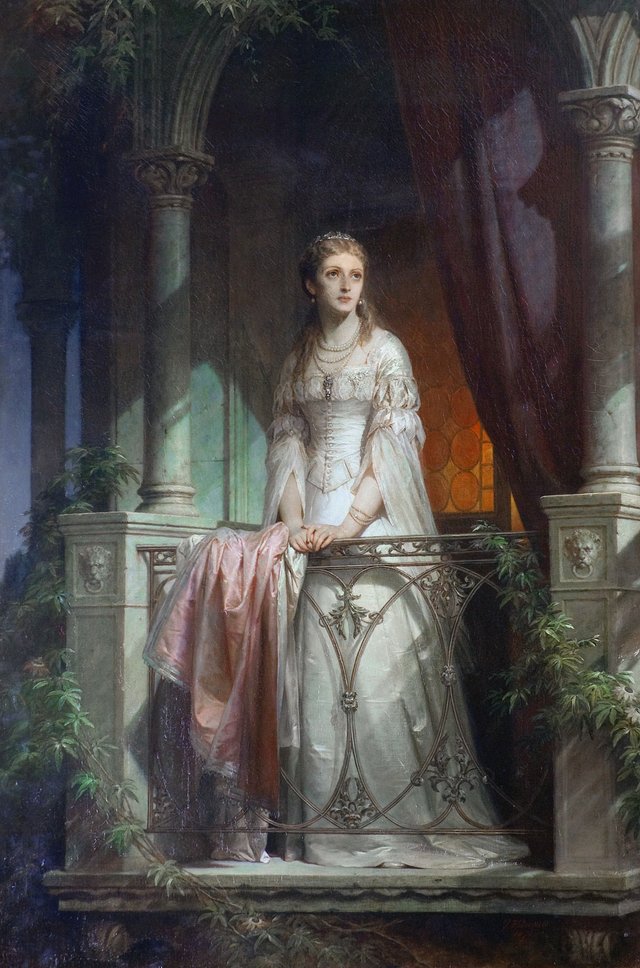
Capulet's orchard.
Enter Juliet alone.
JULIET
Gallop apace, you fiery-footed steeds,
Towards Phoebus' lodging! Such a wagoner
As Phaeton would whip you to the West
And bring in cloudy night immediately.
Spread thy close curtain, love-performing night,
That runaway eyes may wink, and Romeo
Leap to these arms untalk'd of and unseen.
Lovers can see to do their amorous rites
By their own beauties;
or, if love be blind,
It best agrees with night. Come, civil night,
Thou sober-suited matron, all in black,
And learn me how to lose a winning match,
Play'd for a pair of stainless maidenhoods.
Hood my unmann'd blood, bating in my cheeks,
With thy black mantle till strange love, grown bold,
Think true love acted simple modesty.
Come, night;
come, Romeo;
come, thou day in night;
For thou wilt lie upon the wings of night
Whiter than new snow upon a raven's back.
Come, gentle night;
come, loving, black-brow'd night;
Give me my Romeo;
and, when he shall die,
Take him and cut him out in little stars,
And he will make the face of heaven so fine
That all the world will be in love with night
And pay no worship to the garish sun.
O, I have bought the mansion of a love,
But not possess'd it;
and though I am sold,
Not yet enjoy'd. So tedious is this day
As is the night before some festival
To an impatient child that hath new robes
And may not wear them. O, here comes my nurse,Enter Nurse, with cords.
And she brings news;
and every tongue that speaks
But Romeo's name speaks heavenly eloquence.
Now, nurse, what news? What hast thou there? the cords
That Romeo bid thee fetch?
NURSE
Ay, ay, the cords.[Throws them down.]
JULIET
Ah me! what news? Why dost thou wring thy hands?
NURSE
Ah, weraday! he's dead, he's dead, he's dead!
We are undone, lady, we are undone!
Alack the day! he's gone, he's kill'd, he's dead!
JULIET
Can heaven be so envious?
NURSE
Romeo can,
Though heaven cannot. O Romeo, Romeo!
Who ever would have thought it? Romeo!
JULIET
What devil art thou that dost torment me thus?
This torture should be roar'd in dismal hell.
Hath Romeo slain himself? Say thou but 'I,'
And that bare vowel 'I' shall poison more
Than the death-darting eye of cockatrice.
I am not I, if there be such an 'I';
Or those eyes shut that make thee answer 'I.'
If he be slain, say 'I';
or if not, 'no.'
Brief sounds determine of my weal or woe.
NURSE
I saw the wound, I saw it with mine eyes,
(God save the mark!) here on his manly breast.
A piteous corse, a bloody piteous corse;
Pale, pale as ashes, all bedaub'd in blood,
All in gore-blood. I swounded at the sight.
JULIET
O, break, my heart! poor bankrout, break at once!
To prison, eyes;
ne'er look on liberty!
Vile earth, to earth resign;
end motion here,
And thou and Romeo press one heavy bier!
NURSE
O Tybalt, Tybalt, the best friend I had!
O courteous Tybalt! honest gentleman
That ever I should live to see thee dead!
JULIET
What storm is this that blows so contrary?
Is Romeo slaught'red, and is Tybalt dead?
My dear-lov'd cousin, and my dearer lord?
Then, dreadful trumpet, sound the general doom!
For who is living, if those two are gone?
NURSE
Tybalt is gone, and Romeo banished;
Romeo that kill'd him, he is banished.
JULIET
O God! Did Romeo's hand shed Tybalt's blood?
NURSE
It did, it did! alas the day, it did!
JULIET
O serpent heart, hid with a flow'ring face!
Did ever dragon keep so fair a cave?
Beautiful tyrant! fiend angelical!
Dove-feather'd raven! wolvish-ravening lamb!
Despised substance of divinest show!
Just opposite to what thou justly seem'st-
A damned saint, an honourable villain!
O nature, what hadst thou to do in hell
When thou didst bower the spirit of a fiend
In mortal paradise of such sweet flesh?
Was ever book containing such vile matter
So fairly bound? O, that deceit should dwell
In such a gorgeous palace!
NURSE
There's no trust,
No faith, no honesty in men;
all perjur'd,
All forsworn, all naught, all dissemblers.
Ah, where's my man? Give me some aqua vitae.
These griefs, these woes, these sorrows make me old.
Shame come to Romeo!
JULIET
Blister'd be thy tongue
For such a wish! He was not born to shame.
Upon his brow shame is asham'd to sit;
For 'tis a throne where honour may be crown'd
Sole monarch of the universal earth.
O, what a beast was I to chide at him!
NURSE
Will you speak well of him that kill'd your cousin?
JULIET
Shall I speak ill of him that is my husband?
Ah, poor my lord, what tongue shall smooth thy name
When I, thy three-hours wife, have mangled it?
But wherefore, villain, didst thou kill my cousin?
That villain cousin would have kill'd my husband.
Back, foolish tears, back to your native spring!
Your tributary drops belong to woe,
Which you, mistaking, offer up to joy.
My husband lives, that Tybalt would have slain;
And Tybalt's dead, that would have slain my husband.
All this is comfort;
wherefore weep I then?
Some word there was, worser than Tybalt's death,
That murd'red me. I would forget it fain;
But O, it presses to my memory
Like damned guilty deeds to sinners' minds!
'Tybalt is dead, and Romeo- banished.'
That 'banished,' that one word 'banished,'
Hath slain ten thousand Tybalts. Tybalt's death
Was woe enough, if it had ended there;
Or, if sour woe delights in fellowship
And needly will be rank'd with other griefs,
Why followed not, when she said 'Tybalt's dead,'
Thy father, or thy mother, nay, or both,
Which modern lamentation might have mov'd?
But with a rearward following Tybalt's death,
'Romeo is banished'- to speak that word
Is father, mother, Tybalt, Romeo, Juliet,
All slain, all dead. 'Romeo is banished'-
There is no end, no limit, measure, bound,
In that word's death;
no words can that woe sound.
Where is my father and my mother, nurse?
NURSE
Weeping and wailing over Tybalt's corse.
Will you go to them? I will bring you thither.
JULIET
Wash they his wounds with tears? Mine shall be spent,
When theirs are dry, for Romeo's banishment.
Take up those cords. Poor ropes, you are beguil'd,
Both you and I, for Romeo is exil'd.
He made you for a highway to my bed;
But I, a maid, die maiden-widowed.
Come, cords;
come, Nurse I'll to my wedding bed;
And death, not Romeo, take my maidenhead!
NURSE
Hie to your chamber. I'll find Romeo
To comfort you. I wot well where he is.
Hark ye, your Romeo will be here at night.
I'll to him;
he is hid at Laurence' cell.
JULIET
O, find him! give this ring to my true knight
And bid him come to take his last farewell.
Exeunt.