ACT IV - Scene III Romeo and Juliet

Previous Chapter Next Chapter

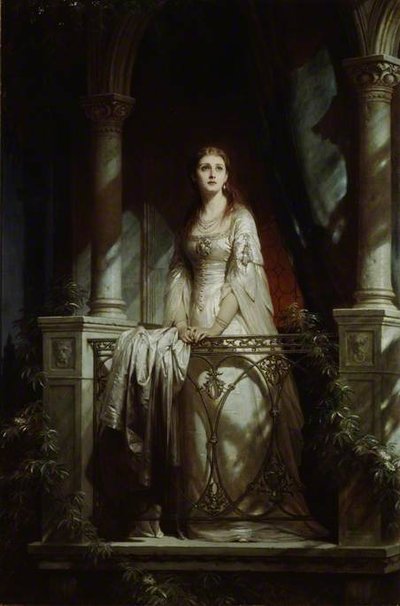
Juliet alone, contemplating the potion
Juliet by Thomas Francis Dicksee (1877)

Juliet's chamber.

Enter Juliet and Nurse.

JULIET
Ay, those attires are best;
but, gentle nurse,
I pray thee leave me to myself to-night;

For I have need of many orisons
To move the heavens to smile upon my state,
Which, well thou knowest, is cross and full of sin.

Enter Mother.

MOTHER
What, are you busy, ho? Need you my help?

JULIET
No, madam;
we have cull'd such necessaries
As are behoveful for our state to-morrow.
So please you, let me now be left alone,
And let the nurse this night sit up with you;

For I am sure you have your hands full all
In this so sudden business.

MOTHER
Good night.
Get thee to bed, and rest;
for thou hast need.

Exeunt [Mother and Nurse.]

JULIET
Farewell! God knows when we shall meet again.
I have a faint cold fear thrills through my veins
That almost freezes up the heat of life.
I'll call them back again to comfort me.
Nurse!- What should she do here?
My dismal scene I needs must act alone.
Come, vial.
What if this mixture do not work at all?
Shall I be married then to-morrow morning?
No, No! This shall forbid it. Lie thou there.

Lays down a dagger.

What if it be a poison which the friar
Subtilly hath minist'red to have me dead,
Lest in this marriage he should be dishonour'd
Because he married me before to Romeo?
I fear it is;
and yet methinks it should not,
For he hath still been tried a holy man.
I will not entertain so bad a thought.
How if, when I am laid into the tomb,
I wake before the time that Romeo
Come to redeem me? There's a fearful point!
Shall I not then be stifled in the vault,
To whose foul mouth no healthsome air breathes in,
And there die strangled ere my Romeo comes?
Or, if I live, is it not very like
The horrible conceit of death and night,
Together with the terror of the place-
As in a vault, an ancient receptacle
Where for this many hundred years the bones
Of all my buried ancestors are pack'd;

Where bloody Tybalt, yet but green in earth,
Lies fest'ring in his shroud;
where, as they say,
At some hours in the night spirits resort-
Alack, alack, is it not like that I,
So early waking- what with loathsome smells,
And shrieks like mandrakes torn out of the earth,
That living mortals, hearing them, run mad-
O, if I wake, shall I not be distraught,
Environed with all these hideous fears,
And madly play with my forefathers' joints,
And pluck the mangled Tybalt from his shroud,
And, in this rage, with some great kinsman's bone
As with a club dash out my desp'rate brains?
O, look! methinks I see my cousin's ghost
Seeking out Romeo, that did spit his body
Upon a rapier's point. Stay, Tybalt, stay!
Romeo, I come! this do I drink to thee.

She [drinks and] falls upon her bed within the curtains.

Frequently Asked Questions about ACT IV - Scene III from Romeo and Juliet

What happens in Act 4, Scene 3 of Romeo and Juliet?

In Act 4, Scene 3, Juliet prepares to take the sleeping potion given to her by Friar Laurence. She first dismisses the Nurse and Lady Capulet, telling them she needs to be alone to pray before her wedding to Count Paris. Once alone, Juliet delivers a powerful soliloquy in which she wrestles with her fears about the potion’s effects. She worries the potion might not work, that the Friar may have given her actual poison, and that she might wake too early in the suffocating darkness of the Capulet tomb surrounded by the bones of her ancestors and the freshly buried body of Tybalt. Despite her terror, she drinks the potion with a toast to Romeo and falls upon her bed.

What are Juliet's fears before she drinks the potion in Act 4, Scene 3?

Juliet expresses four distinct fears in her soliloquy before drinking the potion. First, she worries that the potion might not work at all, which would force her to marry Paris the next morning—she places a dagger beside her as a contingency. Second, she fears that Friar Laurence may have given her actual poison to cover up his role in her secret marriage to Romeo. Third, she is terrified that she might wake too early in the sealed vault and suffocate before Romeo arrives to rescue her. Fourth, and most vividly, she fears that the horrifying sights and smells of the tomb—including the decomposing body of Tybalt and the bones of her ancestors—will drive her mad.

Why does Juliet place a dagger beside her before drinking the potion?

Juliet lays down a dagger as a backup plan in case the sleeping potion fails to work. She says, "No, No! This shall forbid it. Lie thou there," indicating that if the potion does not render her unconscious, she will use the dagger to kill herself rather than be forced to marry Count Paris. The dagger represents both her desperation and her absolute commitment to Romeo—she would rather die than betray their marriage. The detail also foreshadows the play’s tragic ending, when Juliet does ultimately use a dagger to take her own life upon finding Romeo dead in the Capulet tomb.

What literary devices does Shakespeare use in Juliet's soliloquy in Act 4, Scene 3?

Shakespeare employs several literary devices in Juliet’s soliloquy. The speech itself is a soliloquy, giving the audience intimate access to Juliet’s private thoughts. Shakespeare uses vivid imagery to make her fears tangible: "loathsome smells," "shrieks like mandrakes torn out of the earth," and the gruesome image of playing "with my forefathers’ joints." Dramatic irony pervades the scene, as Juliet’s fears about waking in the tomb prove tragically prophetic. She uses apostrophe when she addresses Tybalt’s ghost directly—"Stay, Tybalt, stay!"—and the speech builds through climax, escalating from rational fears to hallucinatory visions before resolving in her decisive final line. The mandrake allusion references the medieval belief that the mandrake root screamed when pulled from the ground, driving hearers insane.

Why does Juliet send the Nurse and Lady Capulet away in Act 4, Scene 3?

Juliet sends the Nurse and Lady Capulet away by claiming she needs privacy to pray before her wedding. However, her true reason is that she needs to be alone to drink the sleeping potion without being observed or stopped. This deception reveals how completely Juliet’s loyalties have shifted from her family to Romeo. As she says after they leave, "My dismal scene I needs must act alone"—she understands that what she is about to do requires absolute secrecy and solitude. The dismissal also heightens the scene’s emotional intensity, as Juliet faces her most terrifying moment with no one to comfort or support her.

How does Act 4, Scene 3 foreshadow the ending of Romeo and Juliet?

Act 4, Scene 3 contains significant foreshadowing of the play’s tragic conclusion. Juliet’s fear of waking in the tomb before Romeo arrives proves grimly prophetic—she does wake in the vault, but finds Romeo dead rather than alive. Her placement of a dagger as a backup foreshadows her actual suicide by stabbing in the final scene. Her farewell to the Nurse and Lady Capulet—"God knows when we shall meet again"—carries tragic weight, as she will never speak to them again while conscious. Even her vision of Tybalt’s ghost seeking Romeo prefigures the deaths that will occur in the tomb. The pervasive imagery of death, darkness, and entombment throughout the soliloquy prepares the audience for the play’s devastating final scene in the same Capulet vault.


Previous Chapter Next Chapter
Return to the Romeo and Juliet Summary Return to the William Shakespeare Library