ACT IV - Scene V Romeo and Juliet
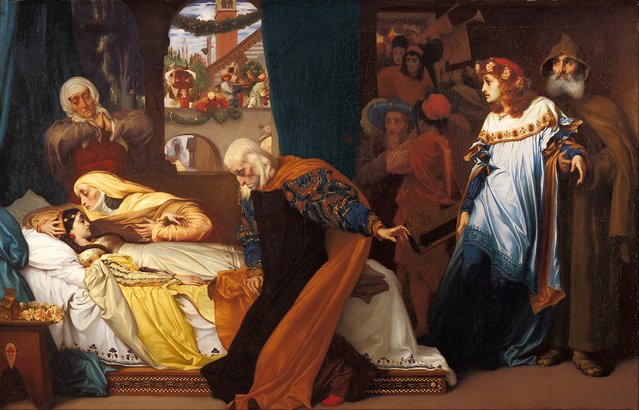
Juliet's chamber.
[Enter Nurse.]
NURSE
Mistress! what, mistress! Juliet! Fast, I warrant her, she.
Why, lamb! why, lady! Fie, you slug-abed!
Why, love, I say! madam! sweetheart! Why, bride!
What, not a word? You take your pennyworths now!
Sleep for a week;
for the next night, I warrant,
The County Paris hath set up his rest
That you shall rest but little. God forgive me!
Marry, and amen. How sound is she asleep!
I needs must wake her. Madam, madam, madam!
Ay, let the County take you in your bed!
He'll fright you up, i' faith. Will it not be?[Draws aside the curtains.]
What, dress'd, and in your clothes, and down again?
I must needs wake you. Lady! lady! lady!
Alas, alas! Help, help! My lady's dead!
O weraday that ever I was born!
Some aqua-vitae, ho! My lord! my lady!Enter Mother.
MOTHER
What noise is here?
NURSE
O lamentable day!
MOTHER
What is the matter?
NURSE
Look, look! O heavy day!
MOTHER
O me, O me! My child, my only life!
Revive, look up, or I will die with thee!
Help, help! Call help.Enter Father.
FATHER
For shame, bring Juliet forth;
her lord is come.
NURSE
She's dead, deceas'd;
she's dead! Alack the day!
MOTHER
Alack the day, she's dead, she's dead, she's dead!
CAPULET
Ha! let me see her. Out alas! she's cold,
Her blood is settled, and her joints are stiff;
Life and these lips have long been separated.
Death lies on her like an untimely frost
Upon the sweetest flower of all the field.
NURSE
O lamentable day!
MOTHER
O woful time!
CAPULET
Death, that hath ta'en her hence to make me wail,
Ties up my tongue and will not let me speak.Enter Friar [Laurence] and the County [Paris], with Musicians.
PARIS
Come, is the bride ready to go to church?
CAPULET
Ready to go, but never to return.
O son, the night before thy wedding day
Hath Death lain with thy wife. See, there she lies,
Flower as she was, deflowered by him.
Death is my son-in-law, Death is my heir;
My daughter he hath wedded. I will die
And leave him all. Life, living, all is Death's.
PARIS
Have I thought long to see this morning's face,
And doth it give me such a sight as this?
MOTHER
Accurs'd, unhappy, wretched, hateful day!
Most miserable hour that e'er time saw
In lasting labour of his pilgrimage!
But one, poor one, one poor and loving child,
But one thing to rejoice and solace in,
And cruel Death hath catch'd it from my sight!
NURSE
O woe? O woful, woful, woful day!
Most lamentable day, most woful day
That ever ever I did yet behold!
O day! O day! O day! O hateful day!
Never was seen so black a day as this.
O woful day! O woful day!
PARIS
Beguil'd, divorced, wronged, spited, slain!
Most detestable Death, by thee beguil'd,
By cruel cruel thee quite overthrown!
O love! O life! not life, but love in death!
CAPULET
Despis'd, distressed, hated, martyr'd, kill'd!
Uncomfortable time, why cam'st thou now
To murther, murther our solemnity?
O child! O child! my soul, and not my child!
Dead art thou, dead! alack, my child is dead,
And with my child my joys are buried!
PARIS
Peace, ho, for shame! Confusion's cure lives not
In these confusions. Heaven and yourself
Had part in this fair maid! now heaven hath all,
And all the better is it for the maid.
Your part in her you could not keep from death,
But heaven keeps his part in eternal life.
The most you sought was her promotion,
For 'twas your heaven she should be advanc'd;
And weep ye now, seeing she is advanc'd
Above the clouds, as high as heaven itself?
O, in this love, you love your child so ill
That you run mad, seeing that she is well.
She's not well married that lives married long,
But she's best married that dies married young.
Dry up your tears and stick your rosemary
On this fair corse, and, as the custom is,
In all her best array bear her to church;
For though fond nature bids us all lament,
Yet nature's tears are reason's merriment.
CAPULET
All things that we ordained festival
Turn from their office to black funeral-
Our instruments to melancholy bells,
Our wedding cheer to a sad burial feast;
Our solemn hymns to sullen dirges change;
Our bridal flowers serve for a buried corse;
And all things change them to the contrary.
FRIAR
Sir, go you in;
and, madam, go with him;
And go, Sir Paris. Every one prepare
To follow this fair corse unto her grave.
The heavens do low'r upon you for some ill;
Move them no more by crossing their high will.Exeunt. Manent Musicians [and Nurse].
FIRST MUSICIAN
Faith, we may put up our pipes and be gone.
Nurse. Honest good fellows, ah, put up, put up!
For well you know this is a pitiful case.[Exit.]
FIRST MUSICIAN
Ay, by my troth, the case may be amended.Enter Peter.
PETER
Musicians, O, musicians, 'Heart's ease,' 'Heart's ease'!
O, an you will have me live, play 'Heart's ease.'
FIRST MUSICIAN
Why 'Heart's ease'?
PETER
O, musicians, because my heart itself plays 'My heart is
full of woe.' O, play me some merry dump to comfort me.
FIRST MUSICIAN
Not a dump we! 'Tis no time to play now.
PETER
You will not then?
FIRST MUSICIAN
No.
PETER
I will then give it you soundly.
FIRST MUSICIAN
What will you give us?
PETER
No money, on my faith, but the gleek. I will give you the
minstrel.
FIRST MUSICIAN
Then will I give you the serving-creature.
PETER
Then will I lay the serving-creature's dagger on your
pate. I will carry no crotchets. I'll re you, I'll fa you.
Do you note me?
FIRST MUSICIAN
An you re us and fa us, you note us.
SECOND MUSICIAN
Pray you put up your dagger, and put out your wit.
PETER
Then have at you with my wit! I will dry-beat you with an
iron wit, and put up my iron dagger. Answer me like men.'When griping grief the heart doth wound,
And doleful dumps the mind oppress,
Then music with her silver sound'-Why 'silver sound'? Why 'music with her silver sound'?
What say you, Simon Catling?
FIRST MUSICIAN
Marry, sir, because silver hath a sweet sound.
PETER
Pretty! What say you, Hugh Rebeck?
SECOND MUSICIAN
I say 'silver sound' because musicians sound for
silver.
PETER
Pretty too! What say you, James Soundpost?
THIRD MUSICIAN
Faith, I know not what to say.
PETER
O, I cry you mercy! you are the singer. I will say for
you. It is 'music with her silver sound' because musicians
have no gold for sounding.'Then music with her silver sound
With speedy help doth lend redress.'[Exit.]
FIRST MUSICIAN
What a pestilent knave is this same?
SECOND MUSICIAN
Hang him, Jack! Come, we'll in here, tarry for the
mourners, and stay dinner.
Exeunt.