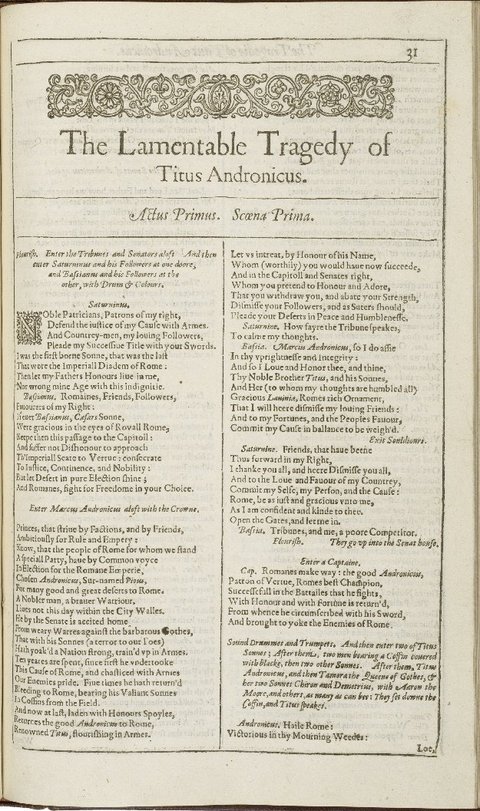
Titus Andronicus
Titus Andronicus, written around 1593, is Shakespeare's earliest tragedy and his most violent play. The Roman general Titus returns to Rome after a victorious campaign against the Goths, bringing as captives Tamora, Queen of the Goths, and her sons. When Titus sacrifices Tamora's eldest son in a ritual offering despite her pleas for mercy, he sets in motion a devastating cycle of revenge. Tamora becomes Empress of Rome through marriage to the decadent Emperor Saturninus, and with her lover Aaron the Moor, she orchestrates a campaign of horror against Titus and his family.
The atrocities escalate relentlessly. Titus's daughter Lavinia is raped and mutilated by Tamora's sons Chiron and Demetrius. Titus's sons are framed for murder, and Titus himself is tricked into cutting off his own hand. The play's horrors culminate in Titus's grim revenge: he kills Chiron and Demetrius, bakes their remains into a pie, and serves it to Tamora at a banquet before killing her and being killed himself. The bloodbath ends only when Titus's surviving son Lucius takes power and restores order to Rome.
Long dismissed as crude sensationalism, Titus Andronicus has been reassessed by modern scholars and directors as a powerful exploration of violence, justice, and the disintegration of civilization. Its unflinching depiction of atrocity speaks to audiences who have witnessed the horrors of modern warfare and political brutality. Aaron the Moor, unapologetically villainous yet strangely compelling, is a forerunner of Shakespeare's later great villains.