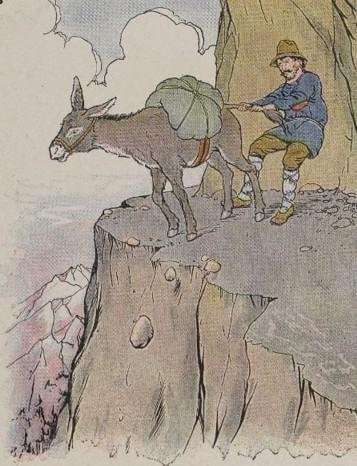
The Ass And His Driver


The Ass and His Driver (Perry Index 187) is one of Aesop's cautionary fables about the deadly consequences of stubbornness. The fable appears in the Augustana collection of Greek prose fables and was retold by George Fyler Townsend and other Victorian-era translators. Its theme of willful self-destruction through ignoring guidance links it to several other Aesopian tales featuring donkeys, including The Ass and Its Shadow and The Ass Carrying the Image, which explore different aspects of asinine folly.
The Ass And His Driver by Aesop

An Ass was being driven along a road leading down the mountainside, when he suddenly took it into his foolish head to choose his own path. He could see his stable at the foot of the mountain, and to him the quickest way down seemed to be over the edge of the nearest cliff. Just as he was about to leap over, his master caught him by the tail and tried to pull him back, but the stubborn Ass would not give in and pulled with all his might.

"Very well," said his master, "go your way, you willful beast, and see where it leads you."

With that he let go, and the foolish Ass tumbled head over heels down the mountainside.

Those who will not listen to reason but stubbornly go their own way against the friendly advice of those who are wiser than they are on the road to misfortune.

An Ass was being driven along a road leading down the mountain side, when he suddenly took it into his silly head to choose his own path. He could see his stall at the foot of the mountain, and to him the quickest way down seemed to be over the edge of the nearest cliff. Just as he was about to leap over, his master caught him by the tail and tried to pull him back, but the stubborn Ass would not yield and pulled with all his might.

"Very well," said his master, "go your way, you willful beast, and see where it leads you."

With that he let go, and the foolish Ass tumbled head over heels down the mountain side.

They who will not listen to reason but stubbornly go their own way against the friendly advice of those who are wiser than they, are on the road to misfortune.


Frequently Asked Questions about The Ass And His Driver

What is the moral of "The Ass and His Driver"?

The moral of The Ass and His Driver is that those who refuse to listen to reason and stubbornly insist on going their own way, against the advice of wiser guides, are headed for disaster. The Ass can see his stable at the bottom of the mountain and believes the fastest route is straight over a cliff. Despite his master's desperate attempts to pull him back by the tail, the Ass refuses to yield — and pays the ultimate price. The fable warns that willfulness without wisdom leads to self-destruction, especially when it overrides the counsel of those with greater experience and perspective.

What is the theme of "The Ass and His Driver"?

The central theme of The Ass and His Driver is the danger of stubbornness and the refusal to accept guidance. The fable explores how overconfidence in one's own judgment — especially when combined with impatience — can lead to catastrophe. A secondary theme involves the limits of a caretaker's responsibility: the Driver does his best to save the Ass, but ultimately cannot prevent someone determined to harm himself. Aesop also touches on the gap between perception and reality — the Ass sees his destination clearly but misjudges the path, illustrating how partial knowledge can be more dangerous than total ignorance.

Why does the Ass try to jump off the cliff?

The Ass tries to jump off the cliff because he can see his stable at the foot of the mountain and believes the shortest path is straight down over the edge. From his vantage point on the mountain road, the stable is visible below, and the cliff appears to be a direct shortcut rather than a deadly drop. The Ass's error is one of flawed reasoning combined with impatience — he focuses on the destination without understanding the terrain between. This reflects Aesop's recurring insight that a little knowledge, paired with stubborn confidence, is far more dangerous than admitting you need guidance.

Why does the Driver let go of the Ass?

The Driver lets go of the Ass because he has exhausted every effort to save the animal and recognizes that further struggle is futile. After catching the Ass by the tail and pulling with all his strength, the Driver realizes the beast will not yield. His parting words — "Very well, go your way, you willful beast, and see where it leads you" — are not spoken in cruelty but in resignation. Aesop uses this moment to illustrate a painful truth: there comes a point when a guide or mentor can no longer help someone who refuses to be helped. The Driver's release is an act of acceptance, not abandonment.

What does the Ass symbolize in Aesop's fable?

In The Ass and His Driver, the Ass symbolizes willful stubbornness and the refusal to accept wise counsel. Donkeys appear frequently in Aesop's fables as symbols of foolishness, vanity, or obstinacy. In this story, the Ass specifically represents people who are so confident in their own judgment that they reject help even when their chosen path leads to obvious danger. The Ass is not portrayed as unintelligent in the traditional sense — he can see his goal clearly — but his stubbornness blinds him to the gap between what he wants and what is actually possible. Aesop uses the donkey to warn against the kind of pride that refuses to bend.

What is the Perry Index number for "The Ass and His Driver"?

The Ass and His Driver is classified as Perry Index 187 in the standard catalogue of Aesopic fables compiled by classical scholar Ben Edwin Perry. The Perry Index organizes over 700 fables attributed to Aesop and provides a universal numbering system used by scholars worldwide. This particular fable appears in the Augustana collection of Greek prose fables and has been retold by numerous translators, including George Fyler Townsend and V. S. Vernon Jones. It belongs to a group of Aesop's fables featuring donkeys as central characters, each exploring a different aspect of foolish behavior.

Is "The Ass and His Driver" appropriate for children?

Yes, The Ass and His Driver is widely used in children's literature and educational settings. The fable is short, straightforward, and teaches a clear moral about listening to those with more experience. While the Ass does fall down the mountainside, the story handles the consequence briefly and without graphic detail, making it suitable for young readers. It is frequently included in children's collections of Aesop's fables and is used in elementary and middle school classrooms to teach lessons about stubbornness, decision-making, and the value of accepting guidance from parents, teachers, and other mentors.

What are the best Aesop fables to read next?

If you enjoyed The Ass and His Driver, here are some thematically related Aesop fables worth reading:

  • The Ass and Its Shadow — Another tale featuring a donkey, this fable explores how a petty argument over something trivial can cost you everything.
  • The Goatherd and the Goat — A goatherd strikes a disobedient goat and must face the consequences, mirroring the tension between a master and a willful animal.
  • The Mother and the Wolf — A wolf learns the hard way that not every warning should be taken at face value, complementing this fable's theme of heeding advice.
  • The Goose and the Golden Egg — Another classic tale about impatience and greed destroying what patience could have preserved.

Save stories, build your reading list, and access all study tools — completely free.

Save The Ass And His Driver to your library — it's free!

Need help with The Ass And His Driver?

Study tools to help with homework, prepare for quizzes, and deepen your understanding.

Flashcards →