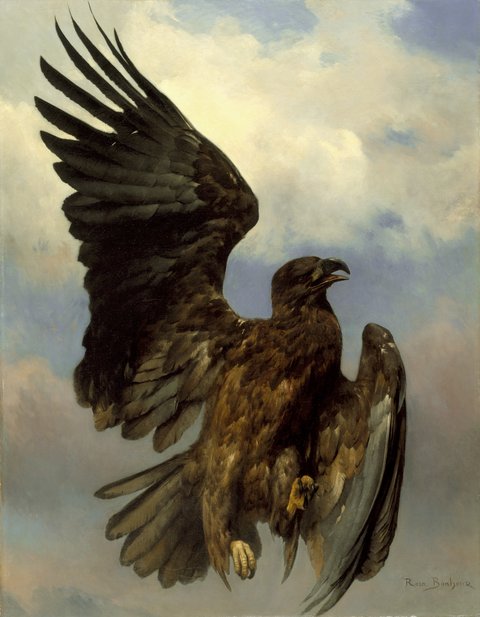
The Eagle and the Arrow (Perry Index 276) is one of Aesop's most enduring fables, first referenced in Aeschylus's lost tragedy The Myrmidons (5th century BCE), where it was said to be of Libyan origin. The image of the eagle slain by its own feathers has inspired poets for centuries: Edmund Waller adapted it in "To a Lady Singing a Song of His Own Composing" (1645), and Lord Byron immortalized it in English Bards and Scotch Reviewers (1809): "So the struck eagle, stretch'd upon the plain, / No more through rolling clouds to soar again."
An Eagle sat upon a high cliff, surveying the wide land below with keen and lordly eyes. He feared nothing, for he was the king of the sky, and no creature could reach him in his lofty perch.
Suddenly, an arrow came whistling through the air and struck him in the breast. The Eagle felt the sharp sting and knew at once that the wound was mortal. As he sank down, he turned his dying gaze upon the arrow that had pierced him.
There, fitted to the shaft, he saw feathers—and with a pang sharper than the wound itself, he recognized them as his own.
"Alas," he cried, "how much sharper are the wounds we give ourselves! It is with my own plumage that I am slain."
We often give our enemies the means of our own destruction.
Frequently Asked Questions about The Eagle and the Arrow
What is the moral of "The Eagle and the Arrow"?
The moral is: "We often give our enemies the means of our own destruction." The eagle discovers that the arrow which killed it was feathered with its own plumes, illustrating how our own resources, words, or actions can be turned against us by others.
What is the Perry Index number for this fable?
This fable is classified as Perry Index 276 ("Aquila et Sagitta" in Latin). The Perry Index is the standard classification system for Aesop's fables, compiled by scholar Ben Edwin Perry in 1952.
What is the origin of "The Eagle and the Arrow"?
The earliest known reference appears in The Myrmidons, a lost tragedy by Aeschylus written in the 5th century BCE, where it was said to be of Libyan origin. Aeschylus used the image to describe Achilles' guilt over the death of Patroclus. The fable was later collected in the Aesopic tradition and has been retold for over 2,500 years.
What does the eagle symbolize in this fable?
The eagle symbolizes power, pride, and invulnerability. Sitting on a high cliff, surveying the land with "keen and lordly eyes," it represents anyone who believes themselves untouchable. Its downfall by its own feathers suggests that strength and dominance carry within them the seeds of their own destruction.
How did Lord Byron use this fable in his poetry?
Lord Byron echoed the fable in English Bards and Scotch Reviewers (1809) with the lines: "So the struck eagle, stretch'd upon the plain, / No more through rolling clouds to soar again." He used the image to lament the early death of poet Henry Kirke White, drawing on the fable's themes of talent destroyed and potential cut short.
What is the difference between the eagle's physical wound and its emotional wound?
The physical wound from the arrow is mortal, but the emotional wound is worse. As the eagle says, "How much sharper are the wounds we give ourselves!" The recognition that its own feathers were used against it transforms a simple death into a tragedy of self-awareness. The 17th-century translator Roger L'Estrange captured this: "Nothing goes nearer a man in his misfortunes than to find himself undone by his own folly."
What is the meaning of "The Eagle and the Arrow" in modern life?
The fable remains relevant as a warning about how we inadvertently enable those who wish us harm. Sharing confidential information that gets leaked, trusting the wrong people with sensitive resources, or providing tools that are later used against us—these are all modern versions of the eagle's feathered arrow. The fable urges vigilance about what we give away and to whom.
What other Aesop fables explore similar themes of self-destruction?
Several Aesop fables deal with the consequences of pride and poor judgment: The Lion and the Ass shows how overconfidence leads to humiliation, The Fisherman and the Little Fish warns against greed that costs us what we already have, The Fox and the Monkey exposes the dangers of false pretenses, and The Boy Bathing illustrates how recklessness invites disaster.
Save stories, build your reading list, and access all study tools — completely free.
An eagle—king of the sky, untouchable on its high cliff—is struck down by an arrow. That alone would be tragedy enough. But the real blow comes in the …
...
Advertisement
Understanding The Eagle and the Arrow
A short summary of the story
The Wound That Cuts Deepest
An eagle—king of the sky, untouchable on its high cliff—is struck down by an arrow. That alone would be tragedy enough. But the real blow comes in the dying moment: the eagle looks down and recognizes its own feathers fitted to the shaft. The weapon that killed it was partly of its own making.
Aesop's moral is blunt: "We often give our enemies the means of our own destruction." But the fable operates on several levels that make it far more than a simple cautionary tale.
At the most literal level, the story warns about carelessness with our resources. The eagle shed feathers naturally—an unavoidable part of life—and a hunter collected them to craft a better weapon. We constantly leave traces of ourselves in the world: our words, our work, our trust. Others can gather those traces and turn them against us. A confidence shared with the wrong person becomes gossip. A business strategy leaked to a competitor becomes a counter-strategy. The fable asks us to consider what we leave behind and who might pick it up.
On a deeper level, the fable explores the particular anguish of complicity in one's own downfall. The 17th-century translator Roger L'Estrange put it memorably: "Nothing goes nearer a man in his misfortunes than to find himself undone by his own folly." The eagle's physical wound is mortal, but the emotional wound—the recognition—is what makes the scene devastating. Death can be borne; the knowledge that you helped cause it cannot.
The fable also carries a political edge that ancient audiences would have recognized immediately. The eagle was a symbol of imperial power throughout the Mediterranean world. To show an eagle brought low by its own plumage is to suggest that empires often contain the seeds of their own collapse—through overreach, through arming the wrong allies, through the pride that comes with unchallenged dominance. Aeschylus reportedly used the image in his lost play The Myrmidons to describe Achilles' guilt over the death of Patroclus, framing it as a case where strength itself became the instrument of loss.
The fable's final, most unsettling layer is its inevitability. Eagles must shed feathers. Living in the world means giving parts of yourself away. The question Aesop leaves us with is not whether we can prevent this—we cannot—but whether we can face the consequences with the clear-eyed honesty the dying eagle shows in its final cry.
Advertisement
Find this helpful? Create a free account to bookmark stories and save explanations for quick reference.