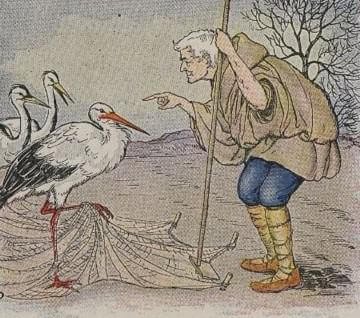
The Farmer And The Stork


The Farmer and the Stork (Perry Index 194) is one of Aesop's fables about guilt by association, preserved in the Greek collections of Babrius and Aphthonius. The fable was later retold by Phaedrus in Latin and by Jean de La Fontaine as L'Oiseleur, l'Autour, et l'Alouette. Its moral—that we are judged by our associations regardless of personal innocence—gave rise to the enduring proverb "A man is known by the company he keeps."
The Farmer And The Stork by Aesop

A Stork with a very simple and trusting nature had been invited by a lively group of Cranes to visit a field that had been newly planted. But the outing ended badly when all the birds became tangled in the meshes of the Farmer's net.

The Stork begged the Farmer to let him go.

"Please spare me," he pleaded. "I belong to the Stork family, who you know are honest and birds of good character. Besides, I had no idea the Cranes were going to steal."

"You may be a very good bird," answered the Farmer, "but I caught you with the thieving Cranes, and you will have to share the same punishment with them."

You are judged by the company you keep.

A Stork of a very simple and trusting nature had been asked by a gay party of Cranes to visit a field that had been newly planted. But the party ended dismally with all the birds entangled in the meshes of the Farmer's net.

The Stork begged the Farmer to spare him.

"Please let me go," he pleaded. "I belong to the Stork family who you know are honest and birds of good character. Besides, I did not know the Cranes were going to steal."

"You may be a very good bird," answered the Farmer, "but I caught you with the thieving Cranes and you will have to share the same punishment with them."

You are judged by the company you keep.


Frequently Asked Questions about The Farmer And The Stork

What is the moral of The Farmer and the Stork?

The moral is "You are judged by the company you keep." The fable teaches that associating with wrongdoers will bring the same consequences upon you, even if you are personally innocent. The Stork did not steal from the Farmer’s field, but because he was caught alongside the thieving Cranes, he faced the same punishment. Aesop’s lesson is that the world judges us by our associations, not just our individual actions, so we must choose our companions wisely.

What is the theme of The Farmer and the Stork?

The central theme is guilt by association—the idea that being found in bad company can ruin your reputation regardless of your personal character. The fable also explores themes of judgment, trust, and personal responsibility. The Stork trusts the Cranes without questioning their intentions, and this naivety proves to be his undoing. A secondary theme is the difference between private virtue and public perception: the Stork may be good, but the Farmer can only judge by what he sees.

Why does the Farmer refuse to spare the Stork?

The Farmer refuses because the Stork was caught in the same net as the thieving Cranes. From the Farmer’s perspective, he has no way to verify the Stork’s claim of innocence—all he knows is that the bird was found in his field alongside the criminals. The Farmer’s reasoning reflects a practical reality: when you are discovered among wrongdoers, your personal intentions become irrelevant. The Farmer is not necessarily being cruel; he is applying the only judgment available to him based on the circumstances.

What does the Stork symbolize in this fable?

The Stork symbolizes an innocent person who suffers consequences due to poor choices in companionship. In ancient Greek and Roman culture, storks were widely regarded as symbols of devotion, good character, and family loyalty—which makes the Stork’s plea especially poignant. He genuinely is a bird of good character, yet his naivety and trusting nature lead him into a trap. The Stork represents anyone who assumes their personal virtue will protect them from the consequences of associating with the wrong crowd.

What does "you are judged by the company you keep" mean?

This proverb means that people will form opinions about your character based on who you associate with, regardless of your individual behavior. If you surround yourself with dishonest or disreputable people, others will assume you share those qualities. The saying originates from fables like The Farmer and the Stork, where the innocent Stork is punished simply for being found among thieving Cranes. In modern life, this principle applies to friendships, business partnerships, and professional networks—your associations shape how the world perceives you.

What is the Perry Index number for The Farmer and the Stork?

The Farmer and the Stork is number 194 in the Perry Index, the standard classification system for Aesop’s fables compiled by scholar Ben Edwin Perry in 1952. The fable is preserved in Greek in the collections of Babrius and Aphthonius, and was later adapted into Latin by Phaedrus. It also appears in Jean de La Fontaine’s celebrated French verse adaptations of Aesop, demonstrating its enduring popularity across European literary traditions.

Is The Farmer and the Stork a true story?

No, The Farmer and the Stork is not a true story but a fictional fable attributed to Aesop, the legendary Greek storyteller believed to have lived around 620–564 BCE. Like all of Aesop’s fables, it uses animal characters to illustrate a moral lesson about human behavior. While the story is fictional, the principle it teaches—that we are judged by our associations—is grounded in real social dynamics. Farmers in ancient Greece did indeed set nets to protect their fields from birds, so the scenario, while symbolic, reflects real agricultural practices of the time.

What are the best Aesop fables to read next?

If you enjoyed the lesson about judgment and association in The Farmer and the Stork, consider these Aesop fables that explore related themes:

  • The Wolf and the Crane — A crane risks its life to help a wolf, only to learn that expecting gratitude from the wicked is foolish.
  • The Cat and the Fox — A fox boasts of having a hundred tricks to escape danger, but the cat’s single reliable plan proves superior.
  • The Frogs and the Ox — A frog tries to puff itself up to the size of an ox, learning the danger of overestimating one’s own importance.
  • The Monkey and the Camel — A camel tries to imitate a monkey’s dancing and is laughed out of the gathering, showing the folly of pretending to be what you are not.

Save stories, build your reading list, and access all study tools — completely free.

Save The Farmer And The Stork to your library — it's free!

Need help with The Farmer And The Stork?

Study tools to help with homework, prepare for quizzes, and deepen your understanding.

Flashcards →