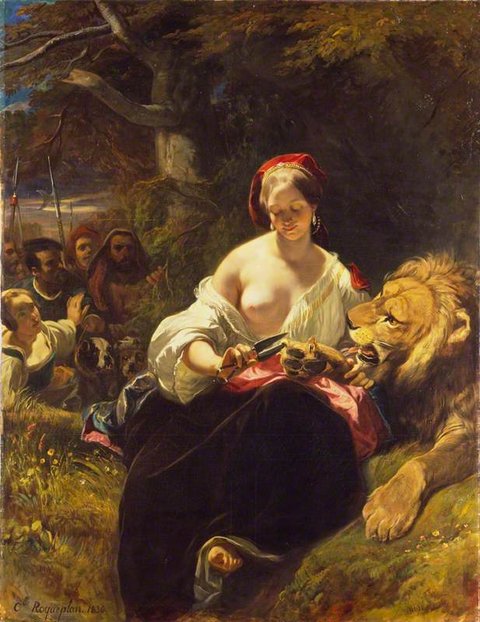
The Lion in Love


The Lion in Love (Perry Index 140) is a fable attributed to Aesop that warns against sacrificing one's natural strengths for the sake of passion. It became one of Jean de La Fontaine's most celebrated retellings in his Fables (1668), where the French poet dedicated it to a young woman and used it to explore the folly and power of love. The story's sharp irony—a mighty lion rendered helpless by his own desire—has made it a favorite among moralists and storytellers for centuries. The fable also gave rise to the English idioms "to draw someone's teeth" and "to clip someone's claws," both meaning to render someone harmless.

A Lion once fell deeply in love with the beautiful daughter of a woodsman. He went to the father and asked for the maiden's hand in marriage.

The woodsman was terrified at the thought of giving his daughter to a wild beast, yet he dared not refuse such a powerful suitor outright. So he thought of a cunning plan.

"I am flattered by your proposal," said the woodsman, bowing low. "But you must understand, my daughter is a tender girl. She is frightened of your great sharp claws and your long teeth. If you truly love her, you will have them removed. Then she will gladly be your bride."

The Lion was so blinded by love that he agreed at once. He went away and had his claws pulled out and his mighty teeth drawn. Then, full of joy, he returned to claim his bride.

But the woodsman, seeing the Lion now helpless and tame, seized a stout club and drove him away from the door. The Lion slunk off into the forest, shorn of all his strength, with nothing to show for his love but pain and humiliation.

Love can tame the wildest.


Frequently Asked Questions about The Lion in Love

What is the moral of The Lion in Love?

The traditional moral is "Love can tame the wildest"—but this is deliberately ironic. In context, "tame" does not mean soften or improve. It means render powerless. The Lion gives up his claws and teeth to win a bride, only to be driven away with a club once he is defenseless. The deeper moral is that love which demands you destroy your core strengths is not love at all—it is a trap. Blind devotion that asks you to surrender who you are will always be exploited.

What is the theme of The Lion in Love?

The central theme is the danger of sacrificing your identity for love. The Lion possesses immense natural power—claws and teeth that make him king of the forest—but he voluntarily gives them up to satisfy the conditions set by the woodsman. Related themes include blind passion versus wisdom, the cunning of the weak against the strong, and the irony that the Lion’s greatest vulnerability is not a physical weakness but his willingness to believe that love requires self-destruction.

Why does the Lion agree to remove his claws and teeth?

The Lion agrees because he is "so blinded by love" that he cannot see the trap. The woodsman frames the request as a reasonable concern—his daughter is frightened of the Lion’s claws and teeth—and the Lion, desperate to win her, accepts without question. Aesop’s point is that passion overrides judgment. The Lion does not stop to consider that removing his natural weapons will leave him vulnerable. He treats love as something worth any price, and he pays the ultimate price: total helplessness.

Is the woodsman the villain in The Lion in Love?

The woodsman is cunning and deceptive, but Aesop does not present him as a villain. He is a father protecting his daughter from a dangerous suitor—a lion who could kill her with one swipe. His trick is clever rather than cruel: he does not fight the Lion directly but outsmarts him by exploiting the Lion’s blind desire. In Aesop’s moral framework, the fault lies with the Lion for being foolish enough to surrender his power, not with the woodsman for being shrewd enough to ask for it.

What does "Love can tame the wildest" mean?

This closing moral works on two levels. On the surface, it sounds like a celebration of love’s power—even the fiercest lion can be softened by romance. But in the context of the fable, it is deeply ironic. "Tame" here means strip of power, make docile, render harmless. The Lion is not made better by love. He is made nothing by it. The moral is Aesop’s warning that love’s ability to "tame" is not always a gift—it can be a weapon used against you.

How did La Fontaine retell The Lion in Love?

Jean de La Fontaine retold this fable as Le lion amoureux in his Fables (1668), dedicating it to the young Mademoiselle de Sévigné. La Fontaine expanded the story with elegant verse, emphasizing the Lion’s noble nature before his downfall. He ended with the famous warning: "O love, O love, mastered by you, prudence we well may bid adieu." His version became one of the most celebrated fables in European literature and inspired paintings by Gustave Moreau and other artists.

What English idioms come from The Lion in Love?

This fable gave rise to two common English idioms in the 19th century. "To draw someone’s teeth" and "to clip someone’s claws" both mean to render a person harmless or strip them of their power—exactly what the woodsman does to the Lion. The expressions entered everyday English because the fable’s image is so vivid: a powerful figure voluntarily surrendering the very weapons that made them formidable, only to discover too late that they have been disarmed.

What other Aesop fables are similar to The Lion in Love?

Several of Aesop’s fables explore related themes of cunning versus power, blind desire, and self-inflicted loss. In The Miser, a man’s obsessive attachment to gold destroys the very thing he treasures. The Wolf And The Kid shows another predator outsmarted by a clever weaker creature. The Boys And The Frogs examines how actions taken carelessly can devastate others, while The Bat, the Bramble, and the Seagull warns about reckless ventures that lead to permanent loss.

Save stories, build your reading list, and access all study tools — completely free.

Save The Lion in Love to your library — it's free!

Need help with The Lion in Love?

Study tools to help with homework, prepare for quizzes, and deepen your understanding.

Flashcards →