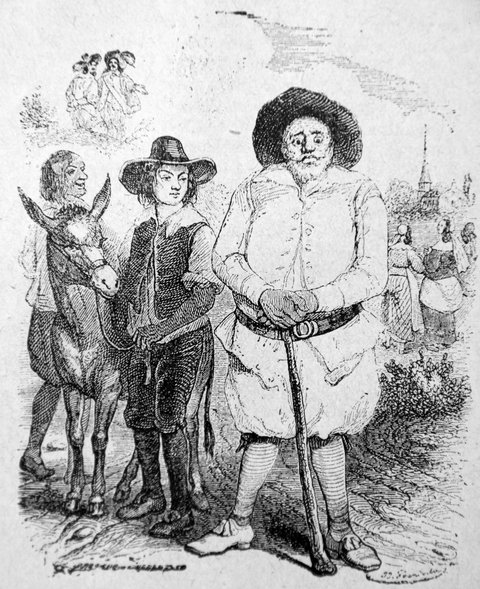
The Man, the Boy, and the Donkey (Perry Index 721) is one of Aesop's most universally recognized fables and the origin of the proverb "you can't please everyone." Though attributed to Aesop, the earliest written version appears in the work of the 13th-century Arab writer Ibn Said, and it entered European literature through the Latin sermon collections of Jacques de Vitry. The Greek playwright Aristophanes alluded to the story as early as 405 BCE in The Frogs, suggesting ancient oral origins. Jean de La Fontaine later included it in his celebrated Fables (1668), and it has remained a staple of children's moral education across cultures ever since.
A Man and his young Son were once walking to market with their Donkey. As they strolled along the dusty road, they passed a group of girls coming from town.
"Look at those fools!" laughed one of the girls. "They walk along the road while their Donkey carries nothing at all. What is a donkey for, if not to ride upon?"
The Man thought this was sensible enough, so he placed his Son upon the Donkey and they continued on their way. Before long they came upon a group of old men sitting by the road.
"There you see it!" grumbled one of them. "The young have no respect for their elders. That lazy boy rides in comfort while his poor old father walks."
The Man told his Son to climb down and got on the Donkey himself. They had not gone far when they passed two women at a well.
"Shame on you!" cried one of them. "How can you ride while that poor little child struggles to keep up on his tired legs?"
The Man did not know what to do, but at last he pulled his Son up onto the Donkey so that they both rode together. By this time they had nearly reached the town, and the townspeople began to gather round.
"Have you no pity for your poor Donkey?" shouted a man from the crowd. "The beast is half dead from carrying two riders. You would do better to carry the donkey yourselves!"
By now the Man and his Son were willing to try anything. They got off, tied the Donkey's legs to a long pole, and struggled to carry him on their shoulders. As they crossed a bridge near the marketplace, the Donkey kicked free of the ropes, tumbled over the railing, and fell into the river below, where it drowned.
The Man trudged home, weary and ashamed, having lost his Donkey and pleased no one at all.
If you try to please everyone, you will please no one.
Frequently Asked Questions about The Man, the Boy, and the Donkey
What is the moral of "The Man, the Boy, and the Donkey"?
The moral is "if you try to please everyone, you will please no one." The father attempts to satisfy every critic he meets on the road to market, but each change he makes only invites new criticism — until he loses his donkey entirely. The fable teaches that seeking universal approval is not only futile but self-destructive.
What is the Perry Index number for this fable?
This fable is Perry Index 721. It is also classified as Aarne–Thompson type 1215. Though attributed to Aesop, the earliest written version comes from the 13th-century Arab writer Ibn Said, and it entered European literature through the Latin sermon collections of Jacques de Vitry.
Why does the man keep changing who rides the donkey?
The man changes the arrangement each time because he takes every passerby's criticism at face value without questioning it. He lacks the confidence to trust his own judgment, so he treats each new opinion as authoritative. This pattern of constant capitulation is the central flaw the fable warns against.
What happens to the donkey at the end of the story?
After being told they should carry the donkey themselves, the man and boy tie the donkey's legs to a pole and attempt to carry it on their shoulders. As they cross a bridge near the marketplace, the donkey kicks free of the ropes, tumbles over the railing, and drowns in the river below. The man loses everything by trying to please everyone.
Is "The Man, the Boy, and the Donkey" the origin of the saying "you can't please everyone"?
This fable is widely considered the origin of the proverb "you can't please everyone." The Greek playwright Aristophanes alluded to the story as early as 405 BCE in The Frogs, suggesting it circulated orally long before it was written down. Jean de La Fontaine's influential 1668 retelling helped cement the moral as a common saying across European languages.
What does this fable teach children?
For young readers, the fable teaches the importance of thinking for yourself rather than blindly following what others say. It shows that different people will always have different opinions, and trying to make everyone happy is impossible. The story encourages children to develop confidence in their own decisions while still being open to thoughtful advice.
How is this fable relevant today?
The fable remains deeply relevant in the age of social media, where public opinion is constant and contradictory. Politicians, creators, and businesses often face the same impossible cycle the man experiences — every decision draws criticism from some quarter. The story's lesson about the futility of chasing universal approval resonates more strongly than ever in a culture of instant, conflicting feedback.
What other Aesop fables explore similar themes of judgment and folly?
Several Aesop fables deal with poor judgment and the consequences of foolish choices. The Lion and the Ass shows what happens when someone overestimates their own importance. The Fox and the Monkey exposes the danger of pretending to be what you are not. The Wolf and the Kid warns about trusting the wrong voices, and The Farmer and the Snake reveals the cost of misplaced kindness toward those who will never change.
Save stories, build your reading list, and access all study tools — completely free.
"The Man, the Boy, and the Donkey" is arguably Aesop's most practical fable — a story that plays out in boardrooms, classrooms, and family dinners every …
...
Advertisement
Understanding The Man, the Boy, and the Donkey
A short summary of the story
Please All, Please None: The Fable Explained
"The Man, the Boy, and the Donkey" is arguably Aesop's most practical fable — a story that plays out in boardrooms, classrooms, and family dinners every single day. A father and son set off to market with their donkey, and what follows is a masterclass in how trying to satisfy every critic leads to disaster.
The structure is deliberately repetitive, and that repetition is the point. Each group of passersby offers a different criticism, and each criticism directly contradicts the last. The girls mock them for walking. The old men scold the boy for riding while his father walks. The women shame the father for riding while his child trudges alongside. The townspeople condemn them both for overloading the poor animal. No arrangement satisfies everyone because the critics don't agree with each other.
What makes the fable devastating is its ending. The man doesn't just fail to please anyone — he loses everything. By trying to carry the donkey, he creates an absurd situation that costs him the animal entirely. The progression from reasonable compromise to total catastrophe is Aesop at his sharpest: each concession to public opinion makes things slightly worse until the whole enterprise collapses.
The deeper lesson goes beyond simple stubbornness. The man's mistake isn't that he listens to others — it's that he listens to everyone without filtering their advice through his own judgment. He never stops to ask whether the criticism is valid or whether the critic has any stake in his journey. He treats every passing opinion as equally authoritative, and that lack of discernment is what destroys him.
This fable also reveals something uncomfortable about human nature: people love to criticize, and they rarely consider whether their advice conflicts with what someone else just said. The girls, the old men, the women, and the townspeople each speak with absolute confidence. None of them are wrong in isolation — but taken together, their advice is impossible to follow. The story quietly indicts the critics as much as the man who listens to them.
Two and a half millennia after it was first told, "The Man, the Boy, and the Donkey" remains the definitive argument for trusting your own judgment. Not because other people are always wrong, but because no one else has to live with the consequences of your decisions. The man who tries to please everyone ends up carrying a donkey across a bridge — and that image has lost none of its absurd, painful truth.
Advertisement
Find this helpful? Create a free account to bookmark stories and save explanations for quick reference.