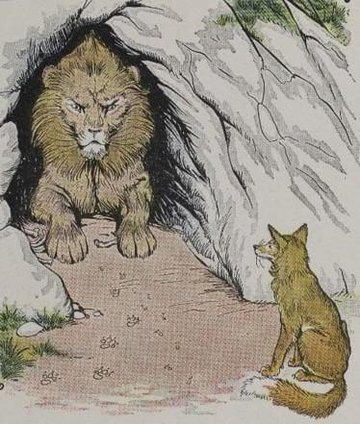
The Old Lion And The Fox


The Old Lion and the Fox (Perry Index 142) is one of the oldest fables in the Aesopic tradition, with versions recorded as early as the 6th century BCE. The Greek poet Horace alluded to it in his Epistles, and the Roman fabulist Phaedrus included it in his Latin verse collection. Jean de La Fontaine later adapted the tale in his celebrated Fables (1668), adding a witty exchange of letters between the lion and the foxes. In the 17th century, the fable was frequently interpreted as a political warning against visiting the courts of tyrants. The fox’s observation about the footprints remains one of the most famous images in all of fable literature—a single detail that reveals a deadly truth.
The Old Lion And The Fox by Aesop

An old Lion, whose teeth and claws were so worn that it was no longer easy for him to catch food as he once could, decided to use cunning instead of strength. He pretended to be terribly sick, and he made sure all the animals in the neighborhood heard the news. Then he lay down in his cave and waited for visitors.

One by one, the animals came to offer their sympathy—and one by one, the Lion seized and devoured them.

At last the Fox came to pay his respects, but he was far more cautious than the others. He stood at a safe distance outside the cave and called in politely to ask how the Lion was feeling. The Lion groaned and begged the Fox to step inside for just a moment.

But the Fox shook his head. “I should be happy to visit,” he said, “but I notice something troubling. I can see many footprints leading into your cave, but not a single one coming back out. Until I see your guests leaving as well as arriving, I think I shall stay right where I am.”

Take warning from the misfortunes of others.

An old Lion, whose teeth and claws were so worn that it was not so easy for him to get food as in his younger days, pretended that he was sick. He took care to let all his neighbors know about it, and then lay down in his cave to wait for visitors. And when they came to offer him their sympathy, he ate them up one by one.

The Fox came too, but he was very cautious about it. Standing at a safe distance from the cave, he inquired politely after the Lion's health. The Lion replied that he was very ill indeed, and asked the Fox to step in for a moment. But Master Fox very wisely stayed outside, thanking the Lion very kindly for the invitation.

"I should be glad to do as you ask," he added, "but I have noticed that there are many footprints leading into your cave and none coming out. Pray tell me, how do your visitors find their way out again?"

Take warning from the misfortunes of others.


Frequently Asked Questions about The Old Lion And The Fox

What is the moral of The Old Lion and the Fox?

The moral is “Take warning from the misfortunes of others.” The fable teaches that wise individuals observe the consequences others have suffered before putting themselves in the same situation. The Fox does not need to enter the Lion’s cave to know it is dangerous—the footprints of previous visitors, all leading in and none coming out, tell him everything. Aesop’s lesson is that paying attention to evidence is more reliable than trusting reassuring words.

What is the story of The Old Lion and the Fox about?

An aging Lion, too weak to hunt, pretends to be gravely ill and invites the neighboring animals to visit him in his cave. As each animal enters to offer sympathy, the Lion devours them. When the Fox arrives, he stays outside and notices that many footprints lead into the cave but none lead back out. He politely declines to enter, exposing the Lion’s deadly trick. The story contrasts blind trust with careful observation.

What does the Fox represent in this fable?

The Fox represents wisdom, caution, and critical thinking. In Aesop’s fables, the fox is almost always the cleverest character—not because of physical strength, but because of a sharp ability to read situations. In this story, the Fox looks past the Lion’s words and examines the physical evidence. He represents the person who refuses to be swayed by social pressure or persuasive language when the facts point to danger.

What is the Perry Index number for this fable?

This fable is number 142 in the Perry Index, the standard classification system for Aesop’s fables compiled by Ben Edwin Perry in 1952. It is sometimes titled The Fox and the Sick Lion or The Lion, the Fox, and the Footprints in different translations. Versions of the story date back to ancient Greece, with allusions appearing in the works of Horace and verse adaptations by Phaedrus.

What do the footprints symbolize in the fable?

The footprints are the fable’s most powerful symbol. They represent observable evidence—the kind of proof that cannot be faked or argued away. Footprints leading in but not out tell a story of disappearance and danger. On a deeper level, they symbolize the traces that deception always leaves behind. No matter how convincing a lie may sound, there are usually visible signs of the truth for anyone willing to look. The Fox’s genius is simply that he looks.

How does La Fontaine's version differ from Aesop's?

Jean de La Fontaine adapted the fable in his Fables (1668) with characteristic French wit. In his version, the Lion issues a formal safe-conduct pass (passeport) to lure the animals, adding a layer of political satire about rulers who use official guarantees to trap the unwary. The foxes send back a written reply echoing the famous observation: “While seeing how the beasts get in, we do not see how they get out.” La Fontaine’s retelling sharpens the fable’s political edge, turning it into a critique of royal courts.

What lesson does this fable teach children?

For children, the fable teaches a straightforward but vital lesson: look before you leap. Just because someone invites you somewhere or tells you something is safe does not mean it truly is. The Fox shows children that it is smart—not rude—to ask questions and look for evidence before going along with something that feels wrong. The story also teaches that you can learn from what happened to others instead of having to make the same mistake yourself.

What other Aesop fables feature a fox outsmarting danger?

The Fox is one of Aesop’s most recurring characters, often using wit to survive situations that overpower stronger animals. Related fables include:

Save stories, build your reading list, and access all study tools — completely free.

Save The Old Lion And The Fox to your library — it's free!

Need help with The Old Lion And The Fox?

Study tools to help with homework, prepare for quizzes, and deepen your understanding.

Flashcards →