Summary
A peacock, unhappy despite his magnificent plumage, goes to Juno (the Roman queen of the gods, equivalent to the Greek Hera) to complain that while the nightingale has a beautiful singing voice, his …
Understanding The Peacock and Juno
Summary
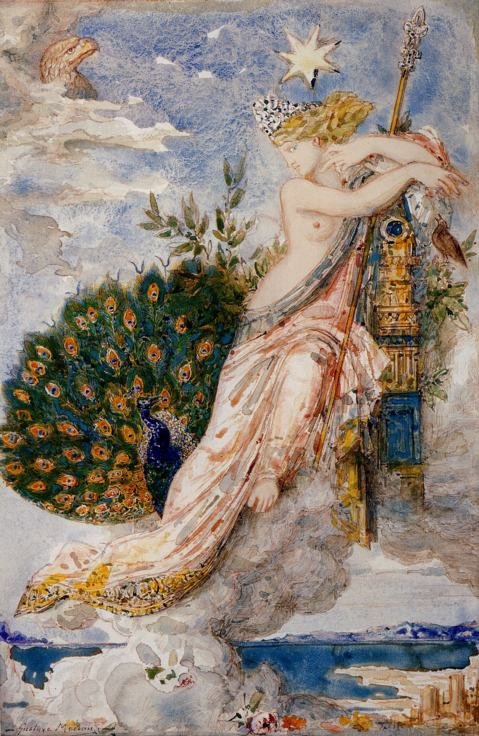
A peacock, unhappy despite his magnificent plumage, goes to Juno (the Roman queen of the gods, equivalent to the Greek Hera) to complain that while the nightingale has a beautiful singing voice, his own voice is harsh and mocked by all. Juno listens patiently and explains that every creature has received its own unique gift: the nightingale has song, the eagle has strength, the raven has prophecy, and the peacock has beauty beyond compare. When the peacock insists he wants to sing as well, Juno tells him that if every creature had every gift, none would be special. The peacock departs, chastened but still trailing his splendid tail.
Moral
The moral, stated directly at the fable's close, is: "Be content with your own gifts, and do not envy others theirs." Juno's wisdom teaches that the gifts of nature (or fate) are distributed so that each creature excels in its own way. Wanting what belongs to another only blinds you to what you already possess.
Analysis
At its core, "The Peacock and Juno" is a fable about the psychology of envy. The peacock already possesses something extraordinary—a tail that is "the wonder of the world"—yet he fixates on the one thing he lacks. This is a pattern Aesop recognized across many fables: dissatisfaction doesn't come from having too little, but from comparing yourself to others.
Juno's response introduces what philosophers call the principle of compensating advantages. No single creature receives everything; instead, gifts are distributed across all. The eagle cannot sing either, and the nightingale has no brilliant plumage. This framework suggests a world that is fair in its totality, even if no individual has every advantage—a deeply consoling idea that resonated from ancient Rome through the Renaissance and into modern psychology.
The choice of Juno as the authority figure is significant. In Roman mythology, Juno was the protector of the state and the goddess of marriage and childbirth—a maternal, ordering presence. The peacock was also her sacred bird, making the complaint doubly personal: the peacock is, in effect, complaining to his own patron goddess about the gifts she herself gave him.
The fable also works as a cautionary tale about ingratitude. The peacock's beauty is acknowledged by everyone except himself. By focusing exclusively on what the nightingale has, he diminishes his own remarkable gifts. In modern terms, this maps neatly onto research about social comparison—the finding that people who habitually compare themselves to others report lower life satisfaction, regardless of their actual circumstances.
The ending is deliberately ambiguous. The peacock "hung his head and walked away, his splendid tail trailing behind him." He is humbled, but is he convinced? The trailing tail—still magnificent, still unappreciated by its owner—suggests that the lesson may not have fully landed. Aesop leaves the reader to complete the moral work that the peacock himself may not.
Themes
- Contentment vs. Envy — The central tension of the fable: the peacock has much but wants what another has.
- Gratitude for One's Gifts — Juno's lesson is fundamentally about recognizing and appreciating what you already possess.
- The Distribution of Talents — No creature has everything; gifts are spread across all beings by design.
- Self-Acceptance — True contentment comes from embracing your own nature rather than wishing to be someone else.
- The Futility of Complaint — Protesting to the gods (or to fate) about your lot changes nothing; only your attitude can change.
Historical Context
This fable is catalogued as Perry Index 509 and comes from Phaedrus (Book III, Fable 18), the Roman freedman who versified Aesop's fables in Latin during the reign of Emperor Tiberius (1st century CE). It is one of the fables attributed to Aesop through the Latin tradition rather than the Greek, which may explain the use of Roman divine names (Juno rather than Hera).
The fable was enormously popular in the medieval and Renaissance periods. Jean de La Fontaine adapted it as "Le Paon se plaignant à Junon" in his celebrated Fables (1668–1694). The French painter Gustave Moréau created a luminous oil painting, The Peacock Complaining to Juno (1881), now in the Musée Gustave Moreau in Paris. The fable has also appeared in countless school readers from the 18th century onward, making it one of Aesop's most recognizable stories in educational settings.
Find this helpful? Create a free account to bookmark stories and save explanations for quick reference.
Sign Up FreeAlready have an account? Log in