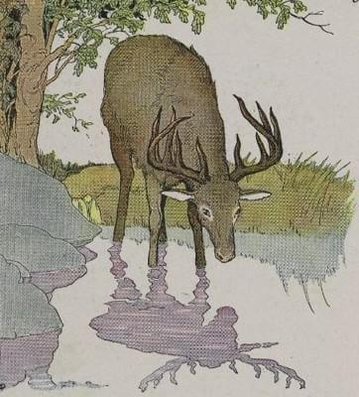
The Stag And His Reflection


The Stag and His Reflection (Perry Index 74), also known as The Stag at the Pool, is one of Aesop's most widely retold fables. Phaedrus included it in his first-century Latin collection as The Stag at the Fountain (Book I, Fable 12), where the stag dies lamenting, "How useful what I did disdain! How grievous that which made me vain!" La Fontaine later adapted the tale in his celebrated French verse fables. The story belongs to a group of Aesop's fables exploring the theme of misplaced vanity and the contrast between appearance and practical worth.
The Stag And His Reflection by Aesop

A Stag, drinking from a crystal-clear spring, caught sight of himself reflected in the still water. He greatly admired the graceful curve of his antlers, but he was deeply ashamed of his thin, spindly legs.

"How can it be," he sighed, "that I should be burdened with such ugly legs when I have so magnificent a crown?"

At that moment he caught the scent of a panther, and in an instant he was bounding away through the forest. But as he ran, his wide-spreading antlers caught in the branches of the trees, and soon the Panther overtook him. Then the Stag realized that the legs he had been so ashamed of would have saved him, had it not been for the useless ornaments on his head.

We often make much of the ornamental and despise the useful.

A Stag, drinking from a crystal spring, saw himself mirrored in the clear water. He greatly admired the graceful arch of his antlers, but he was very much ashamed of his spindling legs.

"How can it be," he sighed, "that I should be cursed with such legs when I have so magnificent a crown."

At that moment he scented a panther and in an instant was bounding away through the forest. But as he ran his wide-spreading antlers caught in the branches of the trees, and soon the Panther overtook him. Then the Stag perceived that the legs of which he was so ashamed would have saved him had it not been for the useless ornaments on his head.

We often make much of the ornamental and despise the useful.


Frequently Asked Questions about The Stag And His Reflection

What is the moral of "The Stag and His Reflection"?

The moral is "We often make much of the ornamental and despise the useful". The Stag admires his beautiful antlers and is ashamed of his thin legs, but when a panther chases him, his legs carry him swiftly while his antlers tangle in the branches and lead to his capture. The fable warns that we frequently overvalue what looks impressive and undervalue what actually serves us, often realizing our mistake only when it is too late.

What is the theme of "The Stag and His Reflection"?

The central theme is the danger of misplaced values—prioritizing appearance and ornament over practical worth. Related themes include vanity and self-deception, since the Stag judges himself by how he looks rather than by what his body can do. The fable also explores the idea of ironic reversal: the very quality the Stag celebrates becomes the cause of his downfall, while the quality he despises would have been his salvation.

Why do the Stag's antlers get him killed?

As the Stag flees a panther through the forest, his wide-spreading antlers catch in the tree branches, slowing him down and eventually allowing the panther to overtake him. The antlers he considered his greatest asset become a literal trap. Aesop uses this detail to show that impressive features can become liabilities in situations that demand practical action rather than display. In the wild, large antlers genuinely do hinder movement through dense forest, making this one of Aesop's most naturalistic metaphors.

What do the antlers and legs symbolize in this fable?

The antlers symbolize outward beauty, status, and ornamental qualities—the things we display to impress others. The legs symbolize practical ability, inner strength, and usefulness—the unglamorous qualities that sustain us in a crisis. Together they represent the contrast between appearance and substance. The Stag's mistake is not in appreciating his antlers but in despising his legs, showing how vanity blinds us to the value of what is truly essential.

What does the Stag see in the water?

The Stag sees his own reflection in a crystal-clear spring while drinking. The still water acts as a mirror, allowing him to admire the graceful arch of his antlers and simultaneously notice his thin, spindly legs. This moment of self-admiration is the setup for the entire fable—the Stag is essentially judging his own worth by appearance alone. The pool scene recalls the myth of Narcissus, another classical story in which gazing at one's own reflection leads to destruction.

What is the origin of "The Stag and His Reflection"?

This fable is catalogued as Perry Index 74 and is one of the oldest in the Aesopic tradition. The Roman poet Phaedrus included it in his first-century Latin collection as The Stag at the Fountain (Book I, Fable 12), giving the dying stag the memorable line: "How useful what I did disdain! How grievous that which made me vain!" La Fontaine later adapted the story into French verse. The fable has appeared continuously in Western literature for over two thousand years, making it one of Aesop's most enduring tales about vanity and misplaced values.

What lesson does "The Stag and His Reflection" teach children?

The fable teaches children that what looks beautiful is not always what is most important. The Stag loves his fancy antlers and hates his plain legs, but when danger comes, it is the plain legs that try to save him while the fancy antlers get him caught. The lesson encourages children to value practical skills and inner qualities—like kindness, hard work, and reliability—over things that merely look impressive. It is also a gentle warning against being too proud of appearances and too quick to dismiss what seems ordinary.

What are the best Aesop fables to read next?

If you enjoyed The Stag and His Reflection, explore these thematically connected Aesop fables: The Lion in Love, where a powerful lion sacrifices his greatest strengths to impress others and pays a devastating price; The Horse, the Hunter, and the Stag, another fable in which a proud animal's vanity leads to a permanent loss of freedom; The Cock and the Fox, a tale of cunning and misplaced trust that explores how cleverness can be both weapon and shield; and The Monkey and the Cat, where flattery and vanity combine to make one character do all the work while another reaps the reward.

Save stories, build your reading list, and access all study tools — completely free.

Save The Stag And His Reflection to your library — it's free!

Need help with The Stag And His Reflection?

Study tools to help with homework, prepare for quizzes, and deepen your understanding.

Flashcards →