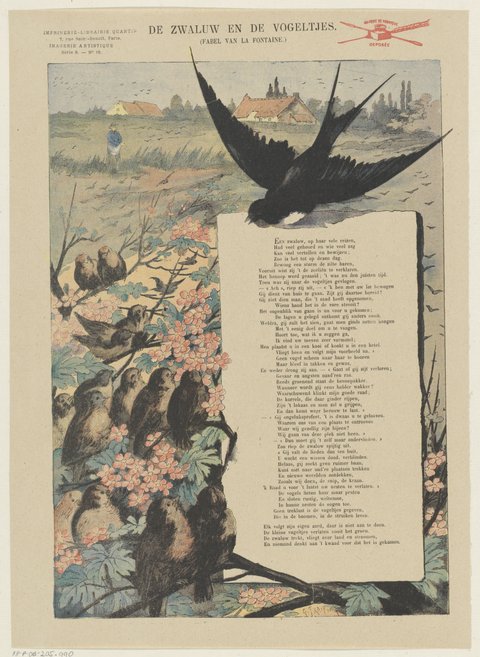
The Swallow and the Other Birds (Perry Index 39a) is one of the oldest fables attributed to Aesop, sometimes known by the title "The Swallow's Advice." The tale warns against ignoring wise counsel and the danger of failing to act when trouble is still small and manageable. Its emphasis on foresight and prevention has made it a lasting moral lesson across many cultures and centuries of retelling.
It happened one spring that a Swallow, who had traveled far and seen much, was perched in a tree at the edge of a field. Below her, a farmer was sowing seeds in long, neat rows.
The Swallow flew down at once and called to the other birds who were hopping about in the hedgerows and trees nearby.
"Come quickly!" she cried. "Do you see what the farmer is planting? Those are hemp seeds. You must pick up every last one before they take root, for if the hemp is allowed to grow, it will be woven into nets and snares that will be the ruin of us all."
But the other birds only laughed at her. "What a fuss over a few little seeds!" said the Sparrow. "You worry too much," said the Finch. And the Blackbird added, "We have far better things to do."
The Swallow begged and pleaded, but not a single bird would listen. So she left them and went to the farmhouse, where she made her nest under the eaves and befriended the farmer and his family.
In time, the hemp seeds sprouted into tall green plants. The Swallow flew back to warn the birds once more. "Pull them up now, while you still can!" she urged. "Soon it will be too late."
Again the birds ignored her. "They are only weeds," they said, and went about their business.
When autumn came, the farmer harvested the hemp and twisted it into strong ropes, which he wove into nets and snares. He spread them across the fields and in the trees, and one by one the careless birds were caught.
As they struggled in the nets, they cried out in despair, wishing they had listened to the Swallow. But the Swallow herself lived safely in the farmer's barn, where no net could reach her.
Frequently Asked Questions about The Swallow and the Other Birds
What is the moral of "The Swallow and the Other Birds"?
The moral is "Destroy the seed of evil before it grows." Aesop warns that small dangers left unaddressed will grow into serious threats. The hemp seeds the birds ignored became the very nets that trapped them — a lesson about the critical importance of acting on credible warnings before it is too late.
Why did the Swallow recognize the danger when the other birds did not?
The fable tells us the Swallow "had traveled far and seen much." Her experience gave her knowledge the other birds lacked — she understood that hemp seeds grow into plants whose fibers are twisted into rope and woven into nets and snares used to catch birds. The contrast highlights how experience and worldly knowledge sharpen the ability to foresee consequences.
Why did the other birds ignore the Swallow's warning?
The birds dismissed the warning because the threat seemed too small and too distant to take seriously. A handful of seeds in the ground looked completely harmless. Aesop captures a universal human tendency: people often refuse to act on warnings about future dangers because the present feels comfortable and the effort of prevention seems unnecessary.
What does the hemp seed symbolize in this fable?
The hemp seed represents any small, early-stage threat that appears insignificant but contains the potential for great harm. In broader terms, it symbolizes bad habits, unchecked problems, misinformation, or any "seed of evil" that grows quietly until it becomes unmanageable. Aesop uses a literal agricultural image to make an abstract principle concrete and memorable.
Why did the Swallow go to live with the farmer instead of staying with the other birds?
When the Swallow realized she could not convince the other birds to act, she adapted. By nesting under the farmer's eaves and befriending his family, she turned the source of danger into a source of protection. This detail adds a second moral layer: true wisdom is not just seeing the future clearly, but adjusting your own behavior when others refuse to listen.
What is the Perry Index number for this fable?
This fable is cataloged as Perry Index 39a in the standard classification system for Aesop's fables compiled by scholar Ben Edwin Perry. It is one of the oldest fables in the collection and has been retold across many cultures. Some versions use flax instead of hemp, and the fable is sometimes titled "The Swallow's Advice."
How is this fable relevant to modern life?
The fable's lesson about early intervention applies to countless modern situations: ignoring early health symptoms, postponing home repairs, overlooking small organizational problems at work, or dismissing early warning signs in relationships. The core insight — that prevention is far easier than cure — is the foundation of risk management, public health policy, and cybersecurity strategy alike.
What other Aesop fables teach similar lessons about foresight and consequences?
Several Aesop fables explore the themes of foresight, ignoring warnings, and facing consequences. The Fisherman and the Little Fish warns about greed and failing to appreciate what you have before it is gone. The Boys and the Frogs teaches that what seems like harmless fun can have deadly consequences for others. The Bat, the Bramble, and the Seagull shows the lasting effects of poor decisions, and The Quack Toad warns against trusting those who cannot help themselves.
Save stories, build your reading list, and access all study tools — completely free.
Why the Swallow Was the Smartest Bird in the Field
"The Swallow and the Other Birds" is one of Aesop's most direct lessons about foresight — the ability to see a threat while …
...
Advertisement
Understanding The Swallow and the Other Birds
A short summary of the story
Why the Swallow Was the Smartest Bird in the Field
"The Swallow and the Other Birds" is one of Aesop's most direct lessons about foresight — the ability to see a threat while it is still small enough to stop. A farmer sows hemp seeds in a field. To every other bird, those seeds are nothing special. But the Swallow recognizes them for what they are: the raw material that will one day become the nets and snares that trap birds. She urges the flock to destroy the seeds immediately. They laugh her off. When the hemp grows tall, she warns them again. They shrug. By autumn, the farmer has harvested the hemp, twisted it into rope, and woven it into nets — and the careless birds are caught one by one.
The moral — "Destroy the seed of evil before it grows" — sounds simple, but it carries surprising depth. The fable does not ask us to be paranoid about every possible danger. It asks us to respect informed warnings. The Swallow had "traveled far and seen much." She spoke from experience, not from fear. The other birds dismissed her not because her logic was wrong but because the threat felt too distant and too small to take seriously. That gap between recognizing a risk intellectually and feeling motivated to act on it is the psychological trap Aesop captures perfectly.
This pattern repeats endlessly in human life. A small crack in a foundation, an early symptom ignored, a piece of misinformation left uncorrected — these are all hemp seeds. They look harmless at first. The effort required to deal with them early feels disproportionate to the visible threat. But the cost of inaction compounds quietly until the problem becomes inescapable. Aesop understood that the hardest part of prevention is convincing people that a seed is worth worrying about.
There is a second, subtler lesson in the Swallow's decision to leave the flock and nest under the farmer's eaves. When her warnings failed, she did not stay and share the fate of the birds who ignored her. She adapted. She found safety by allying herself with the very source of the danger — the farmer — turning a threat into a protector. This pragmatic flexibility is itself a form of wisdom. The fable rewards not just those who can see the future but those who adjust their behavior when others refuse to listen.
Together, these two threads — act early on credible warnings, and adapt when others won't — make this one of Aesop's most practical and enduring fables. It reminds us that wisdom is not just knowing what will happen. It is doing something about it while you still can.
Advertisement
Find this helpful? Create a free account to bookmark stories and save explanations for quick reference.