Requiem
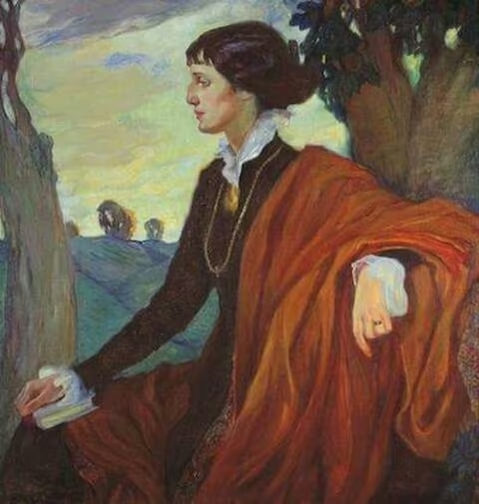
by Anna Akhmatova
Requiem (1935–1940) is Anna Akhmatova's masterpiece and one of the most powerful works of witness literature ever written. Composed in secret during the Stalinist Terror, it chronicles the seventeen months she spent standing in prison lines outside Leningrad's Kresty Prison, waiting for news of her imprisoned son. "I learned to know how faces fall apart, / How fear, beneath the eye-lids, seeks."
No, not under a foreign sky,
No not cradled by foreign wings —
Then I was with my people, I,
With my people, there, sorrowing.
— 1961
Instead of a Preface
In the dreadful years of the Yezhov terror I spent seventeen months in prison queues in Leningrad. One day someone ‘identified’ me. Then a woman standing behind me, blue with cold, who of course had never heard my name, woke from that trance characteristic of us all and asked in my ear (there, everyone spoke in whispers):
— Ah, can you describe this?
And I said:
I can.
Then something like a tormented smile passed over what had once been her face.
1st April 1957
Dedication
Before this sorrow mountains bow,
The vast river's ceased to flow,
The ever-strong prison bolts
Hold the 'convict crews' now,
Abandoned to deathly longing.
For someone the sun glows red,
For someone the wind blows fresh —
But we know none of that, instead
We only hear the soldier's tread,
Keys scraping against our flesh.

Rising as though for early mass,
Through the city of beasts we sped,
There met, breathless as the dead,
Sun low, a mistier Neva. Far ahead,
Hope singing still, as we passed.

Sentence given...tears pour out,
She thought she knew all separation,
In pain, blood driven from the heart,
As if she's hurled to earth, apart,
Yet walks...staggers...is in motion...

Where now my chance-met friends
Of those two years' satanic flight?
What Siberian storms do they resist,
And in what frosted lunar orb exist?
To them it is I send my farewell cry.

March 1940
Prologue
Those days, when only the dead
Smiled, glad to be at peace,
And Leningrad, unneeded, swayed,
Throwing wide its penitentiary.

When legions of the condemned,
Maddened by torment, passed,
Brief the songs of parting then,
The locomotives' farewell blast,

Dead stars hung above us,
And blameless Russia writhed
Under boots stained with blood,
And the Black Marias' tyres.
I.
They took you away at dawn,
As though at a wake, I followed,
In the dark room weeping children,
Among icons, the candle guttered.

On your lips, the chill of a cross,
On your brow a deathly pall.
I'll be, like a woman to be shot,
Dragged to the Kremlin wall.

1935
II.
Quiet flows the silent Don,
Yellow moonlight fills the home.

Fills it, and falls askance,
Yellow moon-ghost in its glance.

A woman there it is, makes moan,
A woman there, she lies alone,

Son in chains, husband clay,
Pray for her, O pray.
III.
No it is not I, someone else is suffering.
I could not have borne it otherwise, all that's happening,
Let them grant to it a dark covering,
And let them take away the glittering...
                                        Night.
IV.
They should have shown you, little teaser,
Little favourite, friend of all,
Sylvan princess, happy charmer,
What situation would be yours —

As three-hundredth in the line
You'd stand, beneath the cross,
And let your tears' hot brine
Burn through New Year's ice.

See the prison poplars sway,
Without a sound — oh what a crowd
Of innocent lives all end today...
V.
Seventeen months I've pleaded
For you to come home.
Flung myself at the hangman's feet,
My terror, oh my son.

And I can't understand,
Now all's eternal confusion,
Who's beast, and who's man,
How long till execution.

And only flowers of dust,
Ringing of censers, tracks just
Running somewhere, nowhere, far.

And deep in my eyes gazing,
Swift, fatal, threatening,
One enormous star.
VI.
Lightly the weeks fly, too,
What's happened I can't understand.
Just as, my darling child, in prison,
White nights gazed at you,

So now again they gaze,
Hawk-eyed, passionate-eyed,
And of your cross on high,
Of death, they speak today.

1939
VII. The Sentencing
It has fallen, the word of stone
On my living breast, now.
No matter, I was prepared, you know,
I'll get by, somehow.

I've things to do today:
I must crush memory down,
I must turn my heart to stone,
I must try living, again.

And then...Hot summer whispers,
As if for a Black Sea holiday.
Long, long ago, I foresaw this
This empty house, this shining day.

Summer, 1939
VIII. To Death
You'll come regardless — why not today?
I await you — life is very hard.
I've killed the lights, cleared the way
For you, so simple, such a marvel.

Take on any shape you wish,
Burst in like a poisoned shell,
Sidle in like a slick bandit,
Or a typhus germ from hell.

Or a fairy-tale you've invented,
Always sickeningly familiar —
Where I see policemen's heads,
And a concierge white with fear.

It's all one now. The Yenisey swirling,
While the Pole star's alight.
And in final terror closing
Blessed eyes, blue and bright.

19th August 1939
The House on the Fontanka,
Leningrad.
IX.
Already madness hovers
Obscuring half my mind,
I drink its wine: its fires
Bring on darkness, blind.

I realise, I must yield,
The victory to it now,
Must listen to it speak,
Strange fever on my brow.

And I must take nothing
With me that's my own
(How I am begging,
How I am disowned!):

Not my son's fearful eyes —
Suffering, turned to stone,
Not the day that storms rise,
Nor the prison meeting-room,

Nor the blessed cool of his hands,
The lime-trees' shady agitation,
Nor the slender distant sounds
Of his final consolation.

4th May 1940
The House on the Fontanka.
X. Crucifixion
'Mother, do not weep for me,
Who am in the grave.'
I.

Angelic choirs, the mighty hour of glory,
And heaven confused in the fiery deep.
To the Father: 'Why hast thou forsaken me!'
But to the Mother: 'O, do not weep...'

II.

Magdalene beat her breast and wept,
The beloved disciple turned to stone,
But there, no one dared, no one looked
Where the Mother stood, still, and alone.

1940–1943
Epilogue
I.

I learned to know how faces fall apart,
How fear, beneath the eye-lids, seeks,
How strict the cutting blade, the art
That suffering etches in the cheeks.

How the black, the ash-blond hair,
In an instant turned to silver,
Learned how submissive lips fared,
Learned terror's dry racking laughter.

Not only for myself I pray,
But for all who stood there, all,
In bitter cold, or burning July day,
Beneath that red, blind prison wall.

II.

Once more, the remembered hour draws near.
I see you, I feel you, and I hear:

You, they could barely carry into line,
And you, whom earth claimed before your time,

And you, who shook your lovely head of hair,
Saying: 'As if this were home, I'm here'.

I'd like to summon you all by name,
But the lists are lost, un-found again.

I've woven a great shroud for them here,
Out of poor words I chanced to overhear.

Remembering them always, everywhere,
Unforgotten in every new terror's care,

And if they shut my tormented lips, shut my
Mouth, where a hundred million people cry,

Let them still remember me, today,
On the eve of my remembrance day.

And if ever in this my native country
They choose to erect a statue for me,

I agree to that ceremonial honour,
But on one condition — don't set it there

Beside the sea-shore, where I was born:
My last ties with it so long outworn,

Nor in the Imperial Garden, by that dead tree
Where an inconsolable shade looks for me,

But here, where I stood three hundred hours,
Where no one ever opened the doors,

Lest I forget in death's blessed oblivion
The Black Maria's screaming hum,

Forget the terrible clang, the gates that hail
Like a wounded beast, the old woman's wail.

And from my eyelids, bronze, unmoving,
May snowflakes fall, like tears melting,

And the prison pigeons coo far from me,
And, on the Neva, ships sail, silently.

March, 1940